Loading...
Searching...
No Matches
a DICTIONARY on an AVL tree, with the operations based on join [see Joinable] More...
#include <ADS/tree/AVLTree.h>
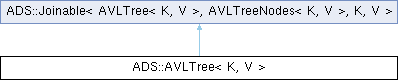
Inheritance diagram for ADS::AVLTree< K, V >:
Classes | |
| struct | Shape |
| the shape of the tree, for PathIterator More... | |
Public types | |
| using | Key = K |
| the type of the keys | |
| using | Value = V |
| the type of the values | |
| using | value_type = std::pair< K , V > |
| the pairs ( key , value ) by value, which own their copies | |
| using | key_type = K |
| the type of the keys | |
| using | mapped_type = V |
| the type of the values | |
| using | size_type = std::size_t |
| the type of the sizes | |
| using | difference_type = std::ptrdiff_t |
| the type of the distances | |
| using | reference = PairRef< const K & , const V & > |
| references, by value | |
| using | const_reference = reference |
| the same | |
| using | const_iterator = PathIterator< AVLTree , Shape > |
| the constant iterator by increasing key, along the path from the root | |
| using | iterator = const_iterator |
| the constant iterator | |
Public member functions | |
| std::optional< V > | lookup (const K &k) const |
| the value of \( k \), or nothing, by the descent of a binary search tree, in \( O( \log n ) \) time | |
| void | insert (const K &k, const V &v) |
| associates \( v \) to \( k \), in \( O( \log n ) \) time | |
| void | remove (const K &k) |
| removes \( k \), if it is there, in \( O( \log n ) \) time | |
| bool | contains (const K &k) const |
| true if \( k \) is there | |
| std::optional< std::pair< K, V > > | lowerBound (const K &k) const |
| the smallest key not smaller than \( k \) and its value, or nothing (the find( x ) of an SSet of Morin), in \( O( \log n ) \) time | |
| const K * | findKey (const K &k) const |
| the address of the key \( k \), nil if absent, in \( O( \log n ) \) time: the find( x ) of a USet of Morin [see DictionarySet]; valid until the key is removed | |
| const K * | lowerBoundKey (const K &k) const |
| the address of the smallest key not smaller than \( k \), nil if none, in \( O( \log n ) \) time: the find( x ) of an SSet of Morin [see DictionarySet]; valid until the key is removed | |
| std::size_t | size (void) const |
| the number \( n \) of keys | |
| bool | empty (void) const |
| true if there is no key | |
| int | height (void) const |
| the height of the tree, -1 if it is empty | |
| template<class F> | |
| void | forEach (F &&f) const |
| f( k , v ) on the pairs by increasing keys | |
| std::pair< std::size_t, std::size_t > | rebalancings (void) const |
| the rebalancings of insert() and remove() so far, i.e., the nodes found unbalanced on their paths and mended by one or two rotations, and those rotations (exercise 9.12 of Morin) | |
| const_iterator | begin (void) const |
| the iterator on the smallest key | |
| const_iterator | end (void) const |
| the iterator past the largest key | |
| const_iterator | cbegin (void) const |
| as begin() | |
| const_iterator | cend (void) const |
| as end() | |
| Public member functions inherited from ADS::Joinable< AVLTree< K, V >, AVLTreeNodes< K, V >, K, V > | |
| std::tuple< AVLTree< K, V >, std::optional< V >, AVLTree< K, V > > | split (const K &k) && |
| the keys before \( k \), the value of \( k \) (if there), the keys after \( k \), by JoinAlgorithms::split(); the tree is consumed, in \( O( \log n ) \) time | |
| AVLTree< K, V > | extractRange (const K &lo, const K &hi) |
| the pairs of the keys in \( [ \mathit{lo} , \mathit{hi} ] \), taken out of the tree by JoinAlgorithms::extract(), in \( O( \log n ) \) time | |
| void | unionWith (AVLTree< K, V > &&o, F f=F()) |
| the union with o, which is consumed, by JoinAlgorithms::unite(); on a key of both, the value f( mine , its ), by default its; \( O( m \log( n / m + 1 ) ) \) work for sizes \( m \le n \) | |
| void | intersectWith (AVLTree< K, V > &&o, F f=F()) |
| the intersection with o, which is consumed, by JoinAlgorithms::intersect(); the value f( mine , its ), by default mine; the work of unionWith(), plus the freeing of the nodes that leave | |
| void | differenceWith (AVLTree< K, V > &&o) |
| the keys not in o, which is consumed, by JoinAlgorithms::subtract(); the work of unionWith(), plus the freeing of the nodes of o | |
| void | multiInsert (std::span< const std::pair< K, V > > B, F f=F()) |
| the pairs of \( B \) inserted, by JoinAlgorithms::multiInsert(); on a key already there, the value f( mine , new ), by default new; \( O( m \log( n / m + 1 ) ) \) work for \( m \) pairs | |
| void | multiRemove (std::span< const K > B) |
| the keys of \( B \) removed, by JoinAlgorithms::multiRemove(), \( O( m \log( n / m + 1 ) ) \) work | |
| void | filter (P p) |
| only the pairs with p( k , v ) kept, by JoinAlgorithms::filter(), \( O( n ) \) work | |
| U | mapReduce (M map, R reduce, U id) const |
| \( \mathrm{reduce}( \ldots \mathrm{reduce}( \mathit{id} , \mathrm{map}(
k_1 , v_1 ) ) \ldots , \mathrm{map}( k_n , v_n ) ) \) by an associative reduce of identity id, by JoinAlgorithms::mapReduce(), \( O( n ) \) work | |
Friends | |
| struct | AVLTreeNodes< K, V > |
Additional Inherited Members | |
| Static public member functions inherited from ADS::Joinable< AVLTree< K, V >, AVLTreeNodes< K, V >, K, V > | |
| static AVLTree< K, V > | join (AVLTree< K, V > &&l, const K &k, const V &v, AVLTree< K, V > &&r) |
| the tree of the keys of \( l \), the pair \( ( k , v ) \) and the keys of \( r \), by the join of the scheme; \( l \) and \( r \) are consumed, in \( O( | \log n_l - \log n_r | + 1 ) \) time | |
| static AVLTree< K, V > | join2 (AVLTree< K, V > &&l, AVLTree< K, V > &&r) |
| the tree of the keys of \( l \) and of \( r \), which are consumed, by JoinAlgorithms::join2(), in \( O( \log n ) \) time | |
Detailed description
template<std::totally_ordered K, class V>
class ADS::AVLTree< K, V >
a DICTIONARY on an AVL tree, with the operations based on join [see Joinable]
Member typedef documentation
◆ const_iterator
template<std::totally_ordered K, class V>
| using ADS::AVLTree< K, V >::const_iterator = PathIterator< AVLTree , Shape > |
the constant iterator by increasing key, along the path from the root
◆ const_reference
template<std::totally_ordered K, class V>
| using ADS::AVLTree< K, V >::const_reference = reference |
the same
◆ difference_type
template<std::totally_ordered K, class V>
| using ADS::AVLTree< K, V >::difference_type = std::ptrdiff_t |
the type of the distances
◆ iterator
template<std::totally_ordered K, class V>
| using ADS::AVLTree< K, V >::iterator = const_iterator |
the constant iterator
◆ Key
template<std::totally_ordered K, class V>
| using ADS::AVLTree< K, V >::Key = K |
the type of the keys
◆ key_type
template<std::totally_ordered K, class V>
| using ADS::AVLTree< K, V >::key_type = K |
the type of the keys
◆ mapped_type
template<std::totally_ordered K, class V>
| using ADS::AVLTree< K, V >::mapped_type = V |
the type of the values
◆ reference
template<std::totally_ordered K, class V>
| using ADS::AVLTree< K, V >::reference = PairRef< const K & , const V & > |
references, by value
◆ size_type
template<std::totally_ordered K, class V>
| using ADS::AVLTree< K, V >::size_type = std::size_t |
the type of the sizes
◆ Value
template<std::totally_ordered K, class V>
| using ADS::AVLTree< K, V >::Value = V |
the type of the values
◆ value_type
template<std::totally_ordered K, class V>
| using ADS::AVLTree< K, V >::value_type = std::pair< K , V > |
the pairs ( key , value ) by value, which own their copies
Member function documentation
◆ begin()
template<std::totally_ordered K, class V>
|
inlinenodiscard |
the iterator on the smallest key
◆ cbegin()
template<std::totally_ordered K, class V>
|
inlinenodiscard |
as begin()
◆ cend()
template<std::totally_ordered K, class V>
|
inlinenodiscard |
as end()
◆ contains()
template<std::totally_ordered K, class V>
|
nodiscard |
true if \( k \) is there
◆ empty()
template<std::totally_ordered K, class V>
|
nodiscard |
true if there is no key
◆ end()
template<std::totally_ordered K, class V>
|
inlinenodiscard |
the iterator past the largest key
◆ findKey()
template<std::totally_ordered K, class V>
|
nodiscard |
the address of the key \( k \), nil if absent, in \( O( \log n ) \) time: the find( x ) of a USet of Morin [see DictionarySet]; valid until the key is removed
◆ forEach()
template<std::totally_ordered K, class V>
template<class F>
| void ADS::AVLTree< K, V >::forEach | ( | F && | f | ) | const |
f( k , v ) on the pairs by increasing keys
◆ height()
template<std::totally_ordered K, class V>
|
nodiscard |
the height of the tree, -1 if it is empty
◆ insert()
template<std::totally_ordered K, class V>
| void ADS::AVLTree< K, V >::insert | ( | const K & | k, |
| const V & | v ) |
associates \( v \) to \( k \), in \( O( \log n ) \) time
In pseudocode (Knuth, section 6.2.3, beyond the book), recursive, \( h( \textbf{nil} ) = -1 \), and the balance of a node restored by a single or a double rotation on the way back:
\[\class{pseudocode}{\begin{array}{r@{\quad}l} 1 & \textbf{procedure}\ \mathrm{insert}( t , k , v ) \cr 2 & \quad \textbf{if}\ t = \textbf{nil}\ \textbf{then}\ t \gets \text{a new node of } ( k , v );\ \textbf{return} \cr 3 & \quad \textbf{if}\ k < t.\mathit{key}\ \textbf{then} \ \mathrm{insert}( t.\mathit{left} , k , v ) \cr 4 & \quad \textbf{else if}\ t.\mathit{key} < k\ \textbf{then} \ \mathrm{insert}( t.\mathit{right} , k , v ) \cr 5 & \quad \textbf{else}\ t.\mathit{value} \gets v \cr 6 & \quad \mathrm{balance}( t ) \cr 7 & \textbf{procedure}\ \mathrm{balance}( t ) \cr 8 & \quad \text{update the height and the size of } t \cr 9 & \quad \textbf{if}\ h( t.\mathit{left} ) - h( t.\mathit{right} ) > 1 \ \textbf{then} \cr 10 & \qquad \textbf{if}\ h( t.\mathit{left}.\mathit{left} ) < h( t.\mathit{left}.\mathit{right} )\ \textbf{then}\ \mathrm{rotateLeft}( t.\mathit{left} ) \cr 11 & \qquad \mathrm{rotateRight}( t ) \cr 12 & \quad \textbf{else if}\ h( t.\mathit{right} ) - h( t.\mathit{left} ) > 1\ \textbf{then}\ \text{the mirror of the } \text{lines 10 and 11} \end{array}} \]
- Postcondition
- \( k \) has the value \( v \)
◆ lookup()
template<std::totally_ordered K, class V>
|
nodiscard |
the value of \( k \), or nothing, by the descent of a binary search tree, in \( O( \log n ) \) time
◆ lowerBound()
template<std::totally_ordered K, class V>
|
nodiscard |
the smallest key not smaller than \( k \) and its value, or nothing (the find( x ) of an SSet of Morin), in \( O( \log n ) \) time
◆ lowerBoundKey()
template<std::totally_ordered K, class V>
|
nodiscard |
the address of the smallest key not smaller than \( k \), nil if none, in \( O( \log n ) \) time: the find( x ) of an SSet of Morin [see DictionarySet]; valid until the key is removed
◆ rebalancings()
template<std::totally_ordered K, class V>
|
inlinenodiscard |
◆ remove()
template<std::totally_ordered K, class V>
| void ADS::AVLTree< K, V >::remove | ( | const K & | k | ) |
removes \( k \), if it is there, in \( O( \log n ) \) time
In pseudocode (Knuth, section 6.2.3, beyond the book), the removal of a binary search tree with the balance() of insert() on the way back:
\[\class{pseudocode}{\begin{array}{r@{\quad}l} 1 & \textbf{procedure}\ \mathrm{remove}( t , k ) \cr 2 & \quad \textbf{if}\ t = \textbf{nil}\ \textbf{then return} \cr 3 & \quad \textbf{if}\ k < t.\mathit{key}\ \textbf{then} \ \mathrm{remove}( t.\mathit{left} , k ) \cr 4 & \quad \textbf{else if}\ t.\mathit{key} < k\ \textbf{then} \ \mathrm{remove}( t.\mathit{right} , k ) \cr 5 & \quad \textbf{else if}\ t \text{ has one child at most} \ \textbf{then}\ t \gets \text{that child};\ \textbf{return} \cr 6 & \quad \textbf{else} \cr 7 & \qquad s \gets \text{the node of the smallest key of } t.\mathit{right} \cr 8 & \qquad ( t.\mathit{key} , t.\mathit{value} ) \gets ( s.\mathit{key} , s.\mathit{value} );\ \mathrm{remove}( t.\mathit{right} , s.\mathit{key} ) \cr 9 & \quad \mathrm{balance}( t ) \end{array}} \]
- Postcondition
- \( k \) is not there
◆ size()
template<std::totally_ordered K, class V>
|
nodiscard |
the number \( n \) of keys
Friends and related symbol documentation
◆ AVLTreeNodes< K, V >
template<std::totally_ordered K, class V>
|
friend |
The documentation for this class was generated from the following file:
- ADS/tree/AVLTree.h
