Loading...
Searching...
No Matches
ADS::ShortestPathsObserver< G, P > Class Template Reference
the shortest paths from \( r \) in \( g \), kept up to date, by the recompute policy P More...
#include <ADS/graph/Reoptimization.h>
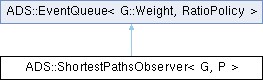
Inheritance diagram for ADS::ShortestPathsObserver< G, P >:
Public types | |
| using | Weight = typename G::Weight |
| the type of the weights | |
| Public types inherited from ADS::EventQueue< G::Weight, RatioPolicy > | |
| using | Event |
| the type of the events | |
| using | Policy |
| the type of the policy | |
Public member functions | |
| ShortestPathsObserver (const G &g, int r, Frontier how=Frontier::HEAP) | |
| the shortest paths from \( r \) in \( g \), computed by how at the first query | |
| void | solve (void) |
| brings the tree up to date | |
| const ShortestPathTree< Weight > & | tree (void) |
| the tree, up to date; its order is that of the last computation from scratch | |
| Weight | distance (int v) |
| the distance of \( v \), infinity() if not reachable | |
| ReoptStats | reoptStats (std::size_t k) const |
| the statistics of a query after \( k \) more events, for the policy: the events queued and the edges | |
| Public member functions inherited from ADS::EventQueue< G::Weight, RatioPolicy > | |
| void | apply (const Event &e) |
| queues \( e \), unless Rebuilt came since the last query | |
| void | notify (const Event &e) |
| apply( e ), for the Observable | |
| void | on (const mod::Rebuilt &) noexcept |
| forgets the queue, and takes no event until the next query, which computes the solution from scratch | |
| std::size_t | pending (void) const |
| the events waiting for the next query | |
| int | outcome (void) const |
| how the last solve() with events to apply, or with no solution yet, did it [see Reopt] | |
| int | cause (void) const |
| why: the cause of the last outcome [see Reopt] | |
| long long | count (int outcome) const |
| the solves of each outcome so far | |
| long long | byCause (int c) const |
| the solves of each cause so far | |
| P & | policy (void) |
| the recompute policy | |
| void | setRecomputeRatio (double ratio) |
| from scratch when the events coalesced exceed \( \mathit{ratio} \) times the edges: \( \rho \) of the policy | |
Additional Inherited Members | |
| Static public member functions inherited from ADS::EventQueue< G::Weight, RatioPolicy > | |
| static constexpr unsigned | mask (void) |
| all the kinds of event | |
| Protected member functions inherited from ADS::EventQueue< G::Weight, RatioPolicy > | |
| std::vector< Event > | take (void) |
| the queue coalesced, emptied | |
| bool | tooMany (std::size_t k, long long m) |
| whether the policy wants \( k \) events on \( m \) edges from scratch | |
| bool | fresh (bool ready) |
| whether a solve from scratch is due before any event: no solution yet, or Rebuilt; the queue then emptied | |
| void | tally (int cause) |
| the cause of a solve() counted, not told to the policy | |
| void | done (int cause, double w) |
| the cause of a solve() counted and told to the policy with the work \( w \) | |
| Static protected member functions inherited from ADS::EventQueue< G::Weight, RatioPolicy > | |
| static ReoptStats | stats (std::size_t k, long long m) |
| the statistics of \( k \) events on \( m \) edges | |
| Protected attributes inherited from ADS::EventQueue< G::Weight, RatioPolicy > | |
| std::vector< Event > | f_q |
| the events queued | |
| P | f_policy |
| the recompute policy | |
| bool | f_stale |
| whether Rebuilt came | |
| int | f_outcome |
| the last outcome | |
| int | f_cause |
| the last cause | |
| long long | f_count [3] |
| the solves by outcome | |
| long long | f_byCause [Reopt::CAUSES] |
| the solves by cause | |
Detailed description
template<Graph G, ReoptPolicy P = RatioPolicy>
class ADS::ShortestPathsObserver< G, P >
the shortest paths from \( r \) in \( g \), kept up to date, by the recompute policy P
Member typedef documentation
◆ Weight
template<Graph G, ReoptPolicy P = RatioPolicy>
| using ADS::ShortestPathsObserver< G, P >::Weight = typename G::Weight |
the type of the weights
Constructor and destructor documentation
◆ ShortestPathsObserver()
template<Graph G, ReoptPolicy P = RatioPolicy>
| ADS::ShortestPathsObserver< G, P >::ShortestPathsObserver | ( | const G & | g, |
| int | r, | ||
| Frontier | how = Frontier::HEAP ) |
the shortest paths from \( r \) in \( g \), computed by how at the first query
- Precondition
- \( r \) is a node of \( g \)
Member function documentation
◆ distance()
template<Graph G, ReoptPolicy P = RatioPolicy>
|
inlinenodiscard |
the distance of \( v \), infinity() if not reachable
◆ reoptStats()
template<Graph G, ReoptPolicy P = RatioPolicy>
|
nodiscard |
the statistics of a query after \( k \) more events, for the policy: the events queued and the edges
◆ solve()
template<Graph G, ReoptPolicy P = RatioPolicy>
| void ADS::ShortestPathsObserver< G, P >::solve | ( | void | ) |
brings the tree up to date
In pseudocode (the algorithms of Ramalingam and Reps for the decreases and the increases, in the batch form of Bauer and Wagner, beyond the book; it is correct by Lemma 14 of Changes of the graph and reoptimization), the events \( P \) coalesced, \( T \) the tree and \( d \) the distances before them:
\[\class{pseudocode}{\begin{array}{r@{\quad}l} 1 & \textbf{procedure}\ \mathrm{solve}() \cr 2 & \quad R \gets \text{the heads } v \text{ of the arcs } ( u , v ) \in T \text{ raised or deleted in } P \cr 3 & \quad L \gets \text{the arcs lowered or inserted in } P \cr 4 & \quad A \gets \text{the nodes of the subtrees of } T \text{ under } R \cr 5 & \quad \textbf{if}\ p.\mathrm{abandon}( |A| , n )\ \textbf{then} \ \text{from scratch};\ \textbf{return} \quad \triangleright\ \text{by default } 2 |A| > n \cr 6 & \quad \textbf{foreach}\ x \in A\ \textbf{do}\ d[ x ] \gets \infty; \ T[ x ] \gets \textbf{nil} \cr 7 & \quad S \gets \emptyset \cr 8 & \quad \textbf{foreach}\ x \in A\ \textbf{do} \cr 9 & \qquad \textbf{foreach}\ ( u , x ) \in E\ \textbf{with} \ d[ u ] + w( u , x ) < d[ x ]\ \textbf{do}\ d[ x ] \gets d[ u ] + w( u , x );\ T[ x ] \gets u \cr 10 & \qquad \textbf{if}\ d[ x ] < \infty\ \textbf{then}\ S \gets S \cup \{ x \} \cr 11 & \quad \textbf{foreach}\ ( u , v ) \in L\ \textbf{with}\ d[ u ] + w( u , v ) < d[ v ]\ \textbf{do}\ S \gets S \cup \{ u \} \cr 12 & \quad \textbf{if}\ S = \emptyset\ \textbf{then}\ \textbf{return} \quad \triangleright\ \text{certified} \cr 13 & \quad H \gets \text{a priority queue of } S \text{ by } d \cr 14 & \quad \textbf{while}\ H \ne \emptyset\ \textbf{do} \cr 15 & \qquad u \gets \mathrm{deleteMin}( H ) \cr 16 & \qquad \textbf{if}\ u \text{ was extracted more than } n \text{ times}\ \textbf{then}\ \text{Bellman-Ford-Moore}; \ \textbf{return} \cr 17 & \qquad \textbf{if}\ u \text{ was extracted before and } p.\mathrm{abandon}\ \text{on its reinsertions}\ \textbf{then} \ \text{from scratch};\ \textbf{return} \cr 18 & \qquad \textbf{foreach}\ ( u , v ) \in E\ \textbf{with} \ d[ u ] + w( u , v ) < d[ v ]\ \textbf{do} \cr 19 & \qquad\quad d[ v ] \gets d[ u ] + w( u , v );\ T[ v ] \gets u; \ \mathrm{insert}( H , v , d[ v ] ) \end{array}} \]
◆ tree()
template<Graph G, ReoptPolicy P = RatioPolicy>
|
inlinenodiscard |
the tree, up to date; its order is that of the last computation from scratch
The documentation for this class was generated from the following file:
- ADS/graph/Reoptimization.h
