Loading...
Searching...
No Matches
ADS::SpanningForestObserver< G, P > Class Template Reference
the minimum spanning forest of an unoriented \( g \), kept up to date, by the recompute policy P More...
#include <ADS/graph/Reoptimization.h>
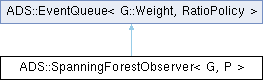
Inheritance diagram for ADS::SpanningForestObserver< G, P >:
Public types | |
| using | Weight = typename G::Weight |
| the type of the weights | |
| Public types inherited from ADS::EventQueue< G::Weight, RatioPolicy > | |
| using | Event |
| the type of the events | |
| using | Policy |
| the type of the policy | |
Public member functions | |
| SpanningForestObserver (const G &g) | |
| the forest of \( g \), computed by Kruskal at the first query; \( \alpha = 1 \) if the policy is a RatioPolicy | |
| void | solve (void) |
| brings the forest up to date | |
| std::vector< WeightedEdge< Weight > > | forest (void) |
| the edges of the forest, up to date, in no given order | |
| Weight | weight (void) |
| the total weight of the forest, kept as it changes when the weights subtract, \( O( 1 ) \) after the query, and summed otherwise; a floating total is summed again after period times \( |F| \) changes, and compensated if compensated, when the policy has them [see RatioPolicy] | |
| bool | inForest (int u, int v) |
| whether \( [ u , v ] \) is in the forest | |
| ReoptStats | reoptStats (std::size_t k) const |
| the statistics of a query after \( k \) more events, for the policy: the events queued and the edges | |
| Public member functions inherited from ADS::EventQueue< G::Weight, RatioPolicy > | |
| void | apply (const Event &e) |
| queues \( e \), unless Rebuilt came since the last query | |
| void | notify (const Event &e) |
| apply( e ), for the Observable | |
| void | on (const mod::Rebuilt &) noexcept |
| forgets the queue, and takes no event until the next query, which computes the solution from scratch | |
| std::size_t | pending (void) const |
| the events waiting for the next query | |
| int | outcome (void) const |
| how the last solve() with events to apply, or with no solution yet, did it [see Reopt] | |
| int | cause (void) const |
| why: the cause of the last outcome [see Reopt] | |
| long long | count (int outcome) const |
| the solves of each outcome so far | |
| long long | byCause (int c) const |
| the solves of each cause so far | |
| P & | policy (void) |
| the recompute policy | |
| void | setRecomputeRatio (double ratio) |
| from scratch when the events coalesced exceed \( \mathit{ratio} \) times the edges: \( \rho \) of the policy | |
Additional Inherited Members | |
| Static public member functions inherited from ADS::EventQueue< G::Weight, RatioPolicy > | |
| static constexpr unsigned | mask (void) |
| all the kinds of event | |
| Protected member functions inherited from ADS::EventQueue< G::Weight, RatioPolicy > | |
| std::vector< Event > | take (void) |
| the queue coalesced, emptied | |
| bool | tooMany (std::size_t k, long long m) |
| whether the policy wants \( k \) events on \( m \) edges from scratch | |
| bool | fresh (bool ready) |
| whether a solve from scratch is due before any event: no solution yet, or Rebuilt; the queue then emptied | |
| void | tally (int cause) |
| the cause of a solve() counted, not told to the policy | |
| void | done (int cause, double w) |
| the cause of a solve() counted and told to the policy with the work \( w \) | |
| Static protected member functions inherited from ADS::EventQueue< G::Weight, RatioPolicy > | |
| static ReoptStats | stats (std::size_t k, long long m) |
| the statistics of \( k \) events on \( m \) edges | |
| Protected attributes inherited from ADS::EventQueue< G::Weight, RatioPolicy > | |
| std::vector< Event > | f_q |
| the events queued | |
| P | f_policy |
| the recompute policy | |
| bool | f_stale |
| whether Rebuilt came | |
| int | f_outcome |
| the last outcome | |
| int | f_cause |
| the last cause | |
| long long | f_count [3] |
| the solves by outcome | |
| long long | f_byCause [Reopt::CAUSES] |
| the solves by cause | |
Detailed description
template<Graph G, ReoptPolicy P = RatioPolicy>
class ADS::SpanningForestObserver< G, P >
the minimum spanning forest of an unoriented \( g \), kept up to date, by the recompute policy P
Member typedef documentation
◆ Weight
template<Graph G, ReoptPolicy P = RatioPolicy>
| using ADS::SpanningForestObserver< G, P >::Weight = typename G::Weight |
the type of the weights
Constructor and destructor documentation
◆ SpanningForestObserver()
template<Graph G, ReoptPolicy P = RatioPolicy>
|
explicit |
the forest of \( g \), computed by Kruskal at the first query; \( \alpha = 1 \) if the policy is a RatioPolicy
- Precondition
- \( g \) is unoriented
Member function documentation
◆ forest()
template<Graph G, ReoptPolicy P = RatioPolicy>
|
nodiscard |
the edges of the forest, up to date, in no given order
◆ inForest()
template<Graph G, ReoptPolicy P = RatioPolicy>
|
nodiscard |
whether \( [ u , v ] \) is in the forest
◆ reoptStats()
template<Graph G, ReoptPolicy P = RatioPolicy>
|
nodiscard |
the statistics of a query after \( k \) more events, for the policy: the events queued and the edges
◆ solve()
template<Graph G, ReoptPolicy P = RatioPolicy>
| void ADS::SpanningForestObserver< G, P >::solve | ( | void | ) |
brings the forest up to date
In pseudocode (Sleator and Tarjan for the cycles, beyond the book), the events \( P \) coalesced applied one at a time to the forest \( F \) kept by a link-cut tree [see LinkCutTree.h], each by (10) of Changes of the graph and reoptimization, as follows:
\[\class{pseudocode}{\begin{array}{r@{\quad}l} 1 & \textbf{procedure}\ \mathrm{solve}() \cr 2 & \quad \textbf{foreach}\ e = [ u , v ] \text{ from } w \text{ to } w' \text{ in } P\ \textbf{do} \cr 3 & \qquad \textbf{if}\ e \in F \textbf{ and } w' \le w\ \textbf{then} \ \text{set its weight in } F \quad \triangleright \ \text{harmless} \cr 4 & \qquad \textbf{else if}\ e \in F\ \textbf{then} \cr 5 & \qquad\quad \mathrm{cut}( u , v );\ X \gets \text{the smaller of} \text{ the two trees, by two visits of } F \text{ in turn} \cr 6 & \qquad\quad f \gets \text{the lightest edge out of } X \text{ ($e$ with } w' \text{ among them, unless deleted)} \cr 7 & \qquad\quad \textbf{if}\ f \ne \textbf{nil}\ \textbf{then} \ \mathrm{link}( f ) \cr 8 & \qquad \textbf{else if}\ w' \ne \bot \textbf{ and } ( w' < w \textbf{ or } w = \bot )\ \textbf{then} \cr 9 & \qquad\quad \textbf{if}\ \textbf{not}\ \mathrm{connected}( u , v ) \ \textbf{then}\ \mathrm{link}( e ) \cr 10 & \qquad\quad \textbf{else}\ f \gets \text{the heaviest edge of } F( u , v ) \text{ by } \mathrm{aggregate}( u , v ) \cr 11 & \qquad\qquad \textbf{if}\ w' < w( f )\ \textbf{then} \ \mathrm{cut}( f );\ \mathrm{link}( e ) \end{array}} \]
When the cuts of \( P \) (the edges of \( F \) raised or deleted) are many, i.e., when the policy abandons the replacements one at a time on their work, the number of the cuts times the mean work of the replacements so far, against that of join(), \( n \) plus the edges off \( F \) (by default with \( \alpha = 1 \), which this observer sets), the lines 5 to 7 only cut, the edges of the lines 8 to 11 wait, and join() joins the trees again before those edges are taken one at a time.
◆ weight()
template<Graph G, ReoptPolicy P = RatioPolicy>
|
nodiscard |
the total weight of the forest, kept as it changes when the weights subtract, \( O( 1 ) \) after the query, and summed otherwise; a floating total is summed again after period times \( |F| \) changes, and compensated if compensated, when the policy has them [see RatioPolicy]
The documentation for this class was generated from the following file:
- ADS/graph/Reoptimization.h
