Loading...
Searching...
No Matches
a DICTIONARY on a treap, with the operations based on join [see Joinable] More...
#include <ADS/tree/Treap.h>
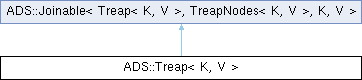
Inheritance diagram for ADS::Treap< K, V >:
Classes | |
| struct | Shape |
| the shape of the tree, for PathIterator More... | |
Public types | |
| using | Key = K |
| the type of the keys | |
| using | Value = V |
| the type of the values | |
| using | value_type = std::pair< K , V > |
| the pairs ( key , value ) by value, which own their copies | |
| using | key_type = K |
| the type of the keys | |
| using | mapped_type = V |
| the type of the values | |
| using | size_type = std::size_t |
| the type of the sizes | |
| using | difference_type = std::ptrdiff_t |
| the type of the distances | |
| using | reference = PairRef< const K & , const V & > |
| references, by value | |
| using | const_reference = reference |
| the same | |
| using | const_iterator = PathIterator< Treap , Shape > |
| the constant iterator by increasing key, along the path from the root | |
| using | iterator = const_iterator |
| the constant iterator | |
Public member functions | |
| Treap (std::uint64_t seed=1) | |
| the empty treap, its priorities drawn from the seed | |
| std::optional< V > | lookup (const K &k) const |
| the value of \( k \), or nothing, by the descent of a binary search tree, in \( O( \log n ) \) expected time | |
| void | insert (const K &k, const V &v) |
| associates \( v \) to \( k \), in \( O( \log n ) \) expected time | |
| void | remove (const K &k) |
| removes \( k \), if it is there, in \( O( \log n ) \) expected time | |
| bool | contains (const K &k) const |
| true if \( k \) is there | |
| std::size_t | size (void) const |
| the number \( n \) of keys | |
| int | height (void) const |
| the height, -1 if empty | |
| template<class F> | |
| void | forEach (F &&f) const |
| f( k , v ) on the pairs by increasing keys | |
| std::optional< std::pair< K, V > > | lowerBound (const K &k) const |
| the smallest key not smaller than \( k \) and its value, or nothing (the find(x) of an SSet of Morin), in \( O( \log n ) \) expected time | |
| const K * | findKey (const K &k) const |
| the address of the key \( k \), nil if absent, in \( O( \log n ) \) expected time: the find( x ) of a USet of Morin [see DictionarySet]; valid until the key is removed | |
| const K * | lowerBoundKey (const K &k) const |
| the address of the smallest key not smaller than \( k \), nil if none, in \( O( \log n ) \) expected time: the find( x ) of an SSet of Morin [see DictionarySet]; valid until the key is removed | |
| std::pair< K, V > | select (std::size_t i) const |
| the pair of rank \( i \), i.e., with \( i \) smaller keys, in \( O( \log n ) \) expected time (exercise 7.10 of Morin) | |
| std::size_t | rank (const K &k) const |
| the number of keys smaller than \( k \), the sizes of the left subtrees passed on the right along the search of \( k \), in \( O( \log n ) \) expected time | |
| const_iterator | begin (void) const |
| the iterator on the smallest key | |
| const_iterator | end (void) const |
| the iterator past the largest key | |
| const_iterator | cbegin (void) const |
| as begin() | |
| const_iterator | cend (void) const |
| as end() | |
| Public member functions inherited from ADS::Joinable< Treap< K, V >, TreapNodes< K, V >, K, V > | |
| std::tuple< Treap< K, V >, std::optional< V >, Treap< K, V > > | split (const K &k) && |
| the keys before \( k \), the value of \( k \) (if there), the keys after \( k \), by JoinAlgorithms::split(); the tree is consumed, in \( O( \log n ) \) time | |
| Treap< K, V > | extractRange (const K &lo, const K &hi) |
| the pairs of the keys in \( [ \mathit{lo} , \mathit{hi} ] \), taken out of the tree by JoinAlgorithms::extract(), in \( O( \log n ) \) time | |
| void | unionWith (Treap< K, V > &&o, F f=F()) |
| the union with o, which is consumed, by JoinAlgorithms::unite(); on a key of both, the value f( mine , its ), by default its; \( O( m \log( n / m + 1 ) ) \) work for sizes \( m \le n \) | |
| void | intersectWith (Treap< K, V > &&o, F f=F()) |
| the intersection with o, which is consumed, by JoinAlgorithms::intersect(); the value f( mine , its ), by default mine; the work of unionWith(), plus the freeing of the nodes that leave | |
| void | differenceWith (Treap< K, V > &&o) |
| the keys not in o, which is consumed, by JoinAlgorithms::subtract(); the work of unionWith(), plus the freeing of the nodes of o | |
| void | multiInsert (std::span< const std::pair< K, V > > B, F f=F()) |
| the pairs of \( B \) inserted, by JoinAlgorithms::multiInsert(); on a key already there, the value f( mine , new ), by default new; \( O( m \log( n / m + 1 ) ) \) work for \( m \) pairs | |
| void | multiRemove (std::span< const K > B) |
| the keys of \( B \) removed, by JoinAlgorithms::multiRemove(), \( O( m \log( n / m + 1 ) ) \) work | |
| void | filter (P p) |
| only the pairs with p( k , v ) kept, by JoinAlgorithms::filter(), \( O( n ) \) work | |
| U | mapReduce (M map, R reduce, U id) const |
| \( \mathrm{reduce}( \ldots \mathrm{reduce}( \mathit{id} , \mathrm{map}(
k_1 , v_1 ) ) \ldots , \mathrm{map}( k_n , v_n ) ) \) by an associative reduce of identity id, by JoinAlgorithms::mapReduce(), \( O( n ) \) work | |
Static public member functions | |
| static Treap | fromSorted (const std::vector< std::pair< K, V > > &A, std::uint64_t seed=1) |
| the treap of the pairs of \( A \), by increasing keys, in \( O( n ) \) time (exercise 7.8 of Morin): the same tree that the insertions of \( A \) in order into Treap( seed ) build, since the priorities are drawn in the same order, and a heap on them built by the stack of the right spine | |
| Static public member functions inherited from ADS::Joinable< Treap< K, V >, TreapNodes< K, V >, K, V > | |
| static Treap< K, V > | join (Treap< K, V > &&l, const K &k, const V &v, Treap< K, V > &&r) |
| the tree of the keys of \( l \), the pair \( ( k , v ) \) and the keys of \( r \), by the join of the scheme; \( l \) and \( r \) are consumed, in \( O( | \log n_l - \log n_r | + 1 ) \) time | |
| static Treap< K, V > | join2 (Treap< K, V > &&l, Treap< K, V > &&r) |
| the tree of the keys of \( l \) and of \( r \), which are consumed, by JoinAlgorithms::join2(), in \( O( \log n ) \) time | |
Friends | |
| struct | TreapNodes< K, V > |
Detailed description
template<std::totally_ordered K, class V>
class ADS::Treap< K, V >
a DICTIONARY on a treap, with the operations based on join [see Joinable]
Member typedef documentation
◆ const_iterator
template<std::totally_ordered K, class V>
| using ADS::Treap< K, V >::const_iterator = PathIterator< Treap , Shape > |
the constant iterator by increasing key, along the path from the root
◆ const_reference
template<std::totally_ordered K, class V>
| using ADS::Treap< K, V >::const_reference = reference |
the same
◆ difference_type
template<std::totally_ordered K, class V>
| using ADS::Treap< K, V >::difference_type = std::ptrdiff_t |
the type of the distances
◆ iterator
template<std::totally_ordered K, class V>
| using ADS::Treap< K, V >::iterator = const_iterator |
the constant iterator
◆ Key
template<std::totally_ordered K, class V>
| using ADS::Treap< K, V >::Key = K |
the type of the keys
◆ key_type
template<std::totally_ordered K, class V>
| using ADS::Treap< K, V >::key_type = K |
the type of the keys
◆ mapped_type
template<std::totally_ordered K, class V>
| using ADS::Treap< K, V >::mapped_type = V |
the type of the values
◆ reference
template<std::totally_ordered K, class V>
| using ADS::Treap< K, V >::reference = PairRef< const K & , const V & > |
references, by value
◆ size_type
template<std::totally_ordered K, class V>
| using ADS::Treap< K, V >::size_type = std::size_t |
the type of the sizes
◆ Value
template<std::totally_ordered K, class V>
| using ADS::Treap< K, V >::Value = V |
the type of the values
◆ value_type
template<std::totally_ordered K, class V>
| using ADS::Treap< K, V >::value_type = std::pair< K , V > |
the pairs ( key , value ) by value, which own their copies
Constructor and destructor documentation
◆ Treap()
template<std::totally_ordered K, class V>
|
explicit |
the empty treap, its priorities drawn from the seed
Member function documentation
◆ begin()
template<std::totally_ordered K, class V>
|
inlinenodiscard |
the iterator on the smallest key
◆ cbegin()
template<std::totally_ordered K, class V>
|
inlinenodiscard |
as begin()
◆ cend()
template<std::totally_ordered K, class V>
|
inlinenodiscard |
as end()
◆ contains()
template<std::totally_ordered K, class V>
|
nodiscard |
true if \( k \) is there
◆ end()
template<std::totally_ordered K, class V>
|
inlinenodiscard |
the iterator past the largest key
◆ findKey()
template<std::totally_ordered K, class V>
|
nodiscard |
the address of the key \( k \), nil if absent, in \( O( \log n ) \) expected time: the find( x ) of a USet of Morin [see DictionarySet]; valid until the key is removed
◆ forEach()
template<std::totally_ordered K, class V>
template<class F>
| void ADS::Treap< K, V >::forEach | ( | F && | f | ) | const |
f( k , v ) on the pairs by increasing keys
◆ fromSorted()
template<std::totally_ordered K, class V>
|
staticnodiscard |
the treap of the pairs of \( A \), by increasing keys, in \( O( n ) \) time (exercise 7.8 of Morin): the same tree that the insertions of \( A \) in order into Treap( seed ) build, since the priorities are drawn in the same order, and a heap on them built by the stack of the right spine
In pseudocode (Vuillemin's Cartesian tree, exercise 7.8 of Morin), \( S \) the right spine of the tree of the pairs read so far:
\[\class{pseudocode}{\begin{array}{r@{\quad}l} 1 & \textbf{function}\ \mathrm{fromSorted}( A ) \cr 2 & \quad \textbf{foreach}\ ( k , v ) \in A\ \textbf{do} \cr 3 & \qquad u \gets \text{a node of } ( k , v ) \text{ and a random} \text{ priority};\ \ell \gets \textbf{nil} \cr 4 & \qquad \textbf{while}\ S \ne \emptyset\ \textbf{and}\ p( \mathrm{top}( S ) ) < p( u )\ \textbf{do}\ \ell \gets \mathrm{pop}( S ) \cr 5 & \qquad u.\mathit{left} \gets \ell;\ \textbf{if}\ S \ne \emptyset\ \textbf{then}\ \mathrm{top}( S ).\mathit{right} \gets u \cr 6 & \qquad \mathrm{push}( S , u ) \cr 7 & \quad \textbf{return}\ \text{the bottom of } S \end{array}} \]
- Precondition
- the keys of \( A \) strictly increasing
◆ height()
template<std::totally_ordered K, class V>
|
nodiscard |
the height, -1 if empty
◆ insert()
template<std::totally_ordered K, class V>
| void ADS::Treap< K, V >::insert | ( | const K & | k, |
| const V & | v ) |
associates \( v \) to \( k \), in \( O( \log n ) \) expected time
In pseudocode (Seidel and Aragon, beyond the book), \( p \) the priorities, a new key rotated up while its priority beats its parent's:
\[\class{pseudocode}{\begin{array}{r@{\quad}l} 1 & \textbf{procedure}\ \mathrm{insert}( t , k , v ) \cr 2 & \quad \textbf{if}\ t = \textbf{nil}\ \textbf{then}\ t \gets \text{a new node of } ( k , v ) \text{ and a random priority}; \ \textbf{return} \cr 3 & \quad \textbf{if}\ k < t.\mathit{key}\ \textbf{then} \cr 4 & \qquad \mathrm{insert}( t.\mathit{left} , k , v ) \cr 5 & \qquad \textbf{if}\ p( t.\mathit{left} ) > p( t )\ \textbf{then} \ \mathrm{rotateRight}( t ) \cr 6 & \quad \textbf{else if}\ t.\mathit{key} < k\ \textbf{then} \ \text{the mirror of the lines 4 and 5} \cr 7 & \quad \textbf{else}\ t.\mathit{value} \gets v \end{array}} \]
- Postcondition
- \( k \) has the value \( v \)
◆ lookup()
template<std::totally_ordered K, class V>
|
nodiscard |
the value of \( k \), or nothing, by the descent of a binary search tree, in \( O( \log n ) \) expected time
◆ lowerBound()
template<std::totally_ordered K, class V>
|
nodiscard |
the smallest key not smaller than \( k \) and its value, or nothing (the find(x) of an SSet of Morin), in \( O( \log n ) \) expected time
◆ lowerBoundKey()
template<std::totally_ordered K, class V>
|
nodiscard |
the address of the smallest key not smaller than \( k \), nil if none, in \( O( \log n ) \) expected time: the find( x ) of an SSet of Morin [see DictionarySet]; valid until the key is removed
◆ rank()
template<std::totally_ordered K, class V>
|
nodiscard |
the number of keys smaller than \( k \), the sizes of the left subtrees passed on the right along the search of \( k \), in \( O( \log n ) \) expected time
◆ remove()
template<std::totally_ordered K, class V>
| void ADS::Treap< K, V >::remove | ( | const K & | k | ) |
removes \( k \), if it is there, in \( O( \log n ) \) expected time
In pseudocode (Seidel and Aragon, beyond the book), the key rotated down, the child of higher priority going up, until it has one child at most:
\[\class{pseudocode}{\begin{array}{r@{\quad}l} 1 & \textbf{procedure}\ \mathrm{remove}( t , k ) \cr 2 & \quad \textbf{if}\ t = \textbf{nil}\ \textbf{then return} \cr 3 & \quad \textbf{if}\ k < t.\mathit{key}\ \textbf{then} \ \mathrm{remove}( t.\mathit{left} , k ) \cr 4 & \quad \textbf{else if}\ t.\mathit{key} < k\ \textbf{then} \ \mathrm{remove}( t.\mathit{right} , k ) \cr 5 & \quad \textbf{else if}\ t \text{ has one child at most} \ \textbf{then}\ t \gets \text{that child} \cr 6 & \quad \textbf{else if}\ p( t.\mathit{left} ) > p( t.\mathit{right} )\ \textbf{then}\ \mathrm{rotateRight}( t );\ \mathrm{remove}( t.\mathit{right} , k ) \cr 7 & \quad \textbf{else}\ \mathrm{rotateLeft}( t );\ \mathrm{remove}( t.\mathit{left} , k ) \end{array}} \]
- Postcondition
- \( k \) is not there
◆ select()
template<std::totally_ordered K, class V>
|
nodiscard |
the pair of rank \( i \), i.e., with \( i \) smaller keys, in \( O( \log n ) \) expected time (exercise 7.10 of Morin)
In pseudocode (exercise 7.10 of Morin), \( s \) the sizes:
\[\class{pseudocode}{\begin{array}{r@{\quad}l} 1 & \textbf{function}\ \mathrm{select}( t , i ) \cr 2 & \quad \textbf{loop} \cr 3 & \qquad \textbf{if}\ i < s( t.\mathit{left} )\ \textbf{then}\ t \gets t.\mathit{left} \cr 4 & \qquad \textbf{else if}\ i = s( t.\mathit{left} )\ \textbf{then return}\ t \cr 5 & \qquad \textbf{else}\ i \gets i - s( t.\mathit{left} ) - 1;\ t \gets t.\mathit{right} \end{array}} \]
- Precondition
- \( i < n \)
◆ size()
template<std::totally_ordered K, class V>
|
nodiscard |
the number \( n \) of keys
Friends and related symbol documentation
◆ TreapNodes< K, V >
template<std::totally_ordered K, class V>
|
friend |
The documentation for this class was generated from the following file:
- ADS/tree/Treap.h
