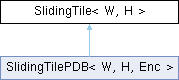
the sliding-tile puzzle on a board of at most 25 cells More...
#include <PBeFS/astar/SlidingTile.h>
Public Types | |
| using | state_type |
| a packed board | |
| using | cost_type = int |
| the cost type | |
| using | board_type = std::array< std::uint8_t , cells > |
| a board | |
Public Member Functions | |
| SlidingTile (const board_type &start, const board_type &goal=korf_goal()) | |
| constructor, taking the start and the goal boards | |
| state_type | initial_state (void) const noexcept |
| the start board | |
| bool | is_goal (state_type s) const noexcept |
| true if s is the goal board | |
| std::uint64_t | hash (state_type s) const noexcept |
| the hash of a board: its packed integer, mixed | |
| cost_type | heuristic (state_type s) const noexcept |
| the Manhattan distance of s from the goal | |
| template<class F> | |
| void | for_each_successor (state_type s, cost_type h, F &&f) const |
| calls f( t , 1 , h( t ) ) for each successor t of s | |
| template<class F> | |
| void | for_each_successor (state_type s, cost_type h, std::uint8_t op, F &&f) const |
| as above, but without the successor that op, the cell where the blank was, leads back to; the operator of a successor is the cell of the blank in s | |
| template<class F> | |
| void | for_each_feature (state_type s, F &&f) const |
| calls f( t W H + c ) for each tile t != 0 in each cell c of s | |
| template<class F> | |
| void | for_each_feature_change (state_type s, state_type t, F &&f) const |
| calls f( k W H + c ) and f( k W H + b ) for the tile k that the move from s to its successor t slides from the cell c to the cell b of the blank of s | |
| std::uint64_t | abstract_state (state_type s) const noexcept |
| the abstract state of AHDA*: the cells of tiles 1, 2 and 3 | |
| std::size_t | nblock (state_type s) const noexcept |
| the nblock of PBNF: the cells of the blank and of tiles 1 and 2 | |
| template<class F> | |
| void | for_each_nblock_successor (std::size_t b, F &&f) const |
| calls f( b' ) for each abstract successor b' of the nblock b | |
| cost_type | pairwise_heuristic (state_type s, state_type t) const noexcept |
| the heuristic of PA*SE: the sum of the displacements of the tiles | |
| std::uint64_t | perfect_hash (state_type s) const noexcept |
| the lexicographic rank of the permutation of the cells of the tiles | |
Static Public Member Functions | |
| static board_type | korf_goal (void) |
| the goal of Korf (1985): the blank in the first cell, then 1 , 2 , ... | |
| static constexpr std::size_t | num_features (void) noexcept |
| the number of features: one per pair ( tile , cell ) | |
| static constexpr std::size_t | num_abstract_features (void) noexcept |
| the number of abstract features: one per pair ( tile , half board ) | |
| static constexpr std::size_t | abstract_feature (std::size_t i) noexcept |
| the abstract feature of a feature: the tile and the half of its cell | |
| static constexpr std::size_t | num_nblocks (void) noexcept |
| the number of nblocks: one per triple of cells, not all of them used | |
| static int | tile (state_type s, int c) noexcept |
| the tile in the cell c of s | |
| static int | blank (state_type s) noexcept |
| the cell of the blank in s, i.e., of the zero field of the integer | |
| static state_type | pack (const board_type &b) noexcept |
| packs a board into a word | |
| static board_type | unpack (state_type s) noexcept |
| unpacks a word into a board | |
| static board_type | parse (const std::string &text) |
| reads a board: W H numbers, the tiles cell by cell, 0 for the blank | |
| static void | print (std::ostream &os, state_type s) |
| prints a board, one row per line | |
Static Public Attributes | |
| static constexpr int | width = W |
| the number of columns | |
| static constexpr int | height = H |
| the number of rows | |
| static constexpr int | cells = W * H |
| the number of cells | |
| static constexpr int | bits = cells <= 16 ? 4 : 5 |
| the bits of a cell | |
Detailed Description
class PBeFS_di_unipi_it::SlidingTile< W, H >
the sliding-tile puzzle on a board of at most 25 cells
The board has \( W \times H \) cells, with \( W H \leq 25 \). A state is packed into one integer, the field of \( b \) bits of the cell \( i = r W + k \) holding the tile in row \( r \) and column \( k \) (0 being the blank): a word of 64 bits with \( b = 4 \) up to 16 cells, as for the 15-puzzle, and a Word128 with \( b = 5 \) above, as for the 24-puzzle. The integer is at the same time the state, its equality test and the key of its hash, as advocated by Burns et al. (SoCS 2012). The blank is found as the zero field of the integer with a few bitwise operations, and the Manhattan distance is updated incrementally from a table of the change caused by each move of each tile.
The feature i of Zobrist hashing is "tile t is in cell c", with \( i = t W H + c \), for the tiles \( t = 1 , \ldots , W H - 1 \). The abstract feature of Abstract Zobrist hashing keeps of the cell only whether it lies in the upper or in the lower half of the board, which is the hand-crafted projection of Jinnai and Fukunaga (JAIR 2017, fig. 8b) for the 15-puzzle. The state abstraction of AHDA* looks at the cells of tiles 1, 2 and 3, and the nblocks of PBNF at those of the blank and of tiles 1 and 2 [see Burns et al., JAIR 2010]. The perfect hash, the rank of the permutation, is given only up to 20 cells, since 21! exceeds \( 2^{64} \).
Member Typedef Documentation
◆ board_type
| using board_type = std::array< std::uint8_t , cells > |
a board
◆ cost_type
| using cost_type = int |
the cost type
◆ state_type
| using state_type |
Constructor & Destructor Documentation
◆ SlidingTile()
|
inlineexplicit |
constructor, taking the start and the goal boards
Constructs the puzzle of going from start to goal; throws std::invalid_argument if either is not a permutation of 0 , ... , W H - 1, or if the goal cannot be reached from the start.
Member Function Documentation
◆ abstract_feature()
|
inlinestaticnodiscardconstexprnoexcept |
the abstract feature of a feature: the tile and the half of its cell
◆ abstract_state()
|
inlinenodiscardnoexcept |
the abstract state of AHDA*: the cells of tiles 1, 2 and 3
◆ blank()
|
inlinestaticnodiscardnoexcept |
the cell of the blank in s, i.e., of the zero field of the integer
The bits of each field are or-ed into its lowest one, which is then 0 only in the field of the blank.
◆ for_each_feature()
|
inline |
calls f( t W H + c ) for each tile t != 0 in each cell c of s
◆ for_each_feature_change()
|
inline |
calls f( k W H + c ) and f( k W H + b ) for the tile k that the move from s to its successor t slides from the cell c to the cell b of the blank of s
The fields of \( s \oplus t \) hold k in the cells b and c and 0 elsewhere, so that the two cells are found without the blanks.
◆ for_each_nblock_successor()
|
inline |
calls f( b' ) for each abstract successor b' of the nblock b
◆ for_each_successor() [1/2]
|
inline |
calls f( t , 1 , h( t ) ) for each successor t of s
Calls f( t , 1 , h( t ) ) for each successor t of s, h( t ) being computed from h = h( s ) by the change of the moved tile.
◆ for_each_successor() [2/2]
|
inline |
as above, but without the successor that op, the cell where the blank was, leads back to; the operator of a successor is the cell of the blank in s
◆ hash()
|
inlinenodiscardnoexcept |
the hash of a board: its packed integer, mixed
◆ heuristic()
|
inlinenodiscardnoexcept |
the Manhattan distance of s from the goal
◆ initial_state()
|
inlinenodiscardnoexcept |
the start board
◆ is_goal()
|
inlinenodiscardnoexcept |
true if s is the goal board
◆ korf_goal()
|
inlinestaticnodiscard |
the goal of Korf (1985): the blank in the first cell, then 1 , 2 , ...
◆ nblock()
|
inlinenodiscardnoexcept |
the nblock of PBNF: the cells of the blank and of tiles 1 and 2
◆ num_abstract_features()
|
inlinestaticnodiscardconstexprnoexcept |
the number of abstract features: one per pair ( tile , half board )
◆ num_features()
|
inlinestaticnodiscardconstexprnoexcept |
the number of features: one per pair ( tile , cell )
◆ num_nblocks()
|
inlinestaticnodiscardconstexprnoexcept |
the number of nblocks: one per triple of cells, not all of them used
◆ pack()
|
inlinestaticnodiscardnoexcept |
packs a board into a word
◆ pairwise_heuristic()
|
inlinenodiscardnoexcept |
the heuristic of PA*SE: the sum of the displacements of the tiles
◆ parse()
|
inlinestaticnodiscard |
reads a board: W H numbers, the tiles cell by cell, 0 for the blank
◆ perfect_hash()
|
inlinenodiscardnoexcept |
the lexicographic rank of the permutation of the cells of the tiles
It is the perfect hash of Korf and Schultze (2005), by which Burns et al. (JAIR 2010) distributed the states of HDA*: as Jinnai and Fukunaga (JAIR 2017) show, modulo the number of processors it depends on very few tiles, and it is kept as a poor work distribution to compare to.
◆ print()
|
inlinestatic |
prints a board, one row per line
◆ tile()
|
inlinestaticnodiscardnoexcept |
the tile in the cell c of s
◆ unpack()
|
inlinestaticnodiscardnoexcept |
unpacks a word into a board
Member Data Documentation
◆ bits
|
staticconstexpr |
the bits of a cell
◆ cells
|
staticconstexpr |
the number of cells
◆ height
|
staticconstexpr |
the number of rows
◆ width
|
staticconstexpr |
the number of columns
The documentation for this class was generated from the following file:
- PBeFS/astar/SlidingTile.h