|
| | SlidingTilePDB (const board_type &start, const PDB &pdb) |
| | constructor, taking the start board and the heuristic
|
| cost_type | heuristic (state_type s) const |
| | the heuristic of s, looked up in the tables
|
| template<class F> |
| void | for_each_successor (state_type s, cost_type h, F &&f) const |
| | calls f( t , 1 , h( t ) ) for each successor t of s
|
| template<class F> |
| void | for_each_successor (state_type s, cost_type h, std::uint8_t op, F &&f) const |
| | as above, but without the successor that op leads back to [see SlidingTile]
|
| const PDB & | pdb (void) const noexcept |
| | the heuristic
|
| | SlidingTile (const board_type &start, const board_type &goal=korf_goal()) |
| | constructor, taking the start and the goal boards
|
| state_type | initial_state (void) const noexcept |
| | the start board
|
| bool | is_goal (state_type s) const noexcept |
| | true if s is the goal board
|
| std::uint64_t | hash (state_type s) const noexcept |
| | the hash of a board: its packed integer, mixed
|
| cost_type | heuristic (state_type s) const noexcept |
| | the Manhattan distance of s from the goal
|
| template<class F> |
| void | for_each_successor (state_type s, cost_type h, F &&f) const |
| | calls f( t , 1 , h( t ) ) for each successor t of s
|
| template<class F> |
| void | for_each_successor (state_type s, cost_type h, std::uint8_t op, F &&f) const |
| | as above, but without the successor that op, the cell where the blank was, leads back to; the operator of a successor is the cell of the blank in s
|
| template<class F> |
| void | for_each_feature (state_type s, F &&f) const |
| | calls f( t W H + c ) for each tile t != 0 in each cell c of s
|
| template<class F> |
| void | for_each_feature_change (state_type s, state_type t, F &&f) const |
| | calls f( k W H + c ) and f( k W H + b ) for the tile k that the move from s to its successor t slides from the cell c to the cell b of the blank of s
|
| std::uint64_t | abstract_state (state_type s) const noexcept |
| | the abstract state of AHDA*: the cells of tiles 1, 2 and 3
|
| std::size_t | nblock (state_type s) const noexcept |
| | the nblock of PBNF: the cells of the blank and of tiles 1 and 2
|
| template<class F> |
| void | for_each_nblock_successor (std::size_t b, F &&f) const |
| | calls f( b' ) for each abstract successor b' of the nblock b
|
| cost_type | pairwise_heuristic (state_type s, state_type t) const noexcept |
| | the heuristic of PA*SE: the sum of the displacements of the tiles
|
| std::uint64_t | perfect_hash (state_type s) const noexcept |
| | the lexicographic rank of the permutation of the cells of the tiles
|
|
| static void | cells_of (state_type s, std::uint8_t *q) noexcept |
| | writes in q the cell of each tile of s
|
| static board_type | korf_goal (void) |
| | the goal of Korf (1985): the blank in the first cell, then 1 , 2 , ...
|
| static constexpr std::size_t | num_features (void) noexcept |
| | the number of features: one per pair ( tile , cell )
|
| static constexpr std::size_t | num_abstract_features (void) noexcept |
| | the number of abstract features: one per pair ( tile , half board )
|
| static constexpr std::size_t | abstract_feature (std::size_t i) noexcept |
| | the abstract feature of a feature: the tile and the half of its cell
|
| static constexpr std::size_t | num_nblocks (void) noexcept |
| | the number of nblocks: one per triple of cells, not all of them used
|
| static int | tile (state_type s, int c) noexcept |
| | the tile in the cell c of s
|
| static int | blank (state_type s) noexcept |
| | the cell of the blank in s, i.e., of the zero field of the integer
|
| static state_type | pack (const board_type &b) noexcept |
| | packs a board into a word
|
| static board_type | unpack (state_type s) noexcept |
| | unpacks a word into a board
|
| static board_type | parse (const std::string &text) |
| | reads a board: W H numbers, the tiles cell by cell, 0 for the blank
|
| static void | print (std::ostream &os, state_type s) |
| | prints a board, one row per line
|
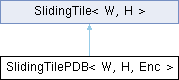
template<int W, int H, class Enc = NibbleEntries>
class PBeFS_di_unipi_it::SlidingTilePDB< W, H, Enc >
the sliding-tile puzzle with an additive pattern database heuristic
The domain SlidingTile, with all its features, hashes and abstractions, whose heuristic is that of an AdditivePDB (which must outlive it) in place of the Manhattan distance; the goal is that of the tables. With Mod3Entries the heuristic of a successor is that of its parent plus the change of the table of the tile moved, which the residues give, and only the initial state is looked up from the residues alone; this needs the sum without the reflection, since from the maximum of two sums the parts cannot be told apart.