6. Maps
We are concerned in this chapter with the maps of the library, i.e., with the
objects that associate a value with a key. Since the graphs store no data of
their own, maps are the only way in which data are attached to the nodes, arcs
and edges of a graph (cf. chapter 3). A map is any
type that offers the types Key and Value together with an operator[] (to
read) or a set() (to write). Hence, besides the standard graph maps, which
store a value for each item, one can pass to an algorithm a map that computes
its values on demand, from other maps, from a function or from the graph.
Section 6.1 gives the concepts and section 6.2 the standard graph maps, as a
user sees them. Sections 6.3 to 6.6 describe the classes of lemon/maps.h
(the basic maps, the map adaptors, the maps tied to a graph and the iterable
maps, with an algorithm that the iterable maps make linear), section 6.7 the
functions that scan a map, and section 6.8 collects the exercises. For a map
on the items of one kind of a graph, \(n_K\) denotes the number of the items of
that kind (nodes, arcs or edges), and \(N_K\) the largest identifier of that
kind plus one.
6.1 The map concepts
The header lemon/concepts/maps.h defines four concepts, as archetype classes
with a nested Constraints template that checkConcept() instantiates on a
candidate type (cf. chapter 3).
concepts::ReadMap< K , T > requires the types Key and Value and the
member Value operator[]( const Key & ) const. concepts::WriteMap< K , T >
requires the same types and void set( const Key & , const Value & ), and
concepts::ReadWriteMap< K , T > is both. Finally,
concepts::ReferenceMap< K , T , R , CR > is a read-write map whose
operator[] returns a Reference (R), and a ConstReference (CR) on a
constant map, through which values can be read and assigned. It declares the
tag typedef True ReferenceMapTag, by which the library recognizes it, and
its constraints are enabled only for a type that declares the tag. Note that
an algorithm reads a map only through operator[] and set(), and the result
of operator[] need not be a reference (in fact, the adaptors of section 6.4
return their values by copy).
Two helpers make writing a map short: MapBase< K , V > is an empty base
class that only defines Key and Value, and the classes of lemon/maps.h
derive from it. MapTraits< M >, in lemon/bits/traits.h, gives the
ReferenceMapTag of any map type and the types ReturnValue and
ConstReturnValue that the map returns. These are references for a reference
map and values otherwise, and the adaptors use them to forward the reference
of the map they wrap.
abLEMON
The archetypes of lemon/concepts/maps.h return a static buffer of the
size and alignment of the value, instead of dereferencing the address
sizeof( Value ) as LEMON 1.3.1 did (which is undefined behavior, and
which the optimizer flagged as an access out of bounds), while the
concepts are unchanged.
6.2 Graph maps
Each graph structure of chapter 4 has the nested
templates NodeMap< V >, ArcMap< V > and, if it is undirected,
EdgeMap< V > (a bipartite graph also has RedNodeMap< V > and
BlueNodeMap< V >). They are reference maps, built by
NodeMap( const Graph & g ), which value-initializes the values, or by
NodeMap( const Graph & g , const V & value ). The graph keeps them up to
date, since each map registers itself as an observer of the alteration
notifier of the graph (cf. appendix A), and it
is told of each item added or erased. A key added after the construction of
the map receives the value V(), not the value given to the constructor, and
the value of an erased key is lost. The assignment operators of the standard
maps are private; one copies the values of a map into another by mapCopy()
(section 6.7).
The storage is chosen by DefaultMap, in lemon/bits/default_map.h: for
bool, the character types, the integer types, the floating-point types and
the pointers, it is a VectorMap, i.e., a std::vector< V > indexed by the
identifier of the item. For any other value type it is an ArrayMap, an array
allocated through std::allocator, whose capacity is the first power of two
above the largest identifier when the map is built, and which doubles until it
exceeds the identifier of an item added beyond it.
Lemma 6.1. A read or a write of a standard graph map costs \(O(1)\); the notification of an added item costs \(O(1)\) amortized over a sequence of additions, and the memory of the map is \(O(N_K)\) values, whatever the number \(n_K\) of the items present.
Proof. Both storages index an array by the identifier of the item, and a
VectorMap grows by resize() of its vector to the new identifier plus one,
of amortized constant cost per element added. An ArrayMap that grows from
capacity \(c\) to \(2^jc\) moves its \(O(n_K)\le O(c)\) values once, and since the
capacities are powers of two the total cost of the moves up to capacity \(c\) is
\(O(c)\), i.e., \(O(1)\) per identifier added. The sizes are bounded by \(N_K\)
(rounded up to a power of two for the ArrayMap), and they do not shrink when
items are erased. \(\square\)
Each map also has three iterators, inherited from MapExtender (in
lemon/bits/map_extender.h). MapIt iterates on the items and dereferences
to a reference to their value, ConstMapIt dereferences to a constant
reference, and ItemIt only iterates on the items. The test
test/maps_test.cc uses MapIt and ConstMapIt on the maps of a
SmartDigraph.
abLEMON
ArrayMap constructs and destroys its values through
std::allocator_traits, since C++20 removed the members construct() and
destroy() of std::allocator. When it grows, it moves the values into
the larger buffer by std::move_if_noexcept(), rather than copying them.
6.3 Basic maps
The basic maps of lemon/maps.h need no graph; NullMap< K , V > reads V()
at each key and absorbs whatever is written to it. It is the map to pass (in
place of a real one) when an algorithm requires a map whose content is not
wanted (e.g., a predecessor map that the caller does not read).
ConstMap< K , V > reads one value at each key, given to the constructor
(ConstMap( const V & v )) or default-constructed, and it also absorbs the
writes. Its setAll( v ) changes the value, and a further constructor
ConstMap( const ConstMap< K , V1 > & , const V & v ) builds the map of value
v from one of another value type. Its specialization
ConstMap< K , Const< V , v > > carries the value in its type, as the
template argument of the empty tag Const< T , v >, so that the compiler may
fold the read. The filtering adaptors of chapter 5,
e.g., use ConstMap< Node , Const< bool , true > > in place of the filter
they lack. TrueMap< K > and FalseMap< K > are the read-only constant maps
of true and false, and IdentityMap< T > reads the key (its key and value
types are both T).
RangeMap< V > is a std::vector< V > with integer keys in
\([0,\mathrm{size})\). It is built from a size and a value
(RangeMap( int size = 0 , const V & value = V() )), from a std::vector, or
from another RangeMap whose value type converts to V; size() returns the
size, and resize( size , value ) changes the key set, giving value to the
new keys. It is a reference map, whose types Reference and ConstReference
are those of the vector, and, unlike the graph maps, it can be copied and
assigned; it is typically used as the cross-reference map of a heap whose
items are small integers (cf. chapter 7).
abLEMON
In LEMON 1.3.1, size() of RangeMap and operator()( id ) of IdMap
were not constant members, and they could not be called on a constant map;
maps_test calls both through constant references.
SparseMap< K , V , Comp > is a std::map< K , V , Comp >, with
Comp = std::less< K > by default, together with a default value for the keys
that are not stored. It is built from the default value (by default V()),
from a std::map and a default value, or from another SparseMap with the
same key type. One remark is in order here: the non-constant operator[],
which returns a reference, inserts an absent key with the default value, while
the constant one does not. setAll( v ) changes the default value and erases
the stored keys, and the class can be copied but not assigned (its copy
assignment is private).
Lemma 6.2. The reads and the writes of
NullMap, ConstMap, TrueMap, FalseMap, IdentityMap and RangeMap
cost \(O(1)\); those of SparseMap cost \(O(\log s)\) comparisons by Comp,
where \(s\) is the number of stored keys, and setAll() of SparseMap costs
\(O(s)\).
Proof. The first five maps return a stored value, a constant or the key, and
RangeMap indexes a vector. SparseMap finds the key by lower_bound() or
find() of the balanced search tree of std::map, and inserts it, if absent,
with the position found as a hint; setAll() calls clear() of the tree.
\(\square\)
Each of these classes has a creator function with the name of the class in
lower case: nullMap< K , V >(), constMap< K >( v ) (and
constMap< K , V , v >() for the inlined value), identityMap< T >(),
rangeMap( size , value ) and rangeMap( vector ), sparseMap< K >( value )
(and sparseMap( map , value ) from a std::map), trueMap< K >() and
falseMap< K >().
LoggerBoolMap< IT , KEY > is a write-only bool map, which copies each key
set to true to the output iterator IT (named by the type Iterator), in
the order of the writes, and it ignores the keys set to false. Its begin()
and end() return the first iterator and the one after the last key written.
The map is meant for the algorithms that report a set by writing true once
per item. For instance,
dfs( g ).processedMap( loggerBoolMap( std::back_inserter( v ) ) ).run( s )
stores the nodes in the order in which the search processes them. The key type
KEY is deduced from the iterator (from its value_type, or from that of its
container for an insert iterator, by the traits class IteratorTraits of the
namespace _maps_bits), and the iterator must either be an inserter or point
to enough room. Being only writable, a LoggerBoolMap cannot serve where a
readable map is required, e.g., as the reached map of Bfs, Dfs or
Dijkstra.
6.4 Map adaptors and arithmetic
A map adaptor is a map whose values are computed, at each read, from one or two other maps. It stores references to the maps it combines (or copies of the constants and functors it uses) and nothing else.
Lemma 6.3. Building a map adaptor costs \(O(1)\), and a read (or, for the writable ones, a write) of it costs one read (or write) of each map it adapts, plus one evaluation of its operator or functor.
Proof. Each class of Table 6.1 stores references (or a copy of a functor or
of a constant), and its operator[] and set() are one expression in the
values of the adapted maps at the key, as the table gives them. \(\square\)
Two remarks apply to all the adaptors: first, they keep the maps by reference,
and the maps must therefore outlive them. For instance, a temporary map passed
to a creator function (e.g., addMap( m , constMap< Node >( 1 ) )) is
destroyed at the end of the full expression, and an adaptor that refers to it
cannot be stored. Second, most adaptors are read-only, since a write to a
computed value has, in general, no meaning; the exceptions are said
explicitly. Table 6.1 lists them, with m, m1 and m2 the adapted maps,
x a key, v a constant and f a functor.
Table 6.1. The map adaptors of lemon/maps.h:
the value at a key and, when the adaptor is writable, the effect of
set(x, y).
| Class | Value at x |
Writes | Key and value types |
|---|---|---|---|
ComposeMap< M1, M2 > |
m1[m2[x]] |
no | key of M2, value of M1 |
CombineMap< M1, M2, F, V > |
f(m1[x], m2[x]) |
no | key of M1, value V |
FunctorToMap< F, K, V > |
f(x) |
no | K, V |
MapToFunctor< M > |
m[x], also as operator() |
no | those of M |
ConvertMap< M, V > |
m[x] converted to V |
no | key of M, V |
ForkMap< M1, M2 > |
m1[x] |
to m1 and m2 |
those of M1 |
AddMap, SubMap, MulMap, DivMap< M1, M2 > |
m1[x] \(\circ\) m2[x] |
no | those of M1 |
ShiftMap< M, C > |
m[x] + v |
no | those of M |
ShiftWriteMap< M, C > |
m[x] + v |
m.set(x, y - v) |
those of M |
ScaleMap< M, C > |
v * m[x] |
no | those of M |
ScaleWriteMap< M, C > |
v * m[x] |
m.set(x, y / v) |
those of M |
NegMap< M > |
-m[x] |
no | those of M |
NegWriteMap< M > |
-m[x] |
m.set(x, -y) |
those of M |
AbsMap< M > |
m[x] if m[x] >= 0, else -m[x] |
no | those of M |
AndMap, OrMap< M1, M2 > |
m1[x] && m2[x], m1[x] \|\| m2[x] |
no | key of M1, bool |
NotMap< M > |
!m[x] |
no | key of M, bool |
NotWriteMap< M > |
!m[x] |
m.set(x, !y) |
key of M, bool |
EqualMap, LessMap< M1, M2 > |
m1[x] == m2[x], m1[x] < m2[x] |
no | key of M1, bool |
In the four arithmetic adaptors \(\circ\) is +, -, * and /, and the key
and value types of M2 must convert to those of M1. The constant type C
of the shift and scale adaptors defaults to the value type of M.
ScaleWriteMap can be written only when the constant is not zero and / is
defined between the value and C. ComposeMap returns its value with the
ConstReturnValue of M1 (by reference, when M1 is a reference map), while
the others return by value. Each class has a creator function with the name of
the class in lower case, e.g., composeMap( m1 , m2 ), addMap( m1 , m2 ),
shiftMap( m , v ) and notWriteMap( m ). The creators of the writable
adaptors take the adapted maps by non-constant reference, and
convertMap< V >( m ) takes the value type as its explicit template argument.
FunctorToMap takes its key and value types from the members argument_type
and result_type of the functor when they are not given. Since lambdas (and
most modern functors) lack these members, K and V must then be given
explicitly, as in functorToMap< int , double >( f ); for a plain function
pointer V (*)(K), an overload of functorToMap() deduces them. Conversely,
MapToFunctor defines argument_type and result_type, for the code that
still uses them. Likewise, combineMap( m1 , m2 , f ) deduces the value type
from the functor, and an overload takes a function pointer V (*)(K1, K2).
One passes the adaptors to the algorithms like any other map, but when the
algorithm is a class, its map type must be named, which the creator functions
do not do; in C++11 and later, decltype names it. The program
manual/examples/06-map-adaptors.cc (the test manual_06_map_adaptors) runs
Dijkstra on the travel time of each arc as the quotient of a length map and
a speed map, through a DivMap that is never stored, and on that time plus a
delay through a CombineMap of a lambda. It checks the two distances and the
results of five utilities of section 6.7.
abLEMON
The value type of CombineMap defaults to the type that the functor
returns on the values of the two maps, deduced by decltype (the helper
CombineValue of the namespace _maps_bits). LEMON 1.3.1 read the member
result_type of the functor instead, which C++20 removed from the
function objects of <functional> and which lambdas never had; thus,
combineMap( m1 , m2 , f ) now accepts a lambda.
6.5 Maps of the items of a graph
The maps of this section are tied to a graph, whose type GR is their first
template parameter, and most of them take the item type K (GR::Node,
GR::Arc or GR::Edge) as the second. They are of two kinds: views compute
their value from the graph (and possibly from a map) at each read, while
look-up maps store a value per item together with an inverse structure that
finds the items by their value. All of them name the graph by the type
Graph, and the classes with an item type also name it by Item.
Views. IdMap< GR , K > reads the identifier id() of an item, which is
unique among the items of its kind, and it does not change while the item
exists (even if other items are erased). Its operator()( id ), and its
nested InverseMap (returned by inverse(), or built from the graph or from
the IdMap), give the item with a given identifier, through fromId() of the
graph. SourceMap< GR > and TargetMap< GR > read the source and the target
of an arc, while ForwardMap< GR > and BackwardMap< GR > read the arcs
direct( e , true ) and direct( e , false ) of an edge of an undirected
graph. PotentialDifferenceMap< GR , POT > reads, at an arc \((i,j)\), the
difference \(\pi_j-\pi_i\) of a node map of potentials \(\pi\); for a zero cost,
it is the reduced cost of the arc up to the sign convention (cf. chapter
13). Each view reads in \(O(1)\) calls of the graph
and of the potential map, and each has a creator function, i.e.,
idMap< K >( g ), sourceMap( g ), targetMap( g ), forwardMap( g ),
backwardMap( g ) and potentialDifferenceMap( g , pot ).
Degree maps. InDegMap< GR > and OutDegMap< GR > read the in-degree and
the out-degree of a node of a digraph. They keep the degrees in a private node
map, AutoNodeMap, which gives the degree zero to a new node, and they
observe the arcs of the digraph.
Lemma 6.4. An InDegMap (or OutDegMap) is
built in \(O(n+m)\) time, it reads a degree in \(O(1)\), and it costs \(O(1)\) per
arc added or erased through the notifier of the digraph; its values are the
in-degrees (out-degrees) as long as the digraph is changed only by additions
and erasures of nodes and arcs, and by clear() and build().
Proof. The constructor attaches the map to the notifier of the arcs and
counts the incoming arcs of each node by countInArcs(), i.e., it visits each
arc once. Thereafter, the functions add() and erase() of the observer
increase or decrease the degree of the target of each arc added or erased, and
a node added gets degree zero from AutoNodeMap; the erasure of a node is
preceded by the erasure of its arcs, which the notifier reports. build()
recounts and clear() sets all degrees to zero, while a change of an arc that
is not reported as an erasure and an addition breaks the invariant. \(\square\)
As the header warns, the functions that change an arc without adding or
erasing it (e.g., changeSource(), changeTarget() and reverseArc() of
ListDigraph) leave the degrees wrong.
Look-up maps. RangeIdMap< GR , K > gives each item of its kind an
identifier in \([0,n_K)\), called its range identifier, and it keeps the inverse
in a std::vector. Hence, operator()( id ) (and InverseMap::operator[],
of the constant map returned by inverse()) return the item with a given
range identifier, and size() (also a member of the InverseMap) returns
\(n_K\) as an unsigned int. The identifiers follow the order of the items at
construction, and a new item takes the next one. When an item is erased, the
item with the largest identifier takes its identifier; the range thus stays
contiguous, but the identifiers may change (and they are usually not those of
IdMap). Furthermore, swap( p , q ) exchanges the identifiers of two items,
by which one can impose any order; the creator function is
rangeIdMap< K >( g ).
Lemma 6.5. At any time the range identifiers of
the items of a RangeIdMap are a bijection onto \([0,n_K)\), whose inverse is
the vector of the map. A read in either direction, an addition, an erasure and
swap() cost \(O(1)\), and the construction \(O(n_K)\).
Proof. The invariant holds after the construction, which numbers the items
in the order of the notifier and pushes them on the vector. An addition gives
the new item the identifier \(n_K\) and pushes it, so that the range grows by
one. An erasure of the item of identifier \(r\) moves the last item of the
vector, of identifier \(n_K-1\), to position \(r\), gives it the identifier \(r\)
and pops the vector, so that the range shrinks by one and both directions stay
consistent. Finally, swap() exchanges two identifiers and the two entries of
the vector. Each of these steps is a constant number of map and vector
operations. \(\square\)
CrossRefMap< GR , K , V > stores a value for each item, and it keeps a
std::multimap from the values to the items. Its operator()( val ), or the
InverseMap, returns one item with the value (or INVALID), count( val )
returns the number of items with a value, and beginValue() and endValue()
delimit a forward iterator, ValueIt (also named ValueIterator), on the
values, with multiplicity and in increasing order. We remark that the inverse
structure holds only the values written by set(): on a newly built map,
which reads V() at each item, count( V() ) is zero. The map is meant for
values that are all different, or nearly so; when many items share a value,
IterableValueMap (section 6.6) is usually the better choice. Neither
CrossRefMap nor IterableValueMap is a reference map, i.e., their values
are written only by set().
Lemma 6.6. Let \(c\) be the number of items whose
value equals the old value of the key. In a CrossRefMap, set(key, val)
costs \(O(\log n_K + c)\) time, operator()( val ) costs \(O(\log n_K)\),
count( val ) costs \(O(\log n_K + c')\) with \(c'\) the result, and the erasure
of an item from the graph costs \(O(\log n_K + c)\), with \(c\) the number of
items of its value.
Proof. The multimap holds at most \(n_K\) pairs, and set() computes the
range of the old value by one equal_range(), scans its at most \(c\) pairs for
the key, erases the pair found, and inserts the new one, each in
\(O(\log n_K)\); the other searches are one find() and one count(). The
function erase() called by the notifier computes and scans the range of the
value of the item as set() does. \(\square\)
abLEMON
CrossRefMap::set() and the erase() called by the notifier compute the
range of the value once, where LEMON 1.3.1 recomputed it at each step of
the search of the key among the items of that value, for \(O(c\log n_K)\)
(the test maps_test counts the comparisons of the erasure of the last of
1000 items of the same value); the iterators ValueIt of CrossRefMap
and IterableValueMap define their member types, instead of deriving
from std::iterator, which C++17 deprecated.
6.6 Iterable maps
An iterable map stores a value for each item of a graph and, besides the reads
and writes of a map, it lists the items that have a given value, in time
proportional to their number. IterableBoolMap and IterableIntMap are
reference maps, whose operator[] returns a proxy object (the nested class
Reference) that converts to the value and writes through set();
IterableValueMap is a read-write map, and the three classes are kept up to
date when items are added to or erased from the graph.
IterableBoolMap< GR , K > keeps the items in one vector, together with the
position of each item, and the items mapped to true are in the positions
before a separator, and those mapped to false after it (Figure 6.1).
set(key, value) moves the item across the separator by swapping it with the
item next to the separator on the other side, setAll( value ) moves only the
separator, and trueNum() and falseNum() count the two sides. The iterators
TrueIt, FalseIt and ItemIt( map , value ) list the items of one side,
from the separator outwards, and so do the ranges trueKeys(), falseKeys()
and items( value ) of the range-based for loops. The constructor
IterableBoolMap( const GR & g , bool def = false ) maps all the items to
def, and an item added later is mapped to false; the proxy also offers
&=, |= and ^=.
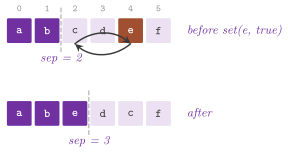
Lemma 6.7. In an IterableBoolMap with vector
\(a_0,\dots,a_{n_K-1}\) and separator \(\sigma\), an item is mapped to true if
and only if its position is below \(\sigma\), and the position stored for each
item is its index in the vector. set(), setAll(), trueNum(),
falseNum(), the reads, the additions and the erasures of items cost \(O(1)\),
and an iterator lists the items of one value in \(O(1)\) per item.
Proof. The constructor pushes the items in the order of the notifier and
puts \(\sigma\) at \(n_K\) or at \(0\). To set an item at position \(p\ge\sigma\) to
true, set() exchanges it with \(a_\sigma\), updates both positions and
increases \(\sigma\); to set an item at \(p<\sigma\) to false, it decreases
\(\sigma\) and exchanges the item with \(a_\sigma\). In both cases only the two
items exchanged change position, and only the moved item changes side. A new
item is pushed at the end, i.e., on the false side; an erased item at
\(p<\sigma\) is replaced by \(a_{\sigma-1}\), which is replaced by the last item,
and \(\sigma\) is decreased, while one at \(p\ge\sigma\) is replaced by the last
item. trueNum() is \(\sigma\), falseNum() is \(n_K-\sigma\), and an iterator
steps from a position to the previous one until it crosses \(\sigma\) (or \(0\)).
\(\square\)
IterableIntMap< GR , K > stores an integer per item, and it keeps a doubly
linked list of the items for each non-negative value, with the heads in a
vector indexed by the value. Thus, set(key, value) unlinks the item from the
list of its old value and links it at the head of the list of the new one.
size() returns the largest value with a non-empty list plus one, and
ItemIt( map , value ) and items( value ) list the items with a value,
while an item with a negative value is in no list and cannot be listed. The
constructor without a value sets all the values to \(-1\), the one with a value
sets them to it, and an item added later reads \(-1\). The proxy returned by
operator[] offers the integer operators (++, --, +=, -=, *=, /=,
%=, &=, |=, ^=, <<=, >>=), each of which goes through set().
IterableValueMap< GR , K , V > does the same for any value type with an
operator<, and it keeps a linked list per value, with the heads in a
std::map< V , K > that holds only the values in use. Its
ItemIt( map , value ) and items( value ) list the items with a value, and
beginValue() and endValue() delimit a forward iterator, ValueIt, on the
distinct values, in increasing order. The constructor maps all the items to a
value (by default V()), and an item added later reads V(). The records of
the lists are the structures IterableIntMapNode and IterableValueMapNode
of the namespace _maps_bits, which are not meant to be used directly.
Lemma 6.8. Let \(w\) be the largest value of an
IterableIntMap, and \(d\) the number of distinct values of an
IterableValueMap. A set() of an IterableIntMap costs \(O(1)\) plus the
change of length of the vector of heads, which is a growth to the new value
plus one, or a shrink by the number of empty lists at its end; the memory is
\(O(N_K+w)\). A set() and the construction of an ItemIt of an
IterableValueMap cost \(O(\log d)\) comparisons. In both maps an ItemIt
lists the items of a value in \(O(1)\) per item.
Proof. set() of an IterableIntMap unlinks the item (one update of its
two neighbours or of the head), pops the empty heads at the end of the vector,
sets the value and links the item at the head of its new list, after resizing
the vector if the value exceeds it. The steps other than the pops and the
resize are \(O(1)\). In an IterableValueMap the head of a value is found by
find() on std::map, and a value whose list becomes empty is erased from
it, in \(O(\log d)\); an ItemIt follows the links next of the records.
\(\square\)
abLEMON
The default constructor of IterableIntMapNode, by which a graph map
creates the record of a new item, and the constructor of
IterableValueMapNode initialize the links to INVALID, which LEMON
1.3.1 left indeterminate.
The iterable integer map is the natural data structure for the buckets of degrees of the smallest-last ordering of Matula and Beck 1983. Let \(G=(V,E)\) be a simple undirected graph (no loops, no parallel edges), and, for \(H\) a subgraph, let \(\delta(H)\) be its least degree. The \(k\)-core of \(G\) is the union of the subgraphs \(H\) with \(\delta(H)\ge k\) (itself such a subgraph, since a node of the union has at least \(k\) neighbours in the subgraph that contains it). The core number \(c(v)\) of a node is the largest \(k\) such that \(v\) is in the \(k\)-core, and the degeneracy of \(G\) is \(\delta^*(G)=\max_{H\subseteq G}\delta(H)\). Algorithm 6.1 removes, one at a time, a node of least degree in the graph that remains, and records the running maximum of the degrees at removal.
Algorithm 6.1 (Smallest-last ordering and core numbers by an iterable integer map).
input:  simple graph G = (V, E)
deg := IterableIntMap on V, deg[v] := degree of v      (deg.set(v, .))
k := 0;  d := 0
repeat |V| times
  while ItemIt(deg, d) == INVALID: d := d + 1
  u := ItemIt(deg, d)                  (a node of least current degree)
  k := max(k, d);  core[u] := k;  append u to the order
  deg.set(u, -1)                       (u leaves all the lists)
  for each edge (u, w) with deg[w] > 0: deg.set(w, deg[w] - 1)
  d := max(d - 1, 0)
output: the order (reversed, the smallest-last order), core, k
Theorem 6.1. Algorithm 6.1 removes at each iteration a node of least degree in the graph that remains, and on output \(\mathrm{core}[v]=c(v)\) for each node and \(k=\delta^*(G)\); also, each node has at most \(k\) neighbours that are removed after it.
Proof. Let \(u_1,\dots,u_n\) be the nodes in the order of removal, \(G_t\) the
subgraph induced by \(u_t,\dots,u_n\), and \(d_t\) the value of \(d\) when \(u_t\) is
chosen. We first show that \(d\le\delta(G_t)\) at the start of iteration \(t\),
which holds for \(t=1\), since \(d=0\). If it holds at \(t\), the buckets below
\(\delta(G_t)\) are empty and that of \(\delta(G_t)\) is not, so that the loop
stops at \(d_t=\delta(G_t)\) and \(u_t\) has least degree in \(G_t\). The neighbours
of \(u_t\) that remain (exactly those with deg positive, since a remaining
neighbour has degree at least 1 and a removed node has \(-1\)) lose one unit of
degree each, as \(G\) is simple, so that \(\delta(G_{t+1})\ge d_t-1\), and the new
\(d\) is at most \(\delta(G_{t+1})\). Hence,
\(\mathrm{core}[u_t]=k_t=\max_{s\le t}\delta(G_s)\). Let \(r\le t\) attain the
maximum; \(G_r\) contains \(u_t\) and has least degree \(k_t\), so that
\(c(u_t)\ge k_t\). Conversely, let \(H\) be the \(c(u_t)\)-core and \(s\) the first
index with \(u_s\in H\); then \(s\le t\), \(H\subseteq G_s\), and
\(\delta(G_s)=\deg_{G_s}(u_s)\ge\deg_H(u_s)\ge c(u_t)\), so that
\(k_t\ge c(u_t)\). Since every subgraph \(H\) has \(\delta(H)\le c(v)\) for its
nodes \(v\), \(\delta^*(G)=\max_v c(v)=\max_t k_t=k\); finally, the neighbours of
\(u_t\) removed after it are its neighbours in \(G_t\), i.e., \(\delta(G_t)\le k\)
of them. \(\square\)
Theorem 6.2. Algorithm 6.1 runs in \(O(|V|+|E|)\) time.
Proof. The initial degrees cost \(O(|V|+|E|)\), and there are \(|V|\) initial
set(), \(|V|\) removals and at most \(|E|\) decrements (an edge decrements one
end, when its other end is removed). The vector of heads grows only during the
initialization, to the largest degree \(\Delta+1\), and the shrinks after it
remove at most \(\Delta+1\) heads in all; by Lemma 6.8, all the set() cost
\(O(|V|+|E|+\Delta)\). The value \(d\) decreases by at most one per iteration and
never exceeds \(\Delta\), so that the tests of the inner loop are at most
\(|V|+\Delta\) plus one per iteration; since \(\Delta\le|E|\), the total is
\(O(|V|+|E|)\). \(\square\)
On a graph with parallel edges, a removal may lower a degree by more than one,
and the last step of Algorithm 6.1 would have to lower \(d\) accordingly. The
program manual/examples/06-degeneracy.cc (the test manual_06_degeneracy)
implements Algorithm 6.1 on a graph of seven nodes, checks the degeneracy, the
core numbers and the first node removed, and marks the nodes of the largest
core in an IterableBoolMap, whose trueNum() gives their number and whose
TrueIt lists them.
6.7 Map utilities
The functions at the end of lemon/maps.h scan the items of one kind of a
graph, the kind given by the key type of the map, and use the values of a map.
mapCopy( g , from , to )writesfrom[x]intotofor each itemxof the kind ofto. An edge map can thus be copied to an arc map of the same graph, since an arc converts to its edge, but not vice versa.mapFill( g , map , val )writesvalat each item.mapCompare( g , m1 , m2 )returnstrueif the two maps agree, byoperator==, at each item of the kind ofm2.mapMin( g , map )andmapMax( g , map )return an item of least and of largest value, orINVALIDon an empty item set. When there are ties (which may well happen on integer data), they return the first one met in the order of the item iterator. The variants with a third argument take a comparison functor in place ofstd::less< V >.mapMinValue()andmapMaxValue()(with or without the functor) return the value, and they require a non-empty item set, since they read the map at the item thatmapMin()ormapMax()returns.mapFind( g , map , val )andmapFindIf( g , map , pred )return the first item whose value equalsval(or satisfiespred), andINVALIDif there is none, whilemapCount( g , map , val )andmapCountIf( g , map , pred )return the number of such items.
Lemma 6.9. Each utility makes one pass over the
items of its kind, with \(O(n_K)\) reads or writes of the maps and \(O(n_K)\)
evaluations of ==, of the comparison or of the predicate (the searches stop
at the first item found).
Proof. Each function is one loop of the item iterator of the kind, with one
read (or write) of each map and one evaluation per item; mapMin() keeps the
current minimum and replaces it only on a strict comparison, which gives the
first item of least value. \(\square\)
The program manual/examples/06-map-adaptors.cc uses mapMin(),
mapCountIf(), mapCopy(), mapCompare() and mapMaxValue(), and the test
test/maps_test.cc checks all the utilities.
6.8 Exercises
Exercise 6.1. Write a map class, derived from
MapBase, whose value at an arc is the Euclidean length of the arc, computed
from a node map of coordinates. Check that it conforms to concepts::ReadMap
by checkConcept(), and then obtain the same map without writing a class,
from SourceMap, TargetMap, ComposeMap and CombineMap.
Exercise 6.2. In
manual/examples/06-map-adaptors.cc, replace the DivMap by a CombineMap
with a lambda, and the delay by a ShiftMap of the DivMap; check that the
distances do not change.
Exercise 6.3. Explain why the declaration
AddMap< M, ConstMap< K, int > > m = addMap( length, constMap< K >( 1 ) );
compiles, while a later read of m has undefined behavior, and correct it.
Exercise 6.4. Modify
manual/examples/06-degeneracy.cc so that it colors the graph greedily in the
smallest-last order, with at most \(k+1\) colors (by the last statement of
Theorem 6.1), and check the coloring. Then extend Algorithm 6.1 to graphs with
parallel edges, and prove that it still runs in \(O(|V|+|E|)\) time.
Exercise 6.5. Use a RangeIdMap and its swap()
to number the nodes of an acyclic digraph in a topological order, and check
that each arc goes from a smaller to a larger range identifier (the test
test/maps_test.cc checks swap() after an erasure).