12. Maximum flows and circulations
We are concerned in this chapter with the classes of lemon/preflow.h,
lemon/edmonds_karp.h and lemon/circulation.h. The first two compute a flow
of maximum value between two nodes of a digraph, together with a cut that
proves it maximum, and they share the interface of the concept in
lemon/concepts/max_flow.h. The third one finds a flow within lower and upper
bounds that meets given supplies, or a set of nodes that proves that no such
flow exists. Section 12.1 states the problem and the duality on which the
results of the chapter rest, sections 12.2 and 12.3 describe the two maximum
flow algorithms, section 12.4 the circulation algorithm, and section 12.5 the
tolerances and the concept that they share. We treat the minimum cost version
of the circulation problem in chapter 13, and the
minimum cuts of a graph with no source and no target in chapter
15. The results of the chapter are stated in exact
arithmetic, i.e., for an integer value type or for data on which no rounding
occurs; section 12.5 describes what changes in floating point.
12.1 The problem and its dual
Let \(G=(V,A)\) be a digraph with \(n\) nodes and \(m\) arcs, let \(cap: A\rightarrow\mathbf{R}_{\geq 0}\) be the capacities of the arcs, and let \(s\neq t\) be two nodes, the source and the target. In the maximum flow problem one looks for a flow \(f: A\rightarrow\mathbf{R}\) that solves
where the objective, i.e., the net flow out of \(s\), is the value of the flow, and the equalities impose the conservation of the flow at the nodes other than \(s\) and \(t\). A cut is a set \(S\subset V\) with \(s\in S\) and \(t\notin S\), whose capacity is
For a flow \(f\), the residual digraph has an arc \(uv\) wherever \(f(uv)<cap(uv)\) and an arc \(vu\) wherever \(f(uv)>0\), with the residual capacities
a path from \(s\) to \(t\) in it is an augmenting path, along which the flow may be increased by the smallest residual capacity of its arcs. We call a set of nodes closed (in the residual digraph of \(f\)) when no residual arc leaves it. All the results of this chapter rest on the following classical theorem.
Theorem 12.1. (Max-flow min-cut.) The value of any feasible flow is at most the capacity of any cut. A feasible flow \(f\) is maximum if and only if its residual digraph has no path from \(s\) to \(t\); then the set \(S\) of the nodes that \(s\) reaches in it is a cut with \(cap(S)\) equal to the value of \(f\), and therefore a minimum cut.
Proof. Summing the conservation constraints over the nodes of a cut \(S\), in which the terms of the arcs with both ends in \(S\) cancel, one finds that the value of \(f\) equals \(\sum_{u\in S,\,v\notin S} f(uv) - \sum_{u\notin S,\,v\in S} f(uv)\), which is at most \(cap(S)\) since \(0\leq f\leq cap\). If an augmenting path exists, increasing the flow along it by its smallest residual capacity, which is positive, gives a feasible flow of larger value, and \(f\) is not maximum. If none exists, \(t\notin S\); an arc \(uv\) with \(u\in S\) and \(v\notin S\) has \(f(uv)=cap(uv)\), or \(uv\) would be a residual arc out of \(S\), and an arc \(vu\) entering \(S\) has \(f(vu)=0\), or \(uv\) would be one. Hence, the value of \(f\) equals \(cap(S)\), which by the first part bounds the value of every flow. \(\square\)
Thus, the answer of the two maximum flow classes can be checked by the user.
Both give, besides the flow and its value, a minimum cut through minCut()
and minCutMap(), and the capacity (12.2) of that cut, computed on the data,
must equal the value of the flow. Of course, the minimum cut need not be
unique, and the two classes need not give the same one; the following lemma,
which we use again for the certificates of chapter
14, describes where the minimum cuts lie.
Lemma 12.1. Let \(f\) be a maximum flow, \(S_{\min}\) the set of the nodes that \(s\) reaches in its residual digraph, and \(S_{\max}\) the set of the nodes that do not reach \(t\) in it. A cut is minimum if and only if it is closed in the residual digraph of \(f\); every minimum cut \(S\) has \(S_{\min}\subseteq S\subseteq S_{\max}\), and both \(S_{\min}\) and \(S_{\max}\) are minimum cuts. Hence, the smallest and the largest minimum cuts do not depend on the maximum flow chosen.
Proof. As in the proof of Theorem 12.1, the value of \(f\) equals \(cap(S)\) for a cut \(S\) if and only if the arcs leaving \(S\) are saturated and those entering it are empty, i.e., if and only if \(S\) is closed. A closed set that contains \(s\) contains every node that \(s\) reaches, and its nodes reach no node outside it, \(t\) in particular; hence, \(S_{\min}\subseteq S\subseteq S_{\max}\). The set \(S_{\min}\) is closed by definition, and \(t\notin S_{\min}\) by Theorem 12.1. The set \(S_{\max}\) contains \(s\) (otherwise \(s\) would reach \(t\)) and does not contain \(t\); it is closed, since a residual arc from \(u\in S_{\max}\) to a node that reaches \(t\) would let \(u\) reach \(t\). The last statement holds since the minimum cuts are defined by the data only. \(\square\)
12.2 The push-relabel algorithm: Preflow
12.2.1 Preflows and labels
We begin with the class Preflow, which implements the push-relabel algorithm
of Goldberg and Tarjan (Goldberg and Tarjan
1988; see also Cormen et al.
2001 and Ahuja, Magnanti and Orlin
1993, chapter 7). This algorithm
does not keep a feasible flow during its course. It keeps instead a preflow,
i.e., a map \(f\) within the bounds of (12.1) whose excess \(e_f(u)=\sum_{vu\in
A} f(vu)-\sum_{uv\in A} f(uv)\) is nonnegative at the nodes other than \(s\).
Together with it, it keeps integer labels \(d(u)\in\{0,\ldots,n\}\) (the
levels of an Elevator, see chapter 8) such that
A node \(u\neq t\) of positive excess and of label below \(n\) is active. A push along a residual arc \(uv\) with \(d(v)<d(u)\) moves the smaller of \(e_f(u)\) and \(r_f(uv)\) from \(u\) to \(v\); it is saturating if it empties the arc, and emptying if it empties \(u\). Note that the class pushes towards any lower level, not only to the level just below, as the textbook rule does. A relabel of an active node raises \(d(u)\) to one more than the least label of the heads of its residual arcs, or to \(n\) if that is larger or if no residual arc leaves \(u\). The top level \(n\) marks the nodes that cannot reach \(t\), which are never active; also, when a relabel leaves the old level of \(u\) empty, every node above that level is lifted to the top (the gap rule).
The implementation runs in two phases. In the first one the excess is pushed towards \(t\). At its end the excess of \(t\) is the maximum flow value, and the nodes at the top level form the source side of a minimum cut; however, some excess may still be stranded at the nodes that cannot reach \(t\). Hence, a second phase sends that excess back to \(s\), with labels computed from \(s\) in the same way, and it leaves a maximum flow. In both phases the active node of highest label is processed first; in the first phase, however, the header describes the rule as "a mixture of the highest label and the bound decrease heuristics". After each sweep of \(n\) selections of the highest active node, the code makes \(20n\) selections of an active node of the current level, or of the nearest level below it that has one, without looking for the highest one again. It starts a new sweep when no level at or below the current one has an active node.
Algorithm 12.1 (Preflow, first phase).
1  f := 0; d(u) := BFS distance from u to t over the arcs of positive
   capacity, n if none, and d(s) := n
2  f(sv) := cap(sv) for the arcs sv of positive capacity with d(v) < n
3  repeat: (n selections of the highest active node, then 20n selections
           from the current level downwards, as described above)
4      u := the selected active node; if none: stop
5      for each residual arc uv (out-arcs, then in-arcs), while e(u) > 0:
6          if d(v) < d(u): push min{ e(u), r(uv) } along uv
7      if e(u) > 0:
8          L := d(u); d(u) := min{ n, 1 + min{ d(v) : uv residual } }
9          if level L is now empty: lift every node above L to level n
10 return e(t) as the value, { u : d(u) = n } as the source side of the cut
Steps 1 and 2 are init(), and steps 3 to 9 are startFirstPhase(). In step
8 the minimum runs over the residual arcs left after the pushes of step 6,
which all go to nodes of level at least \(d(u)\); hence, the new label exceeds
the old one. The following two lemmas prove the first phase correct.
Lemma 12.2. During startFirstPhase(), \(f\) is
a preflow, \(d(t)=0\), \(d(s)=n\), condition (12.4) holds for every residual arc,
the labels never decrease, and the levels below \(n\) that hold a node are
\(0,1,\ldots,h\) for some \(h\leq n-2\).
Proof. After init() the labels below \(n\) are the distances of a breadth
first search from \(t\), which never exceed \(n-2\) since \(s\) is not among the
nodes searched, and they form the levels \(0,\ldots,h\) without gaps. Condition
(12.4) holds for the arcs of positive capacity, along which \(d(u)\leq d(v)+1\);
the only arcs carrying flow, those out of \(s\) saturated in step 2, give
residual arcs into \(s\), whose label is the largest. A residual arc out of a
node of level \(n\) goes to a node of level \(n\), since it is either an
unsaturated arc out of \(s\), whose head step 2 left at level \(n\), or an arc out
of a node that the search did not reach, whose head the search did not reach
either. A push along \(uv\) with \(d(v)<d(u)\) may add the residual arc \(vu\), for
which \(d(v)\leq d(u)+1\); it moves at most \(e_f(u)\) and at most \(r_f(uv)\), and
\(f\) stays a preflow. A relabel sets \(d(u)\leq d(v)+1\) for every residual arc
\(uv\) and raises \(d(u)\), which keeps (12.4) on the arcs into \(u\). When level
\(L\) becomes empty, a residual arc out of a node \(u\) above \(L\) goes to a node
\(v\) with \(d(v)\geq d(u)-1\geq L\), hence above \(L\), so that (12.4) still holds
after those nodes are moved to \(n\). A relabel moves \(u\) to at most \(h+1\),
since some residual arc out of \(u\) reaches a level at most \(h\) unless the new
label is \(n\); if the old level of \(u\) becomes empty, the gap rule lifts \(u\)
too. Hence, the occupied levels below \(n\) stay contiguous from 0, the level of
\(t\), which is never relabeled. Since at most \(n-1\) nodes lie below the top,
\(h\leq n-2\): a relabel to level \(n-1\) would leave \(n\) levels occupied by \(n-1\)
nodes, unless the old level became empty, and then the gap rule lifts \(u\) to
the top. \(\square\)
Lemma 12.3. When startFirstPhase() ends, the
set \(S\) of the nodes at level \(n\) is a cut, no residual arc of the preflow
leaves it, and \(e_f(t)=cap(S)\).
Proof. The phase ends when no node is active, i.e., when every node below level \(n\) other than \(t\) has a zero excess. We have \(s\in S\) and \(t\notin S\) by Lemma 12.2. A residual arc from \(u\in S\) to \(v\notin S\) would need \(n\leq d(v)+1\), i.e., \(d(v)=n-1\), which Lemma 12.2 excludes. Hence, the arcs leaving \(S\) are saturated and those entering it are empty. The flow entering \(V\setminus S\), which is then \(cap(S)\), equals the sum of the excesses of its nodes, i.e., \(e_f(t)\). \(\square\)
The second phase, startSecondPhase(), keeps the nodes of \(V\setminus S\) at
level \(n\) and gives to those of \(S\) the distances of a breadth first search
towards \(s\) over the residual arcs (level \(n-1\) to those that do not reach
\(s\)); then it makes the same pushes and relabels from the active node of
highest label, \(s\) taking the role of \(t\).
Algorithm 12.2 (Preflow, second phase).
1  d(u) := n for u not in S; for u in S, d(u) := BFS distance from u to s
   in the residual digraph, n - 1 if none
2  while some node u != s, t with d(u) < n has e(u) > 0:
3      u := an active node of highest label
4      push from u along residual arcs uv with d(v) < d(u), while e(u) > 0
5      if e(u) > 0: relabel u as in Algorithm 12.1 (steps 8 and 9)
6  return f, a maximum flow
Theorem 12.2. (Correctness of Preflow.) After
init() and startFirstPhase(), flowValue() is the maximum flow value and
minCut() describes a minimum cut \(S\) with \(S_{\min}\subseteq S\subseteq
S_{\max}\) (Lemma 12.1). After startSecondPhase(), flowMap() is a maximum
flow and minCut() describes the same set \(S\).
Proof. Consider the second phase. A node of \(S\) with positive excess reaches
\(s\) in the residual digraph. Indeed, if the preflow is decomposed into paths
from \(s\), cycles and paths from \(s\) that end at nodes with excess, the reverse
of a path that ends at \(u\) is a residual path from \(u\) to \(s\), which stays
within \(S\) since no residual arc leaves \(S\) (Lemma 12.3). The arguments of
Lemma 12.2, with \(s\) in place of \(t\), show that (12.4) holds throughout the
phase. Hence, the label of an active node is at most its residual distance to
\(s\), i.e., at most \(|S|-1<n\), no active node reaches the top, and the branches
that the code marks as a "calculation error" are never taken in exact
arithmetic. No push crosses the boundary of \(S\), since the nodes of
\(V\setminus S\) stay at level \(n\) and have no excess; hence, the arcs between
\(S\) and \(V\setminus S\) keep their flows. By Theorem 12.3 below the phase ends,
with no active node, i.e., with a flow, whose value is the flow entering
\(V\setminus S\), i.e., \(cap(S)=e_f(t)\) by Lemma 12.3. By Theorem 12.1 this flow
is maximum and \(S\) is a minimum cut, closed in its residual digraph, and Lemma
12.1 gives \(S_{\min}\subseteq S\subseteq S_{\max}\). After the first phase
minCut( u ) tests \(d(u)=n\), and after the second phase \(d(u)<n\), which holds
again for the nodes of \(S\) and for no other. \(\square\)
We remark that \(S\) need be neither the smallest nor the largest minimum cut: on the path \(s\rightarrow a\rightarrow b\rightarrow t\) with unit capacities, e.g., the first phase leaves \(a\) and \(b\) below the top, so that \(S=\{s\}=S_{\min}\), while \(S_{\max}=\{s,a,b\}\). In general \(S\) depends on the order of the operations.
Theorem 12.3. (Running time of Preflow.) In each phase there are at most \(n^2\) relabels, at most \(m(n+2)\) saturating pushes and at most \(n^2+nm(n+2)\) emptying pushes. Each selection of a node costs \(O(\Delta)\) time, where \(\Delta\) is the largest number of arcs incident to a node, since the code scans the arcs of the node from the first one; hence, each phase takes \(O(n^2m\Delta)\) time.
Proof. Each label is at most \(n\) and only grows (Lemma 12.2), so that each node is relabeled at most \(n\) times. Between two saturating pushes along the same residual arc \(uv\), a push along \(vu\) must occur. The first push needs \(d(u)>d(v)\), the push along \(vu\) a label of \(v\) above the label of \(u\) at that time, and the second push a label of \(u\) above that of \(v\); hence, \(d(u)\) grows by at least 2. Hence, there are at most \(n/2+1\) saturating pushes along each of the \(2m\) residual arcs. Let \(\Phi\) be the sum of the labels of the active nodes. An emptying push makes \(u\) inactive and may make active \(v\), whose label is smaller, and therefore it decreases \(\Phi\) by at least 1. A saturating push increases \(\Phi\) by at most \(n\), the relabels by the growth of the labels, which sums to at most \(n^2\), and a lift to the top only makes nodes inactive. This gives the bound on the emptying pushes. A selection of a node ends with an emptying push or with a relabel, and it scans at most the arcs incident to the node. \(\square\)
The header states the bound of Theorem 12.3, and remarks that the bound \(O(n^2\sqrt{m})\) of the highest label rule needs a current arc for each node (Cheriyan and Maheshwari 1989; Ahuja, Magnanti and Orlin 1993, chapter 7). The code keeps no current arc, and its first phase is not the pure highest label rule; hence, the proof of that bound does not carry over to it, and Theorem 12.3 is the bound that one can prove for the class as it is. In practice the algorithm is usually the fastest maximum flow method of the library, and the documentation of the module recommends it "in most cases". We remark that the header warns against infinite or very large capacities (e.g., the largest value of the type), since the initial pushes of step 2 and the sums of the excesses at a node must fit in the value type.
12.2.2 The interface
Preflow< GR , CAP , TR > takes the type GR of the digraph, the type CAP
of the capacity map (by default GR::ArcMap< int >), and a traits class TR,
by default PreflowDefaultTraits< GR , CAP >. These traits define the types
Digraph and CapacityMap, the value type Value (that of CAP), the type
FlowMap of the flow map (GR::ArcMap< Value >), and the type Elevator of
the labels (Elevator< GR , GR::Node >, whose alternative is
LinkedElevator). They also define the static functions
createFlowMap( digraph ) and createElevator( digraph , max_level ) that
allocate the last two, and the type Tolerance (Tolerance< Value >) of the
comparisons. The class repeats these types as its own typedefs, together with
Traits, and its typedef Create is the class itself. One rarely sets the
traits directly. Instead, the named template parameters SetFlowMap< T >,
SetElevator< T > and SetStandardElevator< T > replace one type each,
through their member Create. With SetFlowMap and SetElevator the object
must be given by flowMap() or elevator() before init(), since the traits
that they make cannot create it (they assert); SetStandardElevator, instead,
makes a type that the class still allocates, from the digraph and the largest
level.
The constructor Preflow( digraph , capacity , source , target ) stores the
data by reference; it does not check that the source differs from the target,
as the algorithm requires. The setters capacityMap(), flowMap(),
source(), target(), elevator() and tolerance() change the data, each
returning the object, and elevator() and tolerance() without arguments
return a const reference to the elevator and to the tolerance. A flow map or
an elevator that is not given is allocated by init() and released by the
destructor. The execution follows the pattern of chapter
3.
run()isinit(),startFirstPhase()andstartSecondPhase(), andrunMinCut()isinit()andstartFirstPhase(), which suffice for the value and for the minimum cut (Theorem 12.2).init()starts from the zero flow, andinit( flowMap )from a given map, which must be at least a preflow: after copying the map, it returnsfalseif the excess of a node other than \(s\) is negative beyond the tolerance; otherwise it computes the labels by a breadth first search from \(t\) over the residual arcs, saturates the residual arcs out of \(s\) (and empties the arcs into it) towards the nodes that reach \(t\), and returnstrue. It does not check the bounds \(0\leq f\leq cap\), which the caller must ensure.flowValue()returns the excess of \(t\), i.e., the maximum value already after the first phase, whileflow( arc )andflowMap()give a maximum flow only after the second phase.minCut( node )returnstrueif a node is on the source side of the minimum cut found, andminCutMap( map )writes that side into a writableboolnode map, in \(O(n)\) time; both are meaningful after the first or the second phase (Theorem 12.2), and the header remarks that the two answers may differ slightly with inexact computation.
A typical call, with a bool node map cut, is
after which pf.flowValue() is the value. The program
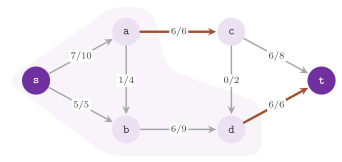
manual/examples/12-max-flow.cc (the test manual_12_max_flow) solves the
network of Figure 12.1 with Preflow and EdmondsKarp, checks the value 12
against the capacity of the cut of each, and gives the maximum flow to a
second Preflow, after the capacity of the arc \((d,t)\) has grown from 6 to
10, whose first phase reaches the value 15.
abLEMON
With a floating-point Value, init( flowMap ) judges the excess of a
node relative to the flow through the node, rather than against the
absolute epsilon of the tolerance. Hence, the maximum flow of another
Preflow on large capacities (e.g., of the order of \(10^9\)) is taken as a
preflow, while LEMON 1.3.1 refused it because the rounding errors of the
sums exceed that epsilon (trac #625). A program may then start from the
maximum flow of a previous run after a change of the capacities, provided
that the old flow is still a preflow for the new ones (e.g., after some
capacities have grown). The header of LEMON 1.3.1 stated the running time
\(O(n^2\sqrt{m})\), which this code does not attain; it states the bound of
Theorem 12.3.
12.3 Augmenting paths: EdmondsKarp
Next, the class EdmondsKarp implements the algorithm of Edmonds and Karp
1972, i.e., the augmenting
path method of Ford and Fulkerson in which each augmenting path is a shortest
one (in the number of arcs) of the residual digraph.
Algorithm 12.3 (Edmonds and Karp).
1  f := 0 (init()), or a given feasible flow (init(flowMap))
2  repeat:                                             (augment())
3      find by BFS from s a path P to t with the fewest arcs,
       along the residual arcs uv with r(uv) > 0
4      if there is none: stop, f is maximum
5      delta := min{ r(uv) : uv in P }
6      increase f along P by delta (decrease it on the backward arcs)
Steps 3 to 6 are one call of augment(), which returns false when no path
is found; start() repeats it until then, and run() is init() followed by
start(). The search of step 3 stops as soon as \(t\) is reached. In our view,
the advantage of the class over Preflow lies in this control: between two
calls of augment() the flow is a feasible flow, whose value flowValue()
returns. One can then stop early, look at the intermediate flows, or
interleave the augmentations with some other work, as a teaching or a
debugging program may want.
Theorem 12.4. (Edmonds and Karp.) Each call of
augment() that returns true keeps \(f\) feasible and increases its value by
\(\delta>0\); when it returns false, \(f\) is maximum and the nodes that the
search reached form the cut \(S_{\min}\) of Lemma 12.1. From any feasible flow,
at most \(nm\) calls return true; hence, start() takes \(O(nm^2)\) time.
Proof. The first statement holds since \(\delta\) is the smallest residual capacity of the path, and the second is Theorem 12.1, the search having visited every node that \(s\) reaches. Let \(\delta_f(v)\) be the number of arcs of a shortest residual path from \(s\) to \(v\). An augmentation along a shortest path \(P\) removes from the residual digraph at least one arc of \(P\), and it may add the reverses of arcs of \(P\), each of which goes from a node at distance \(k+1\) to one at distance \(k\). Such arcs create no shorter path; hence, \(\delta_f(v)\) never decreases. An arc \(uv\) of \(P\) that an augmentation removes (a critical arc) has \(\delta_f(v)=\delta_f(u)+1\); it can be critical again only after an augmentation along a path through \(vu\), which needs \(\delta(u)=\delta(v)+1\) at that time, so that \(\delta(u)\) has grown by at least 2. Since a finite distance is below \(n\), each of the \(2m\) residual arcs is critical at most \(n/2\) times. Hence, there are at most \(nm\) augmentations, each of which costs \(O(m)\) time for the search and the update. \(\square\)
The header gives the running time \(O(nm^2)\), together with the advice to use
Preflow when only the maximum flow is wanted. We remark that the bound does
not depend on the capacities, and holds for real ones.
The template parameters are those of Preflow, with the traits
EdmondsKarpDefaultTraits< GR , CAP > (the types Digraph, CapacityMap,
Value, FlowMap with its creator createFlowMap(), and Tolerance) and
the single named parameter SetFlowMap< T >; the class has the same typedefs
and Create. The constructor
EdmondsKarp( digraph , capacity , source , target ) asserts that \(s\neq t\)
(the setters source() and target() do not); the setters capacityMap(),
flowMap(), source(), target() and tolerance() return the object,
tolerance() without arguments returns the tolerance, and the queries
flowValue(), flow( arc ), flowMap(), minCut( node ) and
minCutMap( map ) are as in Preflow. The cut is that of the last search,
i.e., the set of the nodes reached from \(s\) when augment() returned false,
which by Theorem 12.4 is \(S_{\min}\). It is meaningful only after such a call:
after init() only, or after a call that returned true, the predecessors of
the search describe no cut. In the example of Figure 12.1 the minimum cut is
unique, and the program of section 12.2.2 finds it with both classes. Finally,
init( flowMap ) starts from a given flow, and checkedInit( flowMap ) is
kept as another name of the same function.
abLEMON
init( flowMap ) returns whether the map is a feasible flow, with the
tolerance of the algorithm (conservation at the nodes other than \(s\) and
\(t\), and \(0\leq f\leq cap\) on the arcs), as Preflow::init() does; the
flow is set in any case. In LEMON 1.3.1 it returned nothing, and only
checkedInit() made the same checks. The header of LEMON 1.3.1 allowed
minCut() and minCutMap() after init() alone; it requires the last
call of augment() to have returned false.
12.4 Feasible circulations: Circulation
12.4.1 The problem and its certificate
Let \(lower: A\rightarrow\mathbf{R}\) and \(upper:
A\rightarrow\mathbf{R}\cup\{\infty\}\), with \(lower\leq upper\), be bounds on
the flow of the arcs, and let \(sup: V\rightarrow\mathbf{R}\) be signed supplies
(a node with \(sup(u)>0\) supplies \(sup(u)\) units, one with \(sup(u)<0\) demands
\(-sup(u)\)). In the network circulation problem of the class Circulation
one looks for any \(f\) such that
The system can be feasible only if \(\sum_{u\in V} sup(u)\leq 0\), since its
left-hand sides sum to zero; when the supplies sum to zero, the inequalities
hold as equalities, and (12.5) defines the feasible flows with supplies and
demands. One obtains the opposite inequalities (all the demands met, some
supply left) by reversing the arcs and negating the supplies, as the header
suggests, e.g., with the adaptor ReverseDigraph of chapter
5 and the map NegMap of chapter 6.
As a certificate of infeasibility the class gives a barrier, i.e., a set
\(B\subseteq V\) whose supply exceeds what can leave it:
The theorem of Hoffman states that a barrier exists whenever (12.5) has no solution. Let \(sup'(u)=sup(u)-\sum_{uv\in A} lower(uv)+\sum_{vu\in A} lower(vu)\) be the supplies net of the lower bounds, and let \(x^+=\max\{x,0\}\) and \(x^-=\max\{-x,0\}\). The proof uses the network \(N\) that has the arcs of \(G\), with the capacities \(upper-lower\), a source \(\sigma\) with an arc to each node \(u\) of capacity \(sup'(u)^+\), and an arc from each node \(u\) to a target \(\tau\) of capacity \(sup'(u)^-\). Let \(P=\sum_{u\in V} sup'(u)^+\). A direct expansion of (12.2), in which the lower bounds of the arcs inside \(B\) cancel, gives for each \(B\subseteq V\)
i.e., \(B\) is a barrier if and only if \(cap(\{\sigma\}\cup B)<P\).
Theorem 12.5. (Hoffman.) The system (12.5) has a solution if and only if no set \(B\subseteq V\) satisfies (12.6).
Proof. If \(f\) solves (12.5), summing its inequalities over the nodes of \(B\) gives \(\sum_{v\in B} sup(v)\leq \sum_{u\in B,\,v\notin B} f(uv)-\sum_{u\notin B,\,v\in B}f(uv)\), which is at most the left-hand side of (12.6). Conversely, suppose that a maximum flow \(x\) of \(N\) from \(\sigma\) to \(\tau\) has value \(P\), i.e., saturates every arc out of \(\sigma\). At each node \(u\) the conservation in \(N\) gives \(\sum_{uv\in A}x(uv)-\sum_{vu\in A}x(vu)=sup'(u)^+-x(u\tau)\geq sup'(u)^+-sup'(u)^-=sup'(u)\), and \(f=x+lower\) solves (12.5). Hence, if (12.5) has no solution, the maximum flow value is below \(P\), and by Theorem 12.1 some cut \(\{\sigma\}\cup B\) of \(N\) has a capacity below \(P\), which is finite (no arc of infinite upper bound leaves \(B\)). By (12.7), \(B\) satisfies (12.6). \(\square\)
This is the circulation theorem of Hoffman 1960, which in the form with supplies is the feasibility theorem of Gale 1957.
12.4.2 The algorithm and its interface
Circulation is a push-relabel algorithm written directly for (12.5). In it,
the excess of a node is \(e(u)=sup(u)\) plus the flow into it less the flow out
of it; hence, a node of positive excess is one whose inequality is violated. A
residual arc is an arc \(uv\) with \(f(uv)<upper(uv)\), or the reverse of an arc
\(vu\) with \(f(vu)>lower(vu)\), as in (12.3) with the bounds of (12.5). The flow
starts at the lower bounds (init()) or at a greedy choice (greedyInit()),
which sets each arc, in the order of the arcs, to the deficit \(-e(v)\) of its
head \(v\) at that moment, clipped to the bounds of the arc. All the nodes start
at level 0, and the active nodes are those of positive excess. A comment in
init() records that a global relabeling was tried and gave somewhat worse
running times on random digraphs.
Algorithm 12.4 (Circulation).
1  set f by the greedy rule; e(u) := sup(u) + f(in(u)) - f(out(u))
2  d(u) := 0 for each node u
3  while some node has e(u) > 0:
4      u := an active node of highest level
5      push from u along residual arcs uv with d(v) < d(u), while e(u) > 0
6      if e(u) > 0:
7          if no residual arc leaves u: lift u to level n; L := n;
              return false
8          L := d(u); d(u) := 1 + min{ d(v) : uv residual }
9          if level L is now empty: return false
10 return true            (the barrier is { u : d(u) >= L } after false)
Steps 1 and 2 are greedyInit(), and steps 3 to 10 are start().
Theorem 12.6. (Correctness and running time of
Circulation.) start() ends after at most \(n(n-1)\) relabels, \(O(nm)\)
saturating pushes and \(O(n^2m)\) emptying pushes, i.e., in \(O(n^2m\Delta)\) time
(\(\Delta\) as in Theorem 12.3). If it returns true, the flow satisfies (12.5)
and the barrier is empty; if it returns false, the barrier \(\{u: d(u)\geq
L\}\) satisfies (12.6).
Proof. The flow stays within the bounds, since the greedy rule clips each
value and a push moves at most the residual capacity, and (12.4) holds
throughout by the arguments of Lemma 12.2, all the labels being 0 at the
start. A push moves at most the excess of its tail; hence, a node whose excess
is nonnegative never gets a negative one, and a node with a negative excess
has never been active, so that it is still at level 0. The occupied levels are
\(0,\ldots,h\): a relabel of \(u\) sets \(d(u)\) to one more than the level of a
node at a level at least \(d(u)\), i.e., to at most \(h+1\), and if the old level
becomes empty the algorithm stops. As long as it does not stop, each level up
to \(h\) holds a node, so that \(h\leq n-1\), and a relabel to \(n\) would need one
node on each level, \(u\) the only node of its old one, which step 9 catches.
Hence, while start() runs, the labels stay below \(n\) and each node is
relabeled at most \(n-1\) times; the counts of the pushes and the time follow as
in the proof of Theorem 12.3. If start() returns true, every excess is at
most zero, which is (12.5), and no node is at level \(n\); hence, the barrier is
empty. If it returns false in step 9, a residual arc out of a node \(u\) above
\(L\) goes to a node \(v\) with \(d(v)\geq d(u)-1\geq L\), and level \(L\) is empty;
hence, no residual arc leaves \(B=\{u:d(u)\geq L\}\). In step 7 the barrier is
\(\{u\}\), which no residual arc leaves either, since no other node is at level
\(n\). In both cases the arcs leaving \(B\) are at their upper bounds and those
entering it at their lower bounds, and therefore \(\sum_{v\in B}e(v)\) is the
right-hand side less the left-hand side of (12.6). Every node of \(B\) has a
nonnegative excess (the nodes of negative excess are at level 0, and if \(L=0\)
level 0 is empty), and \(u\) a positive one; hence, (12.6) holds. \(\square\)
The header states no bound on the running time; Theorem 12.6 is the one that
the code satisfies. The template parameters of the class are GR, the lower
bound map LM (by default GR::ArcMap< int >), the upper bound map UM (by
default LM), the supply map SM (by default GR::NodeMap< UM::Value >),
whose value type is the Value of the algorithm, and the traits
CirculationDefaultTraits< GR , LM , UM , SM >. These define the types
Digraph, LowerMap, UpperMap, SupplyMap, Value, FlowMap, Elevator
and Tolerance and the creators createFlowMap() and createElevator(), as
those of Preflow do. Its named parameters SetFlowMap< T >,
SetElevator< T > and SetStandardElevator< T > are those of Preflow, and
its constructor Circulation( graph , lower , upper , supply ) takes the
three maps by reference, which lowerMap(), upperMap() and supplyMap()
change, while flowMap(), elevator() and tolerance() are as in Preflow.
In a debug build, init() and greedyInit() check that no upper bound is
below its lower bound. run() is greedyInit() followed by start(), and it
returns whether a feasible circulation was found; in that case flow( arc )
and flowMap() give it, and otherwise barrier( node ) and
barrierMap( map ) give the barrier (which is empty after a feasible run).
Two checkers verify an answer on the data: checkFlow() tests the bounds
exactly and the inequalities of (12.5) up to the tolerance, and
checkBarrier() tests (12.6) on the barrier found, with the tolerance. In the
latter, an upper bound out of the set that is infinite (or so large that the
sum would overflow) makes the test fail. The program
manual/examples/12-circulation.cc (the test manual_12_circulation) solves
a network of four nodes and then lowers the capacity of the arc \((b,d)\) from 4
to 1, after which the node \(d\), which demands 3 units, can receive at most 2;
run() returns false, and the program checks (12.6) on the barrier.
abLEMON
On a digraph without nodes Circulation read the first of no items of its
elevator in LEMON 1.3.1; now the elevator holds one item more than the
digraph has, and the empty digraph has the empty circulation.
12.5 Tolerances and the common interface
All three classes compare the values of the flows through a
Tolerance< Value > (see chapter 3), which is set
and read by tolerance(). A residual capacity counts as positive only beyond
the epsilon of the tolerance, and so does an excess; also, a push empties the
node unless the residual capacity is less than the excess by more than the
epsilon. For an integer Value the comparisons are exact, and the theorems of
this chapter apply as stated. For a floating-point one the default epsilon of
Tolerance (\(10^{-10}\) for double) is absolute, which usually suits
capacities of moderate size, and a program with data of a rather different
scale should set another one. The theorems then hold only up to the rounding
errors; this is why the second phase of Preflow handles the cases that exact
arithmetic excludes. Indeed, the only comparison that is relative to the data
is the one of Preflow::init( flowMap ) (cf. section 12.2.2).
Preflow and EdmondsKarp meet the concept concepts::MaxFlow< GR , CAP >
of lemon/concepts/max_flow.h, against which a class is checked by
checkConcept (see chapter 3). The concept
requires the member Create and the named parameter SetFlowMap, the
constructor from the digraph, the capacities, the source and the target, the
setters capacityMap(), flowMap(), source(), target() and
tolerance(), the type Tolerance and the getter tolerance(). It also
requires the two init() functions and run(), and the queries
flowValue(), flow(), flowMap(), minCut() and minCutMap(); a function
template written against these members accepts either class.
abLEMON
The concepts of the maximum flow, minimum cost flow and minimum mean cycle
classes are in lemon/concepts (MaxFlow, MinCostFlow and
MinMeanCycle), where the classes of the library are held to them; in
LEMON 1.3.1 they were defined inside the tests.
12.6 Exercises
Exercise 12.1. Modify the program
manual/examples/12-max-flow.cc so that it stops EdmondsKarp after its
first augmenting path and prints the residual capacities (12.3) of the arcs.
Then check by hand that the value of the flow and the number of paths agree
with Algorithm 12.3. (The program counts the paths.)
Exercise 12.2. On the network of Figure 12.1,
add an arc that makes the sets \(S_{\min}\) and \(S_{\max}\) of Lemma 12.1 differ,
and compare minCutMap() of Preflow after runMinCut() with that of
EdmondsKarp; by Theorems 12.2 and 12.4, the first lies between the two sets
and the second is \(S_{\min}\).
Exercise 12.3. Give Preflow::init( flowMap ) a
map that is not a preflow (e.g., one unit more out of a node than into it),
and check that it returns false. Then repeat with capacities of the order of
\(10^9\) in double, where the absolute epsilon of the tolerance would refuse a
true preflow. (Solved by checkInitPreflowLarge() in
test/max_flow_test.cc.)
Exercise 12.4. Write a function template that
takes a class meeting concepts::MaxFlow, runs it, and returns the capacity
(12.2) of its cut minus its value; instantiate it with both Preflow and
EdmondsKarp. (The concept is checked in test/max_flow_test.cc.)
Exercise 12.5. Solve a problem with the opposite
inequalities of (12.5), i.e., all the demands met and some supply left, by
Circulation on a ReverseDigraph with a NegMap of the supplies, and
verify the answer with checkFlow(). (The class is tested in
test/circulation_test.cc.)
Exercise 12.6. Prove the identity (12.7) by
expanding the capacity of the cut \(\{\sigma\}\cup B\), and check it, together
with (12.6), on the barrier of the second network of
manual/examples/12-circulation.cc.