7. Heaps¶
We are concerned in this chapter with the heaps of the library, i.e., with the
implementations of the abstract data type priority queue, which the algorithms
of Part III use to choose the next node to scan. A heap stores a set of items,
each with a priority. It gives the item of least priority, removes it, and
changes the priority of an item in the heap. The cost of these operations
differs (sometimes rather markedly) from one structure to another; hence, the
best choice depends on the mix of operations of the algorithm and on the type
of the priorities. Section 7.1 gives the interface common to all the heaps
(the concept concepts::Heap). Sections 7.2 to 7.4 describe the three
families of implementations, i.e., the implicit \(d\)-ary heaps, the linked
heaps and the heaps of integer priorities, each with its algorithms, its
invariants and its costs. Section 7.5 compares them and shows how an algorithm
is given a heap, and section 7.6 collects the exercises. Throughout the
chapter, \(n\) is the number of items in the heap, "\(p<q\)" between priorities
means comp( p , q ) for the comparison functor of the heap, and an amortized
cost is a bound on the total cost of any sequence of operations from the empty
heap, divided among its operations.
7.1 The heap concept¶
The concept concepts::Heap< PR , IM , CMP > of lemon/concepts/heap.h
describes the interface. PR is the type of the priorities (named Prio),
IM a reference map from the items to int, called the cross-reference map
(named ItemIntMap), and CMP a functor that compares two priorities, by
default std::less< PR >. The type of the items, Item, is IM::Key; thus,
the items are whatever the map takes as keys (nodes, arcs, or integers with a
RangeMap). The heap keeps a reference to the map, which must therefore
outlive it, and it uses the map to find an item in its storage. The states of
an item are the values of the enum State: PRE_HEAP (\(-1\)), if the item has
never been in the heap, IN_HEAP (\(0\)), if it is in the heap, and POST_HEAP
(\(-2\)), if it has been in the heap and has left it. The map must hold
PRE_HEAP for each item before the first insertion, which is the precondition
of the constructors explicit Heap( IM & map ) and
Heap( IM & map , const CMP & comp ). The concept also requires the heap to
be copy-constructible.
The operations are the following; Table 7.1 gives their costs.
size()returns the number of items, andempty()returns whether it is zero.push( i , p )inserts the itemi, which must not be in the heap, with priorityp.top()andprio()return the item of least priority and its priority (the heap must not be empty). Withstd::greaterasCMP, they return the item of largest priority.pop()removes the item of least priority (the heap must not be empty), whose state becomesPOST_HEAP, anderase( i )removes the itemi, which must be in the heap.operator[]( i )returns the priority of the itemi, which must be in the heap.decrease( i , p )andincrease( i , p )change the priority of an item in the heap top, which must not be larger (respectively, smaller) than the current one underCMP. The heaps do not check it.set(i, p)changes the priority ofiif it is in the heap, bydecrease()orincrease()as the case may be, and it insertsiotherwise (also when it isPOST_HEAP).state( i )returns the state of an item.state( i , st ), withstequal toPRE_HEAPorPOST_HEAP, erases the item if it is in the heap and then writesstinto the map (IN_HEAPis ignored).clear()empties the heap without touching the map. To reuse the heap on the same items, the caller must also reset the map toPRE_HEAP.
What the map holds for an item depends on the family. In the implicit heaps of
section 7.2 and in the heaps of section 7.4 it holds the position of the item
in the storage while the item is in the heap, and POST_HEAP after the item
has left it. In the linked heaps of section 7.3 it holds the index of the
record of the item from its first insertion until clear() or
state( i , st ), and state( i ) reads, in the record, whether the item is
in the heap. In both cases state( i ) costs \(O(1)\), and it lets an algorithm
such as Dijkstra distinguish a scanned node from an unreached one without a
further map. Furthermore, the heaps write the map through operator[] (e.g.,
state( i , st ) in all of them, decrease() and erase() of
BinomialHeap, and push(), pop() and erase() of RadixHeap and
BucketHeap), and therefore need a reference map, as their documentation
says; the maps used in practice (a graph map of int or a RangeMap< int >)
are reference maps.
Besides the concept, BinHeap, QuadHeap, DHeap, BucketHeap and
SimpleBucketHeap have push( pair ), which takes a
std::pair< Item , Prio > (the type Pair, which FibHeap also names), and
the comparison heaps name their functor by Compare. Also, BinHeap,
QuadHeap and DHeap have replace( i , j ), which gives the place and the
priority of the item i (in the heap) to the item j (not in the heap), in
\(O(1)\); after it, the map holds for i the state that it held for j. The
test test/heap_test.cc checks each heap against the concept, by
checkConcept(), and then by sorting, by increasing priorities, by priorities
with many ties, by erasures under std::less and std::greater, and inside
Dijkstra; the function templates of these runs are in the header
test/heap_test.h, and they can be called on any class of the concept (e.g.,
heapSortTest< H >() or dijkstraHeapTest< H >( g , length , s ) on any
digraph).
7.2 Implicit d-ary heaps¶
A \(d\)-ary heap (Johnson 1975) is a complete \(d\)-ary tree, stored level by level in a vector, whose items satisfy the heap order: the priority of an item is not smaller than that of its parent. With positions from \(0\), the parent of position \(i>0\) is \(\lfloor (i-1)/d \rfloor\), and its children are \(di+1,\dots,di+d\) (those below \(n\)). The binary heap of Williams 1964 is the case \(d=2\) (Figure 7.1). The cross-reference map holds the position of each item, and each move of an item updates it.
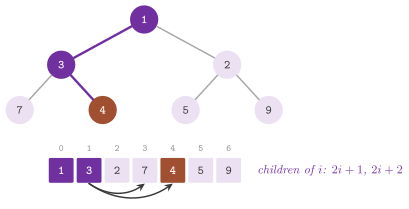
All the operations reduce to the two procedures of Algorithm 7.1, which move an item along a path of the tree until the heap order holds again.
Algorithm 7.1 (Sifting in a \(d\)-ary heap).
bubbleUp(hole, (i, p)):           (the item i with priority p goes up)
  while hole > 0 and p < prio(parent(hole)):
    move the item of parent(hole) to hole;  hole := parent(hole)
  put (i, p) at hole
bubbleDown(hole, (i, p), n):      (the item i with priority p goes down)
  while hole has children among the positions 0 .. n-1:
    c := the child of least priority
    if not prio(c) < p: break
    move the item of c to hole;  hole := c
  put (i, p) at hole
push(i, p):    append a position n; bubbleUp(n, (i, p))
pop():         mark top POST_HEAP; bubbleDown(0, last item, n - 1)
decrease(i,p): bubbleUp(position of i, (i, p))
increase(i,p): bubbleDown(position of i, (i, p), n)
set(i, p):     push if i is not in the heap, else decrease if p < prio(i),
               else increase
erase(i):      mark i POST_HEAP; put the last item in the hole of i by
               bubbleUp and, if it did not move, by bubbleDown
move and each put writes the new position into the cross-reference
map. BinHeap implements erase() as written; QuadHeap and DHeap compare
the last item with the parent of the hole first, and call bubbleDown() if
the parent is smaller and bubbleUp() otherwise, which has the same effect.
Lemma 7.1. A \(d\)-ary heap of \(n\ge1\) items has \(L=\lceil\log_d(n(d-1)+1)\rceil\) levels, i.e., a path from the root to a leaf has at most \(L\) positions.
Proof. The levels \(0,\dots,L-2\) are full, and level \(L-1\) holds at least one item; since level \(h\) holds \(d^h\) positions, \(\sum_{h<L-1}d^h<n\le\sum_{h<L} d^h\), i.e., \(d^{L-1}<n(d-1)+1\le d^L\), which is the statement. \(\square\)
Theorem 7.1. Each operation of Algorithm 7.1
keeps the heap order and keeps in the cross-reference map the position of each
item in the heap; hence, top() returns an item of least priority. push()
and decrease() cost \(O(\log_d n)\) comparisons, pop(), increase() and
erase() cost \(O(d\log_d n)\), and top(), prio(), operator[], state()
and replace() cost \(O(1)\).
Proof. Call a tree with a hole at position \(h\) ordered if the heap order
holds between all the pairs of positions other than \(h\) and, moreover, between
the parent of \(h\) and the children of \(h\). bubbleUp() is called on an
ordered hole whose children are not smaller than \(p\) (for push(), the hole
has no child; for decrease(), the children were not smaller than the old
priority, which is not smaller than \(p\)); each step moves the parent into the
hole, which keeps the tree ordered with the hole one level up and keeps the
children of the new hole not smaller than \(p\); it stops when \(p\) is not
smaller than the parent, and then putting \(p\) restores the heap order.
Symmetrically, bubbleDown() is called on an ordered hole whose parent is not
larger than \(p\), moves the least child up while it is smaller than \(p\), and
stops when no child is smaller. For erase(), the last item is put into the
hole of \(i\): bubbleUp() succeeds when it is smaller than the parent of the
hole, and otherwise the parent is not larger than it and bubbleDown()
applies. Every move writes the new position into the map. By the heap order,
the root has least priority. As for the costs, bubbleUp() makes one
comparison per level, and bubbleDown() makes \(d\) per level (at most \(d-1\) to
find the least child and one with \(p\)); by Lemma 7.1 there are \(O(\log_d n)\)
levels. top() and prio() read position \(0\), operator[] and state()
read the map and the vector, and replace() writes two values of the map and
one item of the vector. \(\square\)
The degree \(d\) thus trades the cost of push() and decrease() for that of
pop(). In an algorithm with many decreases per removal, as Dijkstra on a
dense digraph, the choice of \(d\) balances the two, as follows.
Theorem 7.2. (Johnson.) Dijkstra on a digraph
of \(n\) nodes and \(m\) arcs with a \(d\)-ary heap makes
\(O(nd\log_d n + m\log_d n)\) comparisons in the heap; with
\(d=\max(2,\lceil m/n\rceil)\), this is \(O(m\log_{2+m/n}n)\).
Proof. Dijkstra pushes and pops each node at most once and decreases a
priority at most once per arc, which by Theorem 7.1 gives the first bound.
With \(d=\max(2,\lceil m/n\rceil)\) one has \(nd=O(n+m)\) and
\(\log_d n=O(\log n/\log(2+m/n))\), and \(n\le m\) may be assumed for the nodes
that are reached from the source. \(\square\)
Of course, a larger degree also means fewer levels and fewer cache misses, which in practice often (but not always) favours \(d=4\) over \(d=2\), even when the counts of comparisons do not.
The library has three classes of this family, all with the template parameters
PR, IM and CMP (by default std::less< PR >) and with both constructors
of the concept.
BinHeap< PR , IM , CMP >, inlemon/bin_heap.h, is the binary heap. It is the default heap ofDijkstra,BidirDijkstra,AStar,SuurballeandMinCostArborescence, and the heap (withstd::greater) ofNagamochiIbarakiand ofMaxCardinalitySearchon general capacities; the matching algorithms also use it.QuadHeap< PR , IM , CMP >, inlemon/quad_heap.h, is the 4-ary heap (the header calls it "fourary"), whose four children are compared by unrolled code.DHeap< PR , IM , D , CMP >, inlemon/dheap.h, is the \(d\)-ary heap, with the degree as the template parameterD, by default \(16\). The header suggests a power of two, which lets the compiler turn the divisions and multiplications of the positions into shifts.
abLEMON
CapacityScaling (cf. chapter 13) keeps the
nodes of its shortest path searches in a QuadHeap, where LEMON 1.3.1
used a BinHeap.
7.3 Linked heaps¶
The heaps of this section store the items in heap-ordered trees, linked by
indices. Two trees are joined in \(O(1)\) by making the root of larger priority
a child of the other (a link). Each of the three classes keeps one record per
item in a vector, indexed by the cross-reference map. The record stays after
the item leaves the heap (a flag records whether it is in), and it is reused
when the item comes back; hence, the memory is proportional to the number \(N\)
of distinct items pushed since the last clear(), and \(n\le N\). The three
classes have the template parameters PR, IM and CMP and both
constructors of the concept, and in all three increase() is erase()
followed by push().
Fibonacci heaps. FibHeap< PR , IM , CMP >, in lemon/fib_heap.h, is the
heap of Fredman and Tarjan 1987.
The roots of its trees form a circular list, with a pointer to a root of least
priority, and the children of a node form a circular list as well; a node may
be marked. push() adds a root, and decrease() cuts the item from its
parent when the heap order breaks; the parent, if it was marked, is cut in
turn (the cascading cut), and so on upwards, while an unmarked parent that is
not a root is marked. pop() removes the minimum, moves its children to the
list of the roots, and then consolidates the roots, linking two roots of equal
degree until all the degrees differ. Furthermore, erase( i ) cuts the item
(with the cascading cut), makes it the minimum (in the words of a comment of
the code, "as if its prio would be -infinity"), and pops it.
Algorithm 7.2 (Decrease and pop in a Fibonacci heap).
decrease(i, p):
  prio(i) := p;  q := parent(i)
  if q exists and p < prio(q):
    cut(i, q)                       (i becomes a root, unmarked)
    while q is not a root:          (cascading cut, cascade())
      if q is unmarked: mark q; stop
      r := parent(q);  cut(q, r);  q := r
  if p < prio(min): min := i
pop():
  remove min from the roots and add its children to them
  A[0 .. maxdeg - 1] := none,  maxdeg = floor(2.08 ln N) + 1   (balance())
  for each root r:                   (consolidation)
    while A[degree(r)] is a root s:
      link the one of larger priority under the other, unmarked,
        call the result r            (on a tie, s stays the root)
      A[degree(r) - 1] := none
    A[degree(r)] := r
  min := the root of least priority
erase(i):
  if i has a parent q: cut(i, q) and the cascading cut from q
  min := i;  pop()
Lemma 7.2. Let \(\phi=(1+\sqrt5)/2\). In a
Fibonacci heap, a node of degree \(k\) has at least \(F_{k+2}\ge\phi^k\) nodes in
its subtree, where \(F_j\) is the \(j\)-th Fibonacci number; hence, every degree
is at most \(\log_\phi n\), and the array of balance(), of size
\(\lfloor 2.08\ln N\rfloor+1\), is large enough.
Proof. Let \(y_1,\dots,y_k\) be the children of a node \(x\) in the order in which they were linked to it. When \(y_h\) was linked, \(x\) had at least the children \(y_1,\dots,y_{h-1}\), and links join roots of equal degree; hence, \(y_h\) had degree at least \(h-1\), and since then it has lost at most one child, because a node that is not a root is marked at its first loss and cut at its second (marks are cleared by links and cuts). Thus \(y_h\) has degree at least \(h-2\). Let \(s_k\) be the least size of a subtree whose root has degree \(k\); then \(s_0=1\), \(s_1=2\), and \(s_k\ge 2+\sum_{h=2}^k s_{h-2}\), which by induction gives \(s_k\ge F_{k+2}\), since \(F_{k+2}=1+\sum_{j=0}^k F_j\); the bound \(F_{k+2}\ge\phi^k\) is the classical one. Hence \(k\le\log_\phi n=\ln n/\ln\phi\) with \(1/\ln\phi\approx2.078\), and the degrees met during the consolidation, at most \(\log_\phi n\le 2.078\ln N\), are indices of the array. \(\square\)
Theorem 7.3. In a FibHeap, top(), prio(),
operator[] and state() cost \(O(1)\), push() and decrease() cost \(O(1)\)
amortized time, and pop(), erase() and increase() cost \(O(\log N)\)
amortized time; every operation keeps the heap order, and pop() and
erase() remove exactly the item they should, whatever the type of the
priorities and the comparison.
Proof. (Sketch.) With the potential \(\Phi=t+2\mu\), where \(t\) is the number
of roots and \(\mu\) that of the marked nodes, push() raises \(\Phi\) by one; a
decrease() that makes \(c\) cuts costs \(O(c)\), adds \(c\) roots and unmarks at
least \(c-1\) nodes, so that its amortized cost is \(O(1)\); a pop() costs
\(O(D+t)\), where \(D=O(\log N)\) bounds the degrees and the array (Lemma 7.2),
and leaves at most \(D+1\) roots, so that its amortized cost is \(O(D)\). An
erase() is a decrease() followed by a pop(), and increase() adds a
push(). The details are in Fredman and Tarjan 1987,
§2 and in Cormen et al. 2001,
§20.2 to §20.4. As for the
correctness, a cut makes a subtree a root and links put the larger root under
the smaller, so that every tree stays heap-ordered; pop() ends by scanning
all the roots for the least priority. erase() never compares the priority of
the item: it makes the item a root, and the pop() that follows removes that
root and finds the new minimum by the scan. \(\square\)
Accordingly, the header warns that a heap with many increases and erasures is better a binary one.
Pairing heaps. PairingHeap< PR , IM , CMP >, in lemon/pairing_heap.h, is
the self-adjusting heap of Fredman, Sedgewick, Sleator and Tarjan
1986, i.e., a single heap-ordered
tree in which each node keeps its children in a list (stored in the records as
a binary tree of first children and right siblings). push() links the new
item with the root, and decrease() cuts the subtree of the item, when the
heap order with its parent breaks, and links it with the root. pop() removes
the root and joins its subtrees in two passes: it first links them in pairs
from left to right, and then it links the results from right to left into one
tree (the two-pass pairing). erase( i ) cuts the subtree of the item and
makes the item the root over the rest, whatever the priorities, and then pops
it.
Algorithm 7.3 (Pairing heap).
link(a, b):   make b the first child of a                  (fuse(a, b))
push(i, p):   if the heap is empty: root := i
              else if p < prio(root): link(i, root); root := i
              else link(root, i)
decrease(i, p):
  prio(i) := p
  if i is not the root and p < prio(parent(i)):
    cut the subtree of i                                    (cut())
    if prio(root) < p: link(root, i) else link(i, root); root := i
pop():
  T[0 .. k-1] := the subtrees of the children of the root, left to right
  for h = 0, 2, 4, ... while h + 1 < k:          (first pass)
    link the larger of T[h], T[h+1] under the other, into T[h]
  h := the last even index;  for h, h - 2, ..., 2:   (second pass)
    link the larger of T[h], T[h-2] under the other, into T[h-2]
  root := T[0], or none if k = 0
erase(i):
  if i is not the root: cut the subtree of i; link(i, root); root := i
  pop()
Theorem 7.4. Every operation of a PairingHeap
keeps a single heap-ordered tree whose root is an item of least priority, and
erase( i ) removes exactly \(i\), whatever the type of the priorities and the
comparison. push(), decrease(), top() and prio() cost \(O(1)\) actual
time, and pop() costs \(O(1+k)\), with \(k\) the number of children of the root.
In amortized terms, every operation costs \(O(\log n)\) (Fredman et
al. 1986), and push() and
decrease() cost \(O(2^{2\sqrt{\log\log n}})\) while pop() costs \(O(\log n)\)
(Pettie 2005).
Proof. A link of two heap-ordered trees, with the root of larger priority
under the other, is heap-ordered; a cut subtree is heap-ordered, and so is the
rest. Hence, push(), decrease() and pop() keep the order, and the root
of an ordered tree has least priority. In erase( i ), the tree made by
linking the rest under \(i\) may violate the order only at its root \(i\); pop()
removes that root and joins its subtrees, which are heap-ordered, by links
that compare only their roots, so that the priority of \(i\) is never compared
and the result is an ordered tree of the other items. The actual costs follow
from the algorithm: one link, one cut, or one pass over the \(k\) subtrees. The
amortized bounds are the analyses cited, which are proved there for the
two-pass pairing heap that cuts at each decrease (the class cuts only when the
heap order breaks), and whose proofs take several pages. \(\square\)
The amortized cost of decrease() is thus \(o(\log n)\), and it cannot be
\(O(1)\) for this kind of structure (Fredman
1999). Yet, the pairing heap is
often reported to be as fast as a binary heap (or faster) on the decreases of
the shortest path algorithms.
Binomial heaps. BinomialHeap< PR , IM , CMP >, in lemon/binomial_heap.h,
is the heap of Vuillemin 1978. A
binomial tree of degree \(0\) is a single node, and one of degree \(k\) is the
link of two binomial trees of degree \(k-1\); the heap is a list of heap-ordered
binomial trees of distinct degrees, in increasing order of degree, like the
binary digits of \(n\). Its item of least priority is kept, so that top() and
prio() cost \(O(1)\).
Algorithm 7.4 (Binomial heap).
merge(list L):                                              (merge())
  interleave L with the roots, in increasing order of degree
  scan the roots: when two consecutive roots x, y have the same degree
    and the root after y has a different one, link the larger under
    the smaller (as in a binary addition)
push(i, p):    merge the tree of the single node i;  min := findMin()
pop():         remove min from the roots;
               merge the list of its children, reversed;  min := findMin()
decrease(i, p):
  prio(i) := p
  while i has a parent q and p < prio(q):
    exchange the items (and priorities) of the records of i and q,
    updating the cross-reference map;  i := q
  if p < prio(min): min := i
erase(i):
  move each item of the path from the root of the tree of i to i one
  record down, and put i in the root, updating the map;  min := that root
  pop()
findMin() scans the roots for one of least priority, comparing the
priorities by CMP.
Lemma 7.3. A binomial tree of degree \(k\) has \(2^k\) nodes and height \(k\), and its root has degree \(k\); hence, a binomial heap of \(n\) items has at most \(\lfloor\log_2 n\rfloor+1\) trees, and every path from a root to a leaf has at most \(\lfloor\log_2 n\rfloor+1\) nodes.
Proof. By induction on \(k\), from the definition: the link of two trees of \(2^{k-1}\) nodes, height \(k-1\) and root degree \(k-1\) has \(2^k\) nodes, height \(k\) and root degree \(k\). The trees of a heap have distinct degrees, so that \(n=\sum_k b_k2^k\) with \(b_k\in\{0,1\}\) is the binary representation of \(n\), which has at most \(\lfloor\log_2 n\rfloor+1\) digits, and no tree has degree above \(\log_2 n\). \(\square\)
Theorem 7.5. Every operation of a
BinomialHeap keeps a list of heap-ordered binomial trees of distinct degrees
and keeps min on a root of least priority. push(), pop(), decrease(),
erase() and increase() cost \(O(\log n)\), and top(), prio(),
operator[] and state() cost \(O(1)\). erase( i ) removes exactly \(i\),
whatever the type of the priorities and the comparison.
Proof. A merge of two lists of binomial trees of distinct degrees links only
trees of equal degree, which gives a binomial tree of the next degree, and it
ends with distinct degrees, as the carry of a binary addition; each link puts
the larger root under the smaller, so the trees stay heap-ordered. pop()
merges the children of the minimum, which are binomial trees of degrees
\(0,\dots,k-1\). decrease() moves the decreased item up by exchanges with its
parent while it is smaller, which restores the heap order as in bubbleUp()
(Theorem 7.1). In erase(), the items on the path from the root \(r\) to \(i\)
move one record down; each of them is then above records that held its own
descendants, whose priorities are not smaller, so that the order can fail only
at \(r\), which holds \(i\); pop() removes \(r\) without comparing its priority,
and findMin() recomputes the minimum. The costs follow from Lemma 7.3: a
merge and findMin() scan \(O(\log n)\) roots, and decrease() and erase()
climb \(O(\log n)\) records. \(\square\)
abLEMON
BinomialHeap compares the priorities of the roots as priorities, where
LEMON 1.3.1 compared them as int and truncated the fractional ones,
taking for the minimum a root that was not; and push() looks for the
minimum among the roots after the merge, since the merge may make the
former minimum the child of a root of equal priority, after which pop()
of LEMON 1.3.1 looped for ever (trac #646). The test test/heap_test.cc
gives every comparison heap floating-point priorities with many ties, and
the case of the ticket.
abLEMON
PairingHeap and BinomialHeap erase an item by making it the root (as
in Algorithms 7.3 and 7.4) and popping it. LEMON 1.3.1 decreased its
priority to prio() - 1 and popped it, which needs a numeric priority
type and removes the minimum in place of the item whenever prio() - 1
does not compare smaller than prio() under CMP, i.e., with
std::greater, or with priorities so large that \(x - 1 = x\) (e.g., above
\(2^{53}\) in double); the test heap_test checks both cases for all the
heaps.
7.4 Heaps of integer priorities¶
When the priorities are integers and the sequence of the minima removed does
not decrease (as in Dijkstra with non-negative integer lengths), an array
indexed by the priority may do better than a comparison heap. The library has,
indeed, three such heaps. Their priority type is int, they have no
comparison functor, and their only constructor takes the map (plus the initial
minimum and capacity, for RadixHeap).
Radix heaps. RadixHeap< IM >, in lemon/radix_heap.h, is the one-level
radix heap of Ahuja, Mehlhorn, Orlin and Tarjan
1990. The items are kept in boxes
\(0,\dots,K-1\), each a doubly linked list, and box \(k\) covers the priorities in
\([b_k,b_{k+1})\), where \(b_0\le b_1\le\dots\le b_K\) (Figure 7.2). Box \(k\) has a
nominal width \(w_k\), i.e., \(1,1,2,4,8,\dots\), and its range is never wider
than \(w_k\). Each box is a private record RadixBox (the start \(b_k\) of its
range, its width and the head of its list), and each item a record with its
links, its box and its priority.

Algorithm 7.5 (Radix heap).
push(i, p):
  while p >= b_K: add a box K of width 2 w_{K-1} after the last  (extend())
  find the box of p, searching downwards from box K-1;
  if p < b_0, throw PriorityUnderflowError                  (findDown())
  put i in that box
decrease(i, p):  find the box of p, searching downwards from the box of
                 i, or throw as in push(); prio(i) := p; move i to it
increase(i, p):  prio(i) := p; if p >= b_(box of i + 1): move i to the
                 box of p, searching upwards and extending   (findUp())
moveDown():                          (called by top(), prio() and pop())
  b := the first non-empty box                              (findFirst())
  if b > 0:
    m' := the least priority in box b;  e := b_(b+1)
    for k = 0 .. b: b_k := min(m' + w_0 + ... + w_(k-1), e)
    move each item of box b down to the box of its priority
pop():           moveDown(); remove the first item of box 0
erase(i):        remove i from its box
Lemma 7.4. The operations of a RadixHeap keep
\(b_0\le b_1\le\dots\le b_K\), keep each range \([b_k,b_{k+1})\) no wider than
\(w_k\), and keep each item in the box whose range contains its priority. After
moveDown(), box \(0\) is not empty and all its items have the least priority
of the heap; every item of the box \(b\) redistributed moves to a box of smaller
index.
Proof. The constructor creates the boxes \([m,m+1)\), \([m+1,m+2)\) and then
boxes of doubling width, each starting where the previous one ends, and
extend() does the same; push(), decrease() and increase() place an
item by searching for the box whose range contains its priority. In
moveDown(), the least priority \(m'\) of the first non-empty box \(b\) lies in
\([b_b,e)\), whose width is at most \(w_b=2^{b-1}=w_0+\dots+w_{b-1}\) for \(b\ge1\).
Hence, the new starts \(b_k=\min(m'+w_0+\dots+w_{k-1},e)\) for \(k\le b\) are
non-decreasing, they begin at \(b_0=m'\), the range of each box \(k<b\) is no
wider than \(w_k\), the boxes \(0,\dots,b-1\) cover \([m',e)\), and box \(b\) gets the
empty range \([e,e)\); the boxes above \(b\) are unchanged. Every item of box \(b\)
has its priority in \([m',e)\), so that it moves to a box of index below \(b\),
and the item of priority \(m'\) moves to box \(0\), whose range is \([m',m'+1)\).
Since the boxes below \(b\) were empty and those above hold larger priorities,
\(m'\) is the least priority of the heap. \(\square\)
Hence, the priorities must not go below \(b_0\). This is minimum at first and,
once top(), prio() or pop() has found box \(0\) empty, the least priority
in the heap at that moment. A push(), set() or decrease() below it
throws the exception RadixHeap< IM >::PriorityUnderflowError, even if no
item has been removed yet, and the search that throws comes before any change,
so that the heap, the item and the cross-reference map stay as they were. The
constructor RadixHeap( IM & map , int minimum = 0 , int capacity = 0 )
creates the boxes for the priorities from minimum to
minimum + capacity - 1, the heap adds boxes when a larger priority arrives,
and clear( minimum , capacity ) empties it and creates the boxes again.
Theorem 7.6. Let \(K\) be the number of boxes,
i.e., \(O(\log U)\) with \(U\) the largest priority pushed minus the initial
minimum (or the capacity, if larger). In a RadixHeap, push() and
increase() cost \(O(K)\), erase() costs \(O(1)\), and, in amortized terms,
decrease() costs \(O(1)\) and top(), prio() and pop() cost \(O(K)\).
Proof. Let \(\Phi\) be the sum, over the items in the heap, of the index of
their box. A search downwards (or upwards) over \(j\) boxes costs \(O(1+j)\) and
lowers (raises) \(\Phi\) by \(j\). push() costs \(O(K)\) for the extensions and
the search, and raises \(\Phi\) by at most \(K\); increase() likewise.
decrease() costs \(O(1+j)\) and lowers \(\Phi\) by \(j\), i.e., \(O(1)\) amortized.
moveDown() costs \(O(b)\) to find box \(b\), plus \(O(s)\) to scan its \(s\) items
for \(m'\) and to move them, and each of these moves lowers \(\Phi\) by at least
one (Lemma 7.4); hence, its amortized cost is \(O(K)\). erase() and the
removal of pop() unlink one item and move one record. \(\square\)
In Dijkstra with integer lengths in \([0,C]\), the priorities in the heap lie
in \([d,d+C]\), where \(d\) is the last distance removed, so that the priorities
never go below \(b_0\); for this case, Ahuja et
al. 1990 (cf. Ahuja, Magnanti and
Orlin 1993, §4.8) give the bound
\(O(m+n\log(nC))\) on the running time, \(m\) and \(n\) being the numbers of arcs
and nodes, which follows from Theorem 7.6 with \(U\le nC\).
abLEMON
The boxes of a RadixHeap stay contiguous: in LEMON 1.3.1, moveDown()
gave the boxes before the first non-empty one ranges that could reach past
the start of the next box, which still held its items, so that after an
increase() an item could sit in a box before one with a smaller priority
and be popped first (trac #681); test/heap_test.cc has the case of the
ticket and a long monotone sequence of operations checked against a sorted
set. In LEMON 1.3.1, moreover, a push(), decrease() or set() that
threw had already stored the item, or unlinked it from its box, and left
the heap corrupted; radixHeapTest() checks the three cases.
Bucket heaps. BucketHeap< IM , MIN >, in lemon/bucket_heap.h, keeps a
doubly linked list of the items of each priority, with the heads in a vector
indexed by the priority (the buckets of Dial
1969), together with a pointer \(\mu\)
to a bucket at or below that of the minimum. The priorities must be
non-negative, since they index the vector, which grows up to the largest
priority plus one. The items are private records BucketItem (the item, its
priority and its two links), kept contiguous in a vector: an erased record is
replaced by the last one, whose position is then updated in the
cross-reference map.
Algorithm 7.6 (Bucket heap, MIN = true).
push(i, p):      link i at the head of bucket p (growing the vector);
                 if p < mu: mu := p
decrease(i, p):  unlink i; if p < mu: mu := p; link i in bucket p
increase(i, p):  unlink i; link i in bucket p
top(), prio(), pop():
                 while bucket mu is empty: mu := mu + 1
                 return (or unlink) the head of bucket mu
erase(i):        unlink i
Theorem 7.7. A BucketHeap keeps every
non-empty bucket at or above \(\mu\), so that top() returns an item of least
priority. push(), erase(), decrease() and increase() cost \(O(1)\) apart
from the growth of the vector, and top(), prio() and pop() cost
\(O(1+j)\), where \(j\) is the number of buckets that \(\mu\) passes. On a sequence
of operations with \(r\) removals in which no priority pushed or decreased is
below the last minimum removed, the advances of \(\mu\) add up to at most \(C\),
the largest priority, and all the removals cost \(O(r+C)\).
Proof. The invariant holds when the heap is built (\(\mu=0\)); push() and
decrease() lower \(\mu\) to the new priority when it is below, increase()
and erase() empty no bucket below \(\mu\), and the loop of top() advances
\(\mu\) over empty buckets only. The costs of the list operations are \(O(1)\).
After a removal \(\mu\) equals the priority removed, and under the hypothesis no
later operation lowers it; hence, \(\mu\) never decreases and never exceeds \(C\).
\(\square\)
With MIN = false the heap gives the item of largest priority, and the
pointer moves downwards (Theorem 7.7 holds with the order reversed); e.g.,
MaxCardinalitySearch uses BucketHeap< IM , false > when its capacity map
is the constant map ConstMap< Arc , Const< int , 1 > >. The header states
that the class "is not intended to use as a Dijkstra heap". It works there
(the test runs Dijkstra with it), but its time and memory grow with the
largest distance, rather than with the number of nodes.
SimpleBucketHeap< IM , MIN > is a reduced bucket heap, with singly linked
lists and a free list of records. It supports only push(), top(),
prio(), pop(), size(), empty(), clear() and state( i ), with the
costs of Theorem 7.7; it has no erase(), decrease(), increase(), set()
or state( i , st ), and it does not conform to the concept. Its
operator[]( i ) scans all the buckets, i.e., it costs \(O(n+C)\), and it
returns \(-1\) for an item that is not in the heap.
7.5 Choosing a heap¶
Table 7.1 summarizes the costs proved in sections 7.2 to 7.4; \(n\) is the
number of items in the heap, \(N\ge n\) the number of records of a linked heap,
\(d\) the degree of a DHeap, \(K\) the number of boxes of a RadixHeap (Theorem
7.6), and \(C\) the largest priority of a bucket heap.
Table 7.1. The costs of the heaps (am. = amortized; "−" = not available).
| Heap | push |
top |
pop |
decrease |
increase, erase |
|---|---|---|---|---|---|
BinHeap |
\(O(\log n)\) | \(O(1)\) | \(O(\log n)\) | \(O(\log n)\) | \(O(\log n)\) |
QuadHeap |
\(O(\log_4 n)\) | \(O(1)\) | \(O(4\log_4 n)\) | \(O(\log_4 n)\) | \(O(4\log_4 n)\) |
DHeap |
\(O(\log_d n)\) | \(O(1)\) | \(O(d\log_d n)\) | \(O(\log_d n)\) | \(O(d\log_d n)\) |
FibHeap |
\(O(1)\) | \(O(1)\) | \(O(\log N)\) am. | \(O(1)\) am. | \(O(\log N)\) am. |
PairingHeap |
\(O(1)\) | \(O(1)\) | \(O(\log n)\) am. | \(o(\log n)\) am. | \(O(\log n)\) am. |
BinomialHeap |
\(O(\log n)\) | \(O(1)\) | \(O(\log n)\) | \(O(\log n)\) | \(O(\log n)\) |
RadixHeap |
\(O(K)\) | \(O(K)\) am. | \(O(K)\) am. | \(O(1)\) am. | \(O(K)\), \(O(1)\) |
BucketHeap |
\(O(1)\) | \(O(C)\) | \(O(C)\) | \(O(1)\) | \(O(1)\) |
SimpleBucketHeap |
\(O(1)\) | \(O(C)\) | \(O(C)\) | − | − |
The costs of push() and decrease() of the pairing heap are its actual
costs, and the amortized ones are those of Theorem 7.4. For the bucket heaps,
the costs of top() and pop() are worst case; on a monotone sequence of
operations, they add up to \(O(r+C)\) in all (Theorem 7.7).
These bounds suggest a choice, which measurements on the instances of interest should confirm. A binary or 4-ary heap is the safe default, since it is simple, it has small constants and good locality, and it supports each operation in logarithmic time with any priority type and comparison. A Fibonacci or pairing heap may pay off when the decreases far outnumber the removals and the heap is large; the counts of comparisons then favour it, but the constants often do not. A radix heap or a bucket heap fits integer priorities with a monotone sequence of minima and a "small" span of priorities.
The algorithms of the library take the type of their heap from their traits
class, and they accept another one through a named template parameter
(cf. chapter 3 and chapter
10). SetStandardHeap< H , CR > gives the heap
type H and the cross-reference type CR (by default
Digraph::NodeMap< int >), and the algorithm then creates both objects, as
CR( digraph ) and H( cr ). SetHeap< H , CR > gives only the types, and
the objects are passed by the function heap( h , cr ) before run() or
init(). For instance, the following declaration runs Dijkstra on a radix
heap.
Dijkstra< ListDigraph, ListDigraph::ArcMap< int > >
  ::SetStandardHeap< RadixHeap< ListDigraph::NodeMap< int > > >
  ::Create dijkstra( g, length );
manual/examples/07-dijkstra-heaps.cc (the test
manual_07_dijkstra_heaps) solves one shortest path problem on a grid digraph
with each heap of the library in this way, and checks the distances against
those of the default binary heap.
abLEMON
BidirDijkstra and AStar (which LEMON 1.3.1 did not have) and
MinCostArborescence take the type of their heap from their traits, and
they accept another one through the named parameter SetHeap.
The program manual/examples/07-heap-sort.cc (the test manual_07_heap_sort)
uses the heaps directly: each of them sorts one sequence of priorities after a
decrease, an increase and a set(), with the states checked after each
removal; then a BinHeap with std::greater and a BucketHeap with
MIN = false give the largest priority first, a SimpleBucketHeap sorts by
push and pop only, and a RadixHeap throws on a priority below the last one
removed.
7.6 Exercises¶
Exercise 7.1. From Lemma 7.1, count the
comparisons of pop() in a DHeap of \(n\) items as a function of \(d\), and
find the degree that minimizes the bound of Theorem 7.2 when
\(m=n^{1+\epsilon}\) for a fixed \(\epsilon>0\).
Exercise 7.2. Extend
manual/examples/07-heap-sort.cc with DHeap of degrees 2, 8 and 32, and
with std::greater as the comparison for each comparison heap; then call
erase() on an item that is not the top and check that the others still come
out in order (Theorems 7.3 to 7.5). The function heapEraseTest() of
test/heap_test.h does it for the comparison heaps.
Exercise 7.3. On grid digraphs of growing size,
time manual/examples/07-dijkstra-heaps.cc with each heap and with lengths in
\([1,9]\) and in \([1,10^6]\), and explain the ranking of BucketHeap and
RadixHeap in the two cases by Theorems 7.6 and 7.7. The test
test/heap_test.cc checks the distances of each heap (function
dijkstraHeapTest()).
Exercise 7.4. Show by an example that a
RadixHeap throws PriorityUnderflowError on a push() below the current
minimum after a call of top() with no removal (Lemma 7.4), and explain why
Dijkstra never does it.
Exercise 7.5. Write the cross-reference map of a
heap whose items are the integers \(0,\dots,k-1\) as a RangeMap< int >, and
reuse one heap for several sorts, resetting the map between them with
state( i , PRE_HEAP ) instead of a new map. The function heapSortTest() of
test/heap_test.cc sorts with a RangeMap.