A. Writing a graph, a map or a heap
We are concerned in this appendix with the classes that a user may add to the
library. These are typically a graph structure that computes its items from
some private data (an implicit graph, or a view of another data structure), a
map that computes its values on demand, an observer that follows the changes
of a graph, and a heap. Such a class is accepted by the algorithms as soon as
it conforms to the concept of its kind; also, most of the work is done by the
classes of lemon/bits/, which turn a small base class into a complete graph.
Section A.1 states the concepts as contracts, and section A.2 describes the
base class of a graph and the extenders that complete it. Section A.3 deals
with the alteration notifier through which a graph informs its maps, sections
A.4 and A.5 with the maps and the heaps, and section A.6 with the checking of
a new class. The program manual/examples/A-cycle-digraph.cc (the test
manual_A_cycle_digraph) writes a digraph, a map and an observer in the way
described here, and runs Dijkstra on the first two.
A.1 The concepts as contracts
A concept class of lemon/concepts/ (cf. chapter
3) lists what a generic algorithm may use, and hence
what a new class must provide. For a digraph this is concepts::Digraph,
i.e., the base, idable, iterable and mappable components of chapter
4, while an undirected graph conforms to concepts::Graph
and a bipartite one to concepts::BpGraph. A structure that can grow, shrink
or be cleared also conforms to the extendable, erasable and clearable
components. Each of them requires the alterable one, since a structure that
changes must notify its maps. However, the concepts state only the syntax;
some semantic requirements are written only in their documentation, and the
algorithms rely on them as well.
- The identifiers of the items of one kind are distinct and immutable, and
they lie between 0 and
maxNodeId()(or the other maxima). The maximum should not be much larger than the number of items, since the standard maps allocate one slot for each identifier up to it. - Each iterator visits each item exactly once and then becomes
INVALID. In an undirected graphArcItvisits each of the two arcs of an edge once, andInArcItandOutArcItvisit the arcs of the incident edges. - The ends
u( e )andv( e )do not change while the edge exists, anddirect( e , true )goes fromu( e )tov( e ).
For a map the contracts are concepts::ReadMap< K , V >,
concepts::WriteMap< K , V >, concepts::ReadWriteMap< K , V > and
concepts::ReferenceMap< K , V , R , CR > of lemon/concepts/maps.h
(chapter 6), and for a heap
concepts::Heap< PR , IM , CMP > of lemon/concepts/heap.h (section A.5).
Each concept class has a nested template Constraints, whose function
constraints() is the executable form of the contract that checkConcept
instantiates (section A.6).
A.2 The base class and the extenders
Most of the interface of a graph does not depend on how the graph is stored,
or depends on it only somewhat. Indeed, the iterators can be written once from
functions such as first( Node & ) and next( Node & ), the standard maps
need only the identifiers and a notifier, and the ranges, oppositeNode(),
baseNode() and runningNode() follow from the iterators. Hence, the header
lemon/bits/graph_extender.h defines three class templates,
DigraphExtender< Base >, GraphExtender< Base > and
BpGraphExtender< Base >, which derive from a base class written by the user
and add this common part. All the structures of chapter 4
are made in this way (e.g., ListDigraph derives from
DigraphExtender< ListDigraphBase >). So are the arc and edge sets, by
ArcSetExtender and EdgeSetExtender of lemon/bits/edge_set_extender.h,
and the adaptors of chapter 5, by
DigraphAdaptorExtender and GraphAdaptorExtender of
lemon/bits/graph_adaptor_extender.h.
The base of a digraph. A base class for DigraphExtender defines the
following members, which are those of BaseDigraphComponent,
IDableDigraphComponent and the low-level part of IterableDigraphComponent.
- The handle types
NodeandArc, with default andInvalidconstructors,==,!=and<. - The functions
source( a )andtarget( a ). - The functions
first( Node & ),next( Node & ),first( Arc & )andnext( Arc & ), which enumerate the items and set the handle to the invalid value after the last one. Also,firstOut( Arc & , Node ),nextOut( Arc & ),firstIn( Arc & , Node )andnextIn( Arc & )enumerate the arcs at a node. - The functions
id( Node ),id( Arc ),nodeFromId( int ),arcFromId( int ),maxNodeId()andmaxArcId().
If the structure can change, the base also has addNode(), addArc( s , t ),
erase( Node ), erase( Arc ) and clear(), which modify the storage only,
since the extender adds the notifications. A static structure has instead
build( g , nodeRef , arcRef ) and the tag BuildTag. Optionally, the tags
NodeNumTag and ArcNumTag, with nodeNum() and arcNum(), make the
counting of chapter 4 take \(O(1)\) time, and FindArcTag,
with findArc( s , t , prev ), replaces the scan of findArc().
The extender. On top of the functions above, DigraphExtender< Base >
defines NodeIt, ArcIt, OutArcIt and InArcIt (Algorithm A.1), with the
ranges nodes(), arcs(), outArcs( v ) and inArcs( v ). It also defines
baseNode(), runningNode(), oppositeNode(), maxId() and fromId(), and
one AlterationNotifier for the nodes and one for the arcs, returned by
notifier( Node() ) and notifier( Arc() ). Its map templates NodeMap< V >
and ArcMap< V > are DefaultMaps with the iterators of MapExtender
(cf. chapter 6). Finally, its functions addNode(),
addArc(), erase(), clear() and build() call those of the base and
notify the observers in the order of section A.3; in particular,
erase( Node ) erases the arcs at the node first, one by one, and the base
need not do it, while its destructor notifies the observers of a clear(). A
base whose items are added through the extender also provides the protected
functions undoAdd( Node ) and undoAdd( Arc ), which remove the item just
added by its addNode() or addArc() (section A.3).
For an undirected graph, GraphExtender< Base > requires from the base the
type Edge as well, with u( e ), v( e ), direction( a ),
direct( e , bool ), first( Edge & ), next( Edge & ),
firstInc( Edge & , bool & , Node ), nextInc( Edge & , bool & ),
id( Edge ), edgeFromId() and maxEdgeId(). In return it defines the tag
UndirectedTag, EdgeIt, IncEdgeIt, edges(), incEdges( v ),
oppositeArc(), direct( e , node ), a third notifier for the edges and
EdgeMap< V >, and its addEdge() notifies the new edge and then its two
arcs (an extendable base provides undoAdd( Edge ) in place of
undoAdd( Arc )). In the same way, BpGraphExtender< Base > adds the red and
the blue nodes, with their iterators, notifiers and maps.
Algorithm A.1 (The arc iterators that DigraphExtender derives from the base).
ArcIt(g):          g.first(a)
++a:               g.next(a)
OutArcIt(g, v):    g.firstOut(a, v)
++a:               g.nextOut(a)
InArcIt(g, v):     g.firstIn(a, v)
++a:               g.nextIn(a)
a != INVALID:      Arc::operator!= of the base, against Arc(INVALID)
Lemma A.1. If the enumerations first() and
next() (and firstOut(), nextOut(), firstIn(), nextIn() at a node
\(v\)) of the base visit each item of their set once and then set the handle to
the value of Arc( INVALID ) (or Node( INVALID )), then the iterators of
Algorithm A.1 satisfy the contract of section A.1 on the same sets, and each
step of an iterator costs one step of the base.
Proof. An iterator is a handle of the base, which its constructor sets by
first() (or firstOut(), firstIn()) and its operator++ advances by
next() (or nextOut(), nextIn()); hence, the sequence of the values of
the iterator is the enumeration of the base, and the comparison with
INVALID, which converts to the handle of the base, becomes true after the
last item. \(\square\)
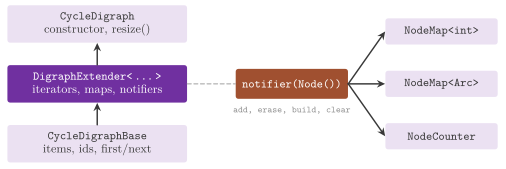
The digraph of the program of this appendix, the directed cycle on \(n\) nodes,
is made in this way (Figure A.1): its base
class CycleDigraphBase stores only \(n\) and computes the arc \(i\) as going
from node \(i\) to node \((i+1)\bmod n\), CycleDigraph derives from
DigraphExtender< CycleDigraphBase >, and its resize( n ) notifies the maps
that all the items were erased and that the new ones were built, as
FullDigraph::resize() does. The program checks the digraph against
concepts::Digraph and runs Dijkstra on it, with no change to the
algorithm.
A.3 The alteration notifier
A graph informs the objects that depend on its items of each change through
one notifier for each kind of item. This is an object of the class
AlterationNotifier< Container , Item > of
lemon/bits/alteration_notifier.h, which keeps a list of observers, i.e., of
objects of classes derived from its nested class ObserverBase. An observer
is attached to a notifier by the protected constructor
ObserverBase( notifier ) or by attach( notifier ), and it is detached by
detach() or by its destructor; notifier() and attached() give its
notifier and its state (these functions are protected as well, i.e., for the
derived class), and a copy of an observer is attached to the same notifier. An
observer overrides six pure virtual functions, which the notifier calls.
add( item )andadd( items ), after one item or astd::vectorof items has been added to the container.erase( item )anderase( items ), before one item or several items are erased from it.build(), after the container has been built from empty, andclear(), before all its items are erased.
A graph calls the functions add(), erase(), build() and clear() of its
notifier in a fixed order with respect to its storage. An item is added to the
storage first and notified afterwards, so that the observer can read it (e.g.,
its identifier), while an item to be erased is notified first and removed
afterwards. The notifier also lets an observer enumerate the current items by
first( item ) and next( item ), and read their identifiers by id( item )
and the bound on them by maxId(). We remark that an observer must not
trigger another alteration of the same notifier, nor detach another observer,
from within these functions.
Exceptions. The calls of add() and build() go from the observer attached
first to the one attached last. If an observer throws, those already notified
receive erase() (or clear()) for the same items, and the exception is
propagated (Algorithm A.2). The calls of erase() and clear() go from the
last attached to the first, and they must not throw, with one exception (the
erase() of a single item is noexcept, so that any other exception there
terminates the program). An observer may throw ImmediateDetach, after which
the notifier detaches it and goes on with the others. The Snapshot of a list
graph uses it when an item older than the snapshot is erased, and so do the
Smart arc and edge sets when an erased node has arcs in them (chapter
4).
Algorithm A.2 (Notifying an addition, with rollback, and an erasure).
add(x):
 1  for each observer o, from the first attached to the last:
 2    try o.add(x)
 3    on an exception:  for each observer o' notified before o:
 4                        o'.erase(x)
 5                      rethrow the exception
erase(x):
 6  for each observer o, from the last attached to the first:
 7    try o.erase(x)
 8    on ImmediateDetach:  detach o and continue
Lemma A.2. Let the notifier have \(k\) observers,
and let the erase( x ) of each observer undo its add( x ). If add( x )
of Algorithm A.2 throws, then every observer has either received nothing or
received add( x ) followed by erase( x ), and the exception reaches the
caller; add( x ) and erase( x ) make at most \(2k\) and \(k\) calls of the
observers, and after erase( x ) exactly the observers that threw
ImmediateDetach are detached.
Proof. The observers are kept in a list in which each new one is put at the
front, and add( x ) visits it from the back, i.e., in the order of
attachment. When the observer \(o\) throws, those visited before it are those
that received add( x ), and lines 3 and 4 send each of them erase( x ),
which by hypothesis undoes its add( x ); \(o\) itself and the later ones
received nothing. Each observer is called at most once on line 2 and at most
once on line 4. The loop of erase( x ) visits each observer once from the
front; one that throws ImmediateDetach is unlinked from the list and marked
as not attached before the loop goes on to its successor, and the others stay.
\(\square\)
Lemma A.2 concerns the observers only. The extender of section A.2 adds the
item to the storage of the base before it notifies it, and when the
notification throws it removes the item from the storage again, by the
protected function undoAdd() that an extendable base provides for each kind
of item it adds, before the exception goes on to the caller; an edge, which is
notified to the observers of the edges and then to those of the arcs, is
erased from the former when one of the latter throws, and a red or a blue
node, notified to the observers of its colour and then to those of the nodes,
is treated in the same way. The extenders of the arc and edge sets of
chapter 4 do the same. Hence, a graph whose addArc()
fails in one of its maps (e.g., for lack of memory) is left as it was before
the call.
abLEMON
In LEMON 1.3.1 the item stayed in the storage of the graph when an
observer refused its addition, with no slot in the maps that had been
rolled back. The tests digraph_test, graph_test and bpgraph_test
attach an observer that throws on every addition and check that the list
and the smart graphs are unchanged, and edge_set_test does the same on
the four arc and edge sets.
Thread safety and limits. Attaching and detaching go through a lock, the
class bits::Lock of lemon/bits/lock.h. It is a std::mutex; thus, maps may
be created and destroyed on one graph from several threads, while the
notifications are not locked. The header also remarks that the notifications
are not always complete. A reversal of an arc by reverseArc() is not notified
(the observers see neither an erasure nor an addition), nor are the other
changes of the ends of an arc or the splitting of a node of chapter
4; therefore, the degree maps InDegMap and OutDegMap of
chapter 6, which observe the arcs, may become wrong after
them. Also, a filter adaptor of chapter 5 cannot notify
the change of its filter map at all.
The program of this appendix includes NodeCounter, an observer of the nodes
of a ListDigraph that keeps their number by build(), add() and
erase(), and checks it against countNodes() after an addition and an
erasure.
A.4 Writing a map
A map that an algorithm only reads is a class with the types Key and Value
and a constant operator[]( const Key & ), which returns a Value (or a
reference to one). A map that the algorithm writes also has set( const Key &
, const Value & ). No other member is needed; in fact, the map need not store
its values and need not know the graph, unless it computes from it. It is
passed by reference to the algorithm, which keeps a pointer to it (and
therefore requires it to outlive the algorithm). For instance, the class
LengthByIndex of the program of this appendix gives each arc of
CycleDigraph the length \(1+(i\bmod 3)\) from the identifier \(i\) of the arc,
and Dijkstra< CycleDigraph , LengthByIndex > reads it in place of an arc
map. A map may derive from MapBase< K , V > of lemon/maps.h, which only
defines the two types. Also, a reference map defines the types Reference and
ConstReference and the tag typedef True ReferenceMapTag, by which
MapTraits (cf. chapter 3) recognizes it.
A map that stores a value for each item of a graph, and must therefore follow
its changes, is an observer of the notifier of that kind of item: its add()
and erase() make room for the new items and release the erased ones. The
standard maps of the extenders, VectorMap and ArrayMap (described in
chapter 6), are written in this way, and so are the degree
maps of lemon/maps.h, while CrossRefMap and RangeIdMap derive from a
standard map and extend its observer functions. A new graph structure obtains
the standard maps from its extender; it usually needs a specific map only for
a different storage (e.g., a map of the arcs of an implicit graph that stores
values only for some of them).
A.5 Writing a heap
The algorithms that keep a priority queue of nodes (Dijkstra,
BidirDijkstra, AStar, MinCostArborescence and several others of Part
III) take the type of their heap from their traits. A user may replace it by
the named template parameter SetHeap< H , CR > (cf. chapter
3), with a heap that conforms to
concepts::Heap< PR , IM , CMP >. The parameters of the concept are the type
PR of the priorities, the type IM of a reference map from the items to
int (i.e., one whose operator[] gives a reference, through which the heap
writes), and the comparison functor CMP, by default std::less< PR >.
Through the map IM, called the cross reference map, the heap finds the place
of an item in \(O(1)\) time, and its key type IM::Key is the type of the
items. The concept requires the following members, which one can compare with
those of the heaps of the library.
- The types
Item,Prio,ItemIntMapandState, the last one an enumeration withIN_HEAP\(=0\),PRE_HEAP\(=-1\) andPOST_HEAP\(=-2\). - The explicit constructors
Heap( IM & map )andHeap( IM & map , const CMP & comp ), and a copy constructor (theConstraintsof the concept copy a heap). - The functions
size(),empty()andclear(), the last of which empties the heap without touching the cross reference map. - The functions
push( i , p )for an item not in the heap,top()andprio()for the item of least priority and its priority,pop(), which removes that item, anderase( i )for an item in the heap. - The query
heap[i], the priority of an item in the heap, and the functionsset(i, p), which inserts the item or changes its priority, anddecrease( i , p )andincrease( i , p ), whose precondition is that the new priority is not larger (resp. smaller) than the old one. - The functions
state( i ), which returnsPRE_HEAPfor an item that has never been in the heap,IN_HEAPfor one in it andPOST_HEAPfor one removed, andstate( i , st ), which sets the state of an item that is not in the heap.
The cross reference map is owned by the caller and shared with the heap. It
must give PRE_HEAP for each item that may be pushed, and the heap typically
writes into it the position of each item in its storage (a nonnegative value)
and POST_HEAP after its removal. For instance, Dijkstra::init() calls
clear() on its heap and then sets the cross reference of each node to
PRE_HEAP, in \(O(n)\) time. The implementations of the library, their costs,
and the test of all of them against the concept (test/heap_test.cc) are
given in chapter 7.
A.6 Checking a new class
A new class is checked at compile time by checkConcept< Concept , T >() of
lemon/concept_check.h, as the program of this appendix does for
CycleDigraph (against concepts::Digraph) and for LengthByIndex (against
concepts::ReadMap< CycleDigraph::Arc , int >). The call instantiates the
function constraints() of the concept on the class, and a missing type or
function (or one with an incompatible signature) gives a compilation error at
that point. It has no cost at run time, and it is empty when NDEBUG is
defined (in which case no check is made). A structure that offers more than
the concept is also checked against the components it adds, e.g.,
checkConcept< concepts::ExtendableDigraphComponent<> , G >() and the
erasable, clearable and alterable components, as test/digraph_test.cc does
for the structures of the library.
Since the concepts check the syntax only, the semantic requirements of section
A.1 are checked by running the class. In the tests, the header
test/graph_test.h has function templates that do it for any graph type, and
a test of a new structure may call them. Thus, checkGraphNodeList( g , n )
and checkGraphArcList( g , m ) count the items visited by the iterators,
checkGraphOutArcList( g , v , d ) and checkGraphInArcList( g , v , d ) the
arcs at a node, and checkGraphIncEdgeArcLists( g , v , d ) the incidences of
an undirected graph. Also, checkNodeIds( g ) and checkArcIds( g ) verify
that the identifiers are distinct and that nodeFromId() inverts them,
checkArcDirections( g ) that the arcs of each edge are directed
consistently, and checkGraphNodeMap( g ) and checkGraphArcMap( g ) that a
map has a value for each item. Finally, an algorithm run on the new structure
should give the results known in closed form or computed on a copy of it into
a ListDigraph (by digraphCopy() of chapter 4); the
program of this appendix, e.g., checks the distances of Dijkstra against
their closed form, and a node map against a resize().