1. Introduction¶
[Source: include/ADS/ADT.h, Contract.h, Iterators.h, Portable.h,
Wide.h, Simd.h, SimdInline.h, Modification.h, Capabilities.h,
Algebra.h, ADS/sequence/IndexedList.h, ADS/sequence/ObservableArray.h,
ADS/sequence/Fenwick.h, ADS/queue/SlidingAggregate.h,
ADS/set/SetInterfaces.h, ADS/set/Bag.h]
We are concerned in this manual with ADS, a header-only library of C++20 that realizes the data structures and the algorithms of the textbooks, each in the form in which a textbook presents it, together with the engineered variants that the literature on algorithm engineering has proposed for many of them. This chapter fixes what the other chapters take for granted. We first recall why the organization of the data matters (§1.1), how an abstract data type is specified and how the library states it as a concept of C++20 (§1.2), and which interfaces the structures realize (§1.3), together with their simplest realizations (§1.4). Then come the mathematics of the analyses (§1.5), the model of computation in which the costs are counted (§1.6), and the meaning of correctness, time and space for an operation, with the contracts by which the library checks correctness (§1.7). In the last sections we describe the iterators (§1.8), the two levels of the library and its conventions (§1.9), how to build, test and use it (§1.10), how this manual is organized (§1.11), the map of all the classes of the library (§1.12), the typed modifications by which a structure tells its observers what changed (§1.13), the capabilities that an algorithm may ask of a structure (§1.14), and the first structures that tell their changes, with the aggregates that their events feed (§1.15).
1.1 The need for efficiency¶
Each of the abstract data types of §1.3 can be realized by a vector, or by a list, whose items are examined one by one at each operation: a search scans them all, an insertion scans them to rule out a duplicate, and a removal scans them to find its item. Such realizations are "easy" to write correctly (those of §1.4 are of this kind), and one may wonder whether anything faster is needed on a machine that executes billions of instructions per second, i.e., on a "fast" one; a rough count shows that it usually is. Suppose that a program keeps \(n = 10^6\) items and looks up each of them once, i.e., makes \(m = 10^6\) searches; if each search examines all the items, the program makes \(n m = 10^{12}\) examinations. A core of a current processor runs at a few billion cycles per second and makes at most a few simple operations per cycle, and each examination reads an item, compares it and moves to the next. Hence, the core makes of the order of \(10^9\) examinations per second, and all the searches take of the order of \(10^3\) seconds, about a quarter of an hour. Doubling \(n\) and \(m\) makes it an hour, and a data set of \(10^9\) items (which is not "large" by today's standards) would take decades. We remark that these figures are rather crude orders of magnitude, not measures (the measures of the library are the subject of appendix B); yet, no constant factor of a faster machine changes the product \(n m\).
A remedy (the "right" one, in most cases) is to organize the items so that an operation need not examine all of them. A hash table (chapter 7) examines a constant number of items per search on average, whatever \(n\) is, and the \(10^6\) searches above then take a few million examinations, i.e., some milliseconds. A balanced search tree (chapter 8) keeps the items in order and examines at most about \(2 \log_2 n\) of them per operation, i.e., about 40 for \(n = 10^6\) and 60 for \(n = 10^9\). However, on a real machine the cost of an examination is not uniform: a read that misses all the levels of the caches costs of the order of a hundred nanoseconds, i.e., some hundreds of operations (Drepper 2007). Two structures that examine the same number of items may thus differ in running time by one order of magnitude (typically, not more), according to how the items they examine lie in memory. In ADS, the textbook structures are written to show the first effect (the organization of the items), and the engineered ones also take the second (somewhat harder to predict) into account (§1.9).
1.2 Abstract data types¶
A specification of an abstract data type is a triple \(( D , F
, A )\) (Montresor 2025,
§3.2). Here \(D\) is a set
of domains, one of which is the designated domain, i.e., the
type being defined (e.g., the stacks), while the others are the
auxiliary ones (e.g., the items and the booleans). Then \(F\) is
a set of operations, each a function among the domains of \(D\);
\(A\) is a set of axioms, which give the meaning of the
operations (Liskov and Zilles
1974; Guttag and Horning
1978). The pair \(( D , F )\)
is the syntactic specification, and \(A\) the semantic one.
The latter may be given in two ways: in the algebraic way, it
is a set of equations among the operations, in which those that
observe or remove are written on the terms built by those that
construct, as in \(\mathrm{top}( \mathrm{push}( S , v ) ) = v\).
In the constructive way, it is the precondition and the
postcondition of each operation, written in terms of a type
already known (e.g., the finite sequences of items). As for the
operations, they are of four kinds, i.e., the constructors,
which make a value of the type (create(), insert(),
push()), the modifiers, which change it, the observers,
which return a property of it (empty(), top(), read()),
and the iterators, which visit its items.
A realization of the type meets the requirement of abstraction if a
program that uses the type does not depend on how it is realized, and that
of protection if only the operations of the type act on its values
(Parnas 1972; Liskov and Zilles
1974). In ADS we therefore write each
realization as a class whose data are private, and two realizations of the
same type can replace each other in a program. In C++20, the syntactic
specification is a concept, i.e., a predicate on types, checked at compile
time, which requires some expressions to be valid and to have some types
(Sutton
and Stroustrup 2012). That of the STACK,
in ADS/ADT.h, requires a type of the items, an observer empty() that
gives a bool, and the operations push(), pop() and top():
// declarations of <ADS/ADT.h>
template< class S >
concept Stack = requires( S s , const S cs , const typename S::Item & v )
{
 typename S::Item;
 { cs.empty() } -> std::same_as< bool >;
 s.push( v );
 { s.pop() } -> std::convertible_to< typename S::Item >;
 { cs.top() } -> std::convertible_to< typename S::Item >;
 };
A class models a concept by having its operations, with no declaration of
the fact. Hence, a realization written outside the library models the
concepts of the library as well as those inside it. A function template
constrained by the concept, e.g., template< Stack S > void f( S & s ),
takes any realization. A call that gives it a type that is not a stack
is rejected at the point of the call, with the name of the requirement that
fails. However, a concept checks the syntax and nothing more: two types with
the same operations and different axioms (say, a stack and a queue whose
operations had the same names) model the same concepts, and the compiler
cannot tell them apart. We therefore state the axioms of each type in the
comments of ADS/ADT.h, and the library checks them in two ways, i.e., the
tests check them on each realization (the tests contract_*.*-axioms), and
the code checks the constructive form, i.e., the preconditions and the
postconditions of the operations (§1.7).
We write the axioms of the STACK, with \(\mathrm{create}\) the empty stack, as
while \(\mathrm{top}( \mathrm{create} )\) and \(\mathrm{pop}( \mathrm{create}
)\) are undefined, i.e., top() and pop() are partial operations, whose
precondition is that the stack is not empty. In ADS pop() also returns the
item it removes, and the last axiom is about the stack it leaves. As for the
QUEUE, it has enqueue(), which adds at the back, dequeue(), which
removes from the front, and top(), which reads the front; besides
\(\mathrm{empty}( \mathrm{create} ) = \mathbf{true}\) and \(\mathrm{empty}(
\mathrm{enqueue}( Q , v ) ) = \mathbf{false}\) for any \(Q\), its axioms are,
for \(Q\) not empty,
with \(\mathrm{top}( \mathrm{enqueue}( \mathrm{create} , v ) ) = v\) and \(\mathrm{dequeue}( \mathrm{enqueue}( \mathrm{create} , v ) ) = \mathrm{create}\). Since the syntactic specifications of the two types are the same up to the names of the operations, (1.1) and (1.2) are the whole difference between a stack and a queue. Note that the axioms must also decide the value of each observer on each value of the type, and they are then sufficiently complete, in the terms of Guttag and Horning 1978, which makes them a specification rather than a list of properties; for the stacks this follows from a normal form of their terms.
Lemma 1.1. By (1.1), each stack built by \(\mathrm{create}\), \(\mathrm{push}\) and \(\mathrm{pop}\), each \(\mathrm{pop}\) applied to a stack that is not empty, is equal to a term
and the observers of a term (1.3) are determined: it is empty if and only if \(k = 0\), and its top is \(v_k\).
Proof. By induction on the number of operations of the term, since the equations of (1.1) may be applied to any subterm. A term with no operation is \(\mathrm{create}\), i.e., (1.3) with \(k = 0\). Otherwise, its outermost operation is applied to a subterm that, by induction, is equal to a term (1.3); a \(\mathrm{push}\) applied to a term (1.3) is a term (1.3), and a \(\mathrm{pop}\) applied to a term (1.3), which has \(k \ge 1\) by hypothesis, is, by the last axiom of (1.1), the term (1.3) of \(v_1 , \ldots , v_{k-1}\). The values of \(\mathrm{empty}\) and \(\mathrm{top}\) on (1.3) are given by the first three axioms of (1.1). \(\square\)
The same argument holds for the queues by (1.2), with a normal form \(\mathrm{enqueue}( \cdots \mathrm{enqueue}( \mathrm{create} , v_1 ) \cdots , v_k )\) made of \(\mathrm{enqueue}\) only. A \(\mathrm{dequeue}\) of such a term with \(k \ge 1\) is, by induction on \(k\) (the second axiom of (1.2) for \(k \ge 2\), and \(\mathrm{dequeue}( \mathrm{enqueue}( \mathrm{create} , v ) ) = \mathrm{create}\) for \(k = 1\)), the normal form of \(v_2 , \ldots , v_k\). The axioms on \(\mathrm{empty}\) and \(\mathrm{top}\) give that the term is empty if and only if \(k = 0\) and that its front is \(v_1\). For the sets, the axioms (1.6) below decide \(\mathrm{contains}( x , A )\) for each item \(x\) and each term \(A\), by induction on \(A\). Hence, if we take two sets as equal when they contain the same items (the only equality that (1.6) can define, since it has no equation among sets), each term is equal to a term made of \(\mathrm{insert}\) only, on the distinct items that it contains, in any order. Of course, the axioms say nothing about the cost of the operations, which is rather the business of the realizations; a stack on a vector and a stack on a list satisfy (1.1) in the same way, and differ in time and space (§3.2 and §3.3).
1.3 The interfaces¶
An interface (i.e., an abstract data type, as a program sees it) states
what a structure does, and an implementation (or realization) how it does
it. There are typically several realizations of one interface, which differ
in the cost of the operations, and choosing among them is the first decision
in the use of a library (Morin 2013,
§1.2). ADS has the interfaces of two
textbooks. Those of Montresor 2025
name the operations as its pseudocode does, and are the concepts of
ADS/ADT.h. Those of Morin 2013, §1.2
read the sequences by rank and the sets through the items they find, and are
the concepts of ADS/sequence/IndexedList.h and ADS/set/SetInterfaces.h,
the latter with two more concepts of the library that view the keys of a
dictionary as such a set. Table 1.1 lists them,
with the chapters where their realizations are described. The concepts of the
other areas (the PRIORITY QUEUE of ADS/priority/PriorityQueue.h, the GRAPH
of ADS/graph/Graph.h, the executors of ADS/parallel/Executor.h) are
described with their areas instead.
Table 1.1. The concepts of the interfaces of chapter 1, their operations and the chapters of their realizations; M is Montresor 2025, O is Morin 2013, and ADS marks a concept of the library.
| Concept | Interface | Operations | Source | Chapters |
|---|---|---|---|---|
Sequence |
SEQUENCE | empty(), finished(), head(), tail(), next(), prev(), insert(), remove(), read(), write() |
M, §3.2.1 | 2 |
Set |
SET | size(), contains(), insert(), remove() |
M, §3.2.2 | 10 |
Dictionary |
DICTIONARY | lookup(), insert(), remove() |
M, §3.2.3 | 7, 8 |
Stack |
STACK | empty(), push(), pop(), top() |
M, §4.3.1 | 3 |
Queue |
QUEUE | empty(), enqueue(), dequeue(), top() |
M, §4.3.1 | 4 |
IndexedList |
LIST | size(), operator[], insert( i , x ), erase( i ) |
O, §1.2.2 | 2, 4 |
IndexedDeque |
DEQUE | size(), push_front(), push_back(), pop_front(), pop_back(), front(), back() |
O, §1.2.1 | 2, 4 |
USet |
USet | size(), insert(), remove(), find() |
O, §1.2.3 | 1 |
SSet |
SSet | those of USet and lowerBound() |
O, §1.2.4 | 1 |
KeyedDictionary |
USet of keys | findKey(), insert( k , v ), remove( k ) |
ADS | 10 |
OrderedDictionary |
SSet of keys | those of KeyedDictionary and lowerBoundKey() |
ADS | 10 |
1.3.1 Stacks, queues and deques¶
A queue, in the wide sense of Morin 2013,
§1.2.1, is a collection to which items are
added and from which the next item is removed, its queueing discipline
deciding which item is the next one. A first in, first out discipline (FIFO)
removes the items in the order in which they were added, and gives the QUEUE
of (1.2). A last in, first out discipline (LIFO) removes the item added last,
and gives the STACK of (1.1); a discipline of priorities removes the item of
least priority, and gives the PRIORITY QUEUE of chapter
9. In ADS we keep the names of Montresor 2025,
§4.3.1, i.e., push(), pop() and
top() for the stack and enqueue(), dequeue() and top() for the queue,
while Morin calls both pairs add() and remove(). A DEQUE is a sequence
changed at both ends, by push_front(), push_back(), pop_front() and
pop_back(), and read by front() and back(); these are the names of
std::deque for the addFirst(), addLast(), removeFirst() and
removeLast() of Morin, and the concept is IndexedDeque. A deque realizes
both of the other two, since push_front() and pop_front() give a stack,
and push_back() with pop_front() a queue.
A stack is the "natural" structure of the nested computations, and Morin
2013, exercises 1.2 and 1.3 make this
precise. A Dyck word is a sequence \(w_1 , \ldots , w_n\) of \(+1\) and \(-1\)
whose prefix sums \(s_j = w_1 + \cdots + w_j\) are never negative (with no
condition on \(s_n\), as in the exercise). If we read \(+1\) as a
\(\mathrm{push}\) and \(-1\) as a \(\mathrm{pop}\), \(w\) becomes a sequence of
operations on a stack; by (1.1) each \(\mathrm{push}\) adds one item and each
\(\mathrm{pop}\) removes one, and hence the height of the stack after \(j\)
operations is \(s_j\). Since the items pushed play no role, the function
isDyckWord() of ADS/stack/StackAlgorithms.h keeps the stack as its
height \(h\) (Algorithm 1.1).
Lemma 1.2. The sequence \(w\) is a Dyck word
if and only if the operations it encodes, applied to an empty stack, never
apply \(\mathrm{pop}\) to the empty stack; the stack is empty at the end if
and only if, in addition, \(s_n = 0\). Hence isDyckWord() decides whether
\(w\) is a Dyck word in \(O( n )\) time and \(O( 1 )\) space.
Proof. Let \(h_j\) be the height of the stack after the first \(j\)
operations. As long as no \(\mathrm{pop}\) is applied to the empty stack, one
has \(h_j = s_j\), by induction on \(j\) and (1.1). The first \(\mathrm{pop}\)
applied to the empty stack, if any, is thus the operation \(j\) for the least
\(j\) with \(s_{j-1} = 0\) and \(w_j = -1\), i.e., for the least \(j\) with \(s_j <
0\), since the prefix sums change by 1 at each step and the first negative
one is therefore \(-1\), reached from 0. Hence no \(\mathrm{pop}\) is applied to
the empty stack if and only if no prefix sum is negative, and in that case
the final height is \(s_n\), which is 0 exactly when the stack is empty at the
end. Finally, isDyckWord() (Algorithm 1.1)
keeps \(h = s_j\) and returns false at the first \(j\) with \(h = 0\) and \(w_j =
-1\); it makes \(O( 1 )\) operations per item, and its counter \(h \le n\) takes
one word (§1.6). \(\square\)
Algorithm 1.1. The Dyck words and the matched strings of brackets by a stack (Morin 2013, exercises 1.2 and 1.3).
A string of the brackets (), [] and {} is matched when the brackets
pair up properly. For instance, {{()[]}} is matched, while {{()]} is
not, since its second { faces a ]. Similarly, isMatched()
(Algorithm 1.1) pushes each open bracket and
pops one at each closed bracket, which must be of the same kind, and answers
that the string is matched if no pop fails or mismatches and the stack is
empty at the end, in \(O( 1 )\) time per character and \(O( n )\) in all. In
fact, read with \(+1\) for an open bracket and \(-1\) for a closed one, a
matched string is a Dyck word with \(s_n = 0\) by Lemma
1.2; the stack, which here keeps the brackets
themselves, also checks that each pair is of one kind. A third exercise
reverses a stack through a queue (reverseWithQueue()). We pop all the
items into the queue, and push them back in the order in which they leave
it. Indeed, the queue keeps the order of the pops, i.e., from the top down,
and the first item pushed back (the old top) ends at the bottom; hence, the
order is reversed, in \(O( n )\) time
(Algorithm 3.7).
1.3.2 Sequences and lists¶
The SEQUENCE of Montresor 2025,
§3.2.1 is a dynamic sequence of items
\(s_0 , \ldots , s_{n-1}\) reached through positions. Here \(\mathit{pos}_i\)
is the position of \(s_i\), of the type Pos of the realization, and two more
positions, \(\mathit{pos}_{-1}\) and \(\mathit{pos}_n\), come before the first
item and after the last one, the observer finished( p ) being true on
these two and only on them. The operations head(), tail(), next() and
prev() move among the positions, while read() and write() read and
change the item of a position. With \(p = \mathit{pos}_i\), insert( p , v )
puts \(v\) at the index \(i\), the old items from the index \(i\) on moving one
place on, and returns the position of the new item. Similarly, remove( p )
removes the item of index \(i\) and returns the position of the new item of
index \(i\); hence the axioms
the last one with the other items unchanged, together with
\(\mathrm{empty}( s ) = \mathrm{finished}( \mathrm{head}( s ) )\), which makes
empty() redundant. What a position is depends on the realization (an
index of a vector, the address of a cell, a cursor in a vector of cells),
and so does the cost of each operation, while (1.4) holds on all of them.
The LIST of Morin 2013, §1.2.2 reaches the
items by their rank instead: its get( i ) and set( i , x ) read and
write \(x_i\), its add( i , x ) sets \(x_{j+1} \gets x_j\) for
\(j = n - 1 , \ldots , i\), then \(x_i \gets x\) and \(n \gets n + 1\), and its
remove( i ) sets \(x_j \gets x_{j+1}\) for \(j = i , \ldots , n - 2\) and
\(n \gets n - 1\) (Figure 1.1). The concept
IndexedList of ADS/sequence/IndexedList.h requires these operations with
the names of the standard library, i.e., size(), operator[] for both
get() and set(), insert( i , x ) and erase( i ); it is not called
List, since that is the name of the doubly linked list of
ADS/sequence/List.h. A LIST realizes a DEQUE by
and a realization whose name contains "stack" or "deque" (e.g.,
RootishArrayStack, DualArrayDeque) is a LIST that is especially "fast" in
(1.5) at one end or at both. In ADS, the realizations of IndexedList are
RingDeque (chapter 4), DualArrayDeque, Treque,
ContiguousDeque, RootishArrayStack, TieredVector, CubishArrayStack,
SEList, SkipListSequence and TreapList (chapter
2), and those of IndexedDeque are the first four
of them, together with TieredVector, SEList and XorList. The test
program ods_lists checks at compile time that the first eight are models
of IndexedList and the seven realizations of the DEQUE models of
IndexedDeque, and its test ods_lists.ods-1.2.interfaces runs one
function template on those eight lists. Furthermore, the header has two
rotations of a LIST, rotateArray() and rotate(), which solve Morin
2013, exercises 2.4 and 2.5 and are
described with the sequences in chapter 2.
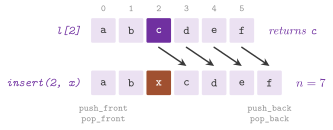
Note that the two interfaces differ somewhat in what is "cheap". A position
of a linked list is the address of its cell, and insert() and remove() at
a position take \(O( 1 )\) time, while reaching the rank \(i\) takes \(O( 1 +
\min\{ i , n - i \} )\) steps from the nearer end. In a vector, on the other
hand, a rank is an index, reached in \(O( 1 )\) time, while an insertion at the
rank \(i\) moves \(n - i\) items. Roughly speaking, a program that walks a
sequence and changes it where it stands had better use the positions of a
SEQUENCE, and one that jumps among ranks the LIST.
1.3.3 Sets, dictionaries and bags¶
The SET of Montresor 2025, §3.2.2 is a
finite collection of distinct items, with size(), contains( x ),
insert( x ) and remove( x ). Its axioms define the observer on each
constructor,
with \(\mathrm{contains}( x , \mathrm{create} ) = \mathbf{false}\); inserting an
item already there, or removing one that is not, thus leaves the set as it is,
and in this way the library relaxes the preconditions \(x \notin A\) and
\(x \in A\) that some specifications state. The DICTIONARY of Montresor 2025,
§3.2.3 is a univocal relation from keys
to values. Its lookup( k ) gives the value of the key \(k\) or nothing (the
nil of the book, std::nullopt in the code), insert( k , v ) associates \(v\)
with \(k\), replacing the value that \(k\) had, and remove( k ) removes \(k\). Its
axioms are those of (1.6) with lookup() in place of contains(), and both
lookup() and remove() are total, i.e., the key need not be there.
The USet of Morin 2013, §1.2.3 has size()
and three more operations. Its insert( x ) (Morin's add( x )) adds \(x\)
unless an item equal to \(x\) is there, and returns whether it did,
remove( x ) returns whether it removed an item equal to \(x\), and find( x )
gives the address of the item \(y\) of the set equal to \(x\), or nil. The
distinction between \(x\) and \(y\) matters, since two items may be equal without
being identical. If a pair \(( k , v )\) is equal to another when the keys are
equal, the pair stored in a USet is found by \(\mathrm{find}( ( k , \cdot ) )\)
with any value, and the USet then serves as a dictionary. The SSet of Morin
2013, §1.2.4 keeps items of a total order,
and adds the successor search of the least item \(y \ge x\), which is
meaningful even when no item equals \(x\). It is Morin's find( x ) of an SSet,
and lowerBound( x ) in ADS, where find( x ) keeps the meaning it has in
the USet. Order usually costs something (perhaps more than one would like):
for instance, the search trees of chapter 8 answer a
successor search in \(O( \log n )\) time, while a hash table gives the find()
of a USet in \(O( 1 )\) expected time (chapter 7); a
program had better use an SSet only when it needs the order.
In ADS/set/SetInterfaces.h, the concepts USet and SSet require these
operations, with insert() and remove() that give a bool, and find()
and lowerBound() that give something convertible to a pointer to a constant
item, nil when there is none; SSet refines USet, i.e., an SSet is also
a USet. The same header has two concepts of the library for the
dictionaries that show their keys as a set. A KeyedDictionary has the
insert( k , v ) and the remove( k ) of a DICTIONARY, and findKey( k ),
the address of the key equal to \(k\) that it holds, or nil, a search that may
change the representation (as that of a splay tree does) but not the set of
the keys. An OrderedDictionary is a KeyedDictionary that also has
lowerBoundKey( k ), the address of the least key not smaller than \(k\), or
nil. On a KeyedDictionary, the adaptor DictionarySet is a USet, and on
the second an SSet (§10.4), which is how each hash
table, search tree, skip list and B-tree of the library, whose lowerBound()
gives a pair or an iterator rather than the address of an item, serves as a
set of Morin. Finally, a BAG is a USet that keeps all the items equal to one
another (Morin 2013, exercise 1.5). Its
insert( x ) always adds \(x\), find( x ) gives one of the items equal to
\(x\), and findAll( x ) gives them all. Its realization Bag models USet,
with an insert() that is always true (§1.4).
1.4 Reference realizations¶
The simplest realizations of the USet and of the SSet keep
the items in a vector, as Morin 2013, exercise
1.6 suggests. They are
rather "slow", but short enough to be evidently correct, and
the tests use them as oracles for the faster ones.
ArrayUSet keeps the \(n\) items in the places \(0 , \ldots , n
- 1\) of a vector \(A\), in no order, with no two of them equal
by its equality Eq (std::equal_to<> by default). Its
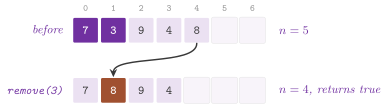
find( x ) scans \(A\), insert( x ) appends \(x\) after a
find() has ruled it out, and remove( x ) moves the last
item into the place of the item it removes, which keeps \(A\)
without gaps (Figure 1.2 and
Algorithm 1.2).
Algorithm 1.2. The removal from an
ArrayUSet and the insertion into an ArraySSet (Morin 2013, exercises
1.6 and 1.7).
In the code, we move the last item instead of copying it, and we do not move it at all when the item removed is the last one.
ArraySSet, instead, keeps the items in strictly increasing order by the
order C (std::less<> by default), two items being equal when neither is
smaller than the other. This is the invariant that its contracts check at the
level 3 (§1.7), and both classes give their
vector, read-only, by items(). Hence we can make lowerBound( x ) a binary
search, which Morin 2013, exercise 1.7
suggests among the improvements of the realization on a vector, and
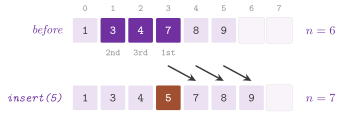
find( x ) is a lowerBound( x ) followed by a test of equality. We search
for the place of an insertion (or of a removal) in the same way. Then we move
the items after that place by one place, as a single block, which is the other
improvement that the exercise suggests (Figure
1.3); the insert() of std::vector makes the
move, and it becomes one memmove() when the items are trivially copyable.
Lemma 1.3. On a set of \(n\) items,
ArrayUSet takes \(O( n )\) time for find(), insert() and remove(), and
remove() takes \(O( 1 )\) time after its scan. ArraySSet takes at most
\(\lceil \log_2 ( n + 1 ) \rceil\) comparisons for lowerBound() and
find() (one more for the test of equality), and \(O( \log n + n - i )\)
time for an insert() or a remove() at the place \(i\). Each of the two
takes \(\Theta( n )\) space, and \(O( 1 )\) amortized time for the growth of its
vector.
Proof. In ArrayUSet, find() compares \(x\) with at most the \(n\) items
of \(A\), insert() makes one find() and one append, and remove() makes
one find() and then moves at most one item and shortens \(A\) by one, in
\(O( 1 )\) time. In ArraySSet, lowerBound() is a binary search, which
keeps an interval of candidate places halved at each comparison
(Lemma 1.5), and find() adds one test of
equality; an insert() or a remove() at the place \(i\) makes one binary
search and moves the \(n - i\) items after the place (fewer by one for a
removal), as one block. Also, the vector is a
std::vector, whose growth by a constant factor costs \(O( 1 )\) amortized
time per insertion (Lemma 3.3), and which never
shrinks on a removal. \(\square\)
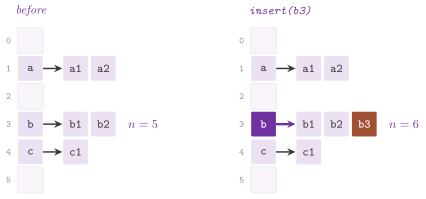
A BAG is a USet of groups, as Morin 2013, exercise
1.5 suggests. Bag keeps
the number \(n\) of its items and a hash table \(G\) (a
FlatHashTable, chapter 7) from an
item to the vector of the items equal to it, in the order of
their insertions. Its invariant is that no group is empty and
that the groups hold \(n\) items in all. An insert( x )
appends \(x\) to the group of \(x\), or makes a new group
\(\langle x \rangle\) when there is none. A remove( x )
removes the last item of the group, and the group itself when
the item was its only one, and find( x ) gives the first
item of the group, and findAll( x ) a copy of the group
(Figure 1.4 and Algorithm
1.3). Also, the class gives
count( x ), the size of the group, and distinct(), the
number of groups, besides size() and empty(), which take
\(O( 1 )\) time.
Algorithm 1.3. The operations of Bag, with
\(G\) the table of the groups (Morin 2013, exercise
1.5).
Lemma 1.4. If the operations of the table
\(G\) take \(O( 1 )\) expected amortized time, then insert() and remove()
of Bag take \(O( 1 )\) expected amortized time, find() and count()
\(O( 1 )\) expected time, and findAll( x ) \(O( 1 + c )\) expected time,
where \(c\) is the number of items equal to \(x\); the space is \(O( n )\). After
each operation no group is empty, and the groups hold \(n\) items in all.
Proof. The invariant holds on the empty bag; an insert() adds one item
to a group, or a new group of one item, and increments \(n\), while a
remove() that finds a group removes one of its items, or the group
itself when it has one item only, and decrements \(n\). Each operation makes
one search in \(G\). Besides, insert() and
remove() make at most one insertion or removal in \(G\), and an append or a
removal at the end of one vector, whose amortized cost is \(O( 1 )\) (Lemma
3.3); findAll() copies \(c\) items. Finally, the groups
hold \(n\) items, and there are at most \(n\) of them, each with its key in \(G\).
\(\square\)
The hypothesis of Lemma 1.4 is that of the
hash tables of chapter 7, where it is stated with
its assumptions on the hash function. We remark that a group keeps all the
items equal to \(x\), not a counter, since equal items need not be identical
(in the test of the exercise they are records equal by their key), which
sets Bag apart from the multiset of counters HashMultiset of chapter
10.
In ADS/set/SetInterfaces.h, the declarations of ArrayUSet and
ArraySSet that a user calls are
// declarations of <ADS/set/SetInterfaces.h>
template< class T , class Eq = std::equal_to<> >
class ArrayUSet
{
 public:
 using Item = T;
 explicit ArrayUSet( Eq eq = Eq() );
 std::size_t size( void ) const;
 const T * find( const T & x ) const;
 bool insert( const T & x );
 bool remove( const T & x );
 const std::vector< T > & items( void ) const;
 };
template< class T , class C = std::less<> >
class ArraySSet
{
 public:
 using Item = T;
 explicit ArraySSet( C less = C() );
 std::size_t size( void ) const;
 const T * find( const T & x ) const;
 const T * lowerBound( const T & x ) const;
 bool insert( const T & x );
 bool remove( const T & x );
 const std::vector< T > & items( void ) const;
 };
In ADS/set/Bag.h, the declarations of Bag that a user calls are
// declarations of <ADS/set/Bag.h>
template< class T , class H = DefaultHash< T > ,
          class Eq = std::equal_to< T > >
class Bag
{
 public:
 using Item = T;
 explicit Bag( H h = H() , Eq eq = Eq() );
 std::size_t size( void ) const;
 bool empty( void ) const;
 std::size_t distinct( void ) const;
 bool insert( const T & x );
 bool remove( const T & x );
 const T * find( const T & x ) const;
 std::vector< T > findAll( const T & x ) const;
 std::size_t count( const T & x ) const;
 };
1.5 Mathematical background¶
We recall here the notation and the few facts that the analyses of the following chapters use, while the textbooks of Graham, Knuth and Patashnik 1994 and of Lehman, Leighton and Meyer 2018 treat them at length, and Knuth 1997, §1.2 gathers those of the analysis of algorithms.
1.5.1 Exponentials and logarithms¶
For a real \(b > 0\) and an integer \(x > 0\), we denote by \(b^x\) the product of \(x\) factors equal to \(b\), while \(b^0 = 1\) and \(b^{-x} = 1 / b^x\); for a real \(x\), \(b^x = e^{x \ln b}\), by the exponential function \(e^x\). For \(b > 1\) and \(k > 0\), the logarithm \(\log_b k\) is the unique real \(x\) such that \(b^x = k\). Two manipulations recur in the analyses, i.e., the removal of a logarithm from an exponent and the change of its base,
In this manual we write \(\log k\) for the binary logarithm \(\log_2 k\), and
\(\ln k\) for the natural one, \(\log_e k\), where \(e = \lim_{n \to \infty} ( 1 +
1 / n )^n \approx 2.71828\); by (1.7), \(\ln k = ( \ln 2 ) \log k \approx 0.693
\log k\). The natural logarithm appears as the integral \(\int_1^k \mathrm{d}x
/ x = \ln k\), and the binary one as a number of halvings. Indeed, \(\lceil
\log k \rceil\) is the least number of times that \(k\) must be halved (rounding
up) to reach 1, and \(\lfloor \log k \rfloor + 1\) is the number of bits of the
integer \(k \ge 1\). On a word of the machine the latter is one instruction,
which C++20 gives as std::bit_width( k ). In ADS it is used wherever one
needs \(\lfloor \log k \rfloor\) of an integer, e.g., in the codes of the
integers and in the rank and select of chapters 21
and 22.
Lemma 1.5. A search that keeps a set of \(a \ge 1\) candidate answers and replaces it, after each comparison, with a set of at most \(\lceil a / 2 \rceil\) of them ends after at most \(\lceil \log a \rceil\) comparisons. Hence the binary search for the place of an item among \(n\) sorted items, which has \(a = n + 1\) answers, takes at most \(\lceil \log ( n + 1 ) \rceil\) comparisons.
Proof. After \(j\) comparisons at most \(\lceil a / 2^j \rceil\) candidates
remain, by induction on \(j\), since \(\lceil \lceil a / 2^j \rceil / 2 \rceil
= \lceil a / 2^{j+1} \rceil\); for \(j = \lceil \log a \rceil\) one has \(a
\le 2^j\), and hence a single candidate, after which the search makes no more
comparisons. In fact, the search of std::lower_bound(), which ArraySSet
calls, keeps \(c\) places, i.e., \(a = c + 1\) answers, makes one comparison
while \(c > 0\), and replaces them with \(\lfloor c / 2 \rfloor\) or \(c -
\lfloor c / 2 \rfloor - 1 \le \lfloor c / 2 \rfloor\) places, i.e., with at
most \(\lfloor c / 2 \rfloor + 1 = \lceil a / 2 \rceil\) answers. \(\square\)
1.5.2 Factorials and binomial coefficients¶
For an integer \(n \ge 0\), \(n! = 1 \cdot 2 \cdots n\) (with \(0! = 1\)) is the number of the permutations of \(n\) distinct items. Stirling's approximation, with the bounds of Robbins 1955, is
for \(n \ge 1\). Hence \(\ln( n! ) = n \ln n - n + \frac{1}{2} \ln( 2 \pi n ) + \alpha( n )\), and \(\log( n! ) = n \log n - n \log e + O( \log n )\), the form that gives the lower bound on the comparisons of a sort. A sort by comparisons must tell apart the \(n!\) orders of its input, and each comparison has two outcomes; hence it needs at least \(\lceil \log( n! ) \rceil\) comparisons in the worst case, which Theorem 12.1 proves by the comparison tree of the sort. For integers \(0 \le k \le n\), the binomial coefficient
is the number of the subsets of \(k\) items of a set of \(n\) items (a "small" number only when \(k\) or \(n - k\) is "small"), and our analyses use the identity \(\binom{n}{k} = \binom{n-1}{k-1} + \binom{n-1}{k}\) (the subsets with the item \(n\) and those without it), together with \(k \binom{n}{k} = n \binom{n-1}{k-1}\) and \(\sum_{k=0}^n \binom{n}{k} = 2^n\). They also use the bounds \(( n / k )^k \le \binom{n}{k} \le ( e n / k )^k\) for \(1 \le k \le n\) (Graham, Knuth and Patashnik 1994, §5.1). The functions of the library that compute these numbers exactly, on integers of any length, are in chapter 17.
1.5.3 Asymptotic notation¶
The running time of an operation depends on the machine, on the compiler and on the run, and even its count of instructions is hard to compute exactly. We therefore bound it up to a constant factor, by the asymptotic notation of Knuth 1976. For a function \(f( n )\), one has
and \(\Omega( f( n ) )\) is defined in the same way with \(g( n ) \ge c f( n )\), while \(\Theta( f( n ) ) = O( f( n ) ) \cap \Omega( f( n ) )\), and \(o( f( n ) )\) is the set of the \(g( n )\) such that \(g( n ) / f( n ) \to 0\). As usual, we write \(g( n ) = O( f( n ) )\) for \(g( n ) \in O( f( n ) )\), and an expression such as \(T( n ) = 2 \log n + O( 1 )\) means that \(T( n ) - 2 \log n\) is a function of \(O( 1 )\). For instance, \(3 n \log n + 10 n + 50 = O( n \log n )\), since for \(n \ge 2\) one has \(\log n \ge 1\) and \(n \log n \ge 2\), and hence \(3 n \log n + 10 n + 50 \le 3 n \log n + 10 n \log n + 25 n \log n = 38 n \log n\); (1.10) thus holds with \(c = 38\) and \(n_0 = 2\). The inclusions
for constants \(0 < b < b'\) and \(c > 1\), compare the usual costs.
Lemma 1.6. Each inclusion of (1.11) is strict, and it still holds, strictly, when both of its sides are multiplied by the same positive function \(h( n )\) (e.g., \(h( n ) = n\) gives \(O( n ) \subset O( n \log n )\)).
Proof. For \(\varepsilon > 0\) and \(x \ge 1\) one has \(\ln x = ( \ln x^\varepsilon ) / \varepsilon \le ( x^\varepsilon - 1 ) / \varepsilon < x^\varepsilon / \varepsilon\), since \(\ln y \le y - 1\) for \(y > 0\); hence \(\log n / n^\varepsilon < 1 / ( \varepsilon \ln 2 )\) for \(n \ge 1\), and by the same bound with \(\varepsilon / 2\) the ratio tends to 0. Now let \(f_1 , f_2\) be two consecutive functions of (1.11), say \(f_1( n ) = n^b \log n\) and \(f_2( n ) = n^{b'}\). We show that \(f_1( n ) / f_2( n ) \to 0\), which gives both \(f_1 = O( f_2 )\) (hence \(O( f_1 ) \subseteq O( f_2 )\), since \(O( \cdot )\) is transitive) and \(f_2 \notin O( f_1 )\). The ratios are \(1 / \log n\), \(\log n / n^b\), \(1 / \log n\) and \(\log n / n^{b' - b}\), which tend to 0 by the bound above with \(\varepsilon = b\) and \(\varepsilon = b' - b\); the last one is \(n^{b'} / c^n = 2^{b' \log n - n \log c}\), whose exponent tends to \(-\infty\), since \(b' \log n / n \to 0\). A positive factor \(h( n )\) common to \(f_1\) and \(f_2\) leaves their ratio unchanged. \(\square\)
With more than one variable, as in the \(O( n + k )\) space of \(k\) stacks of \(n\) items in all (§3.4), \(g = O( f )\) means that there are \(c > 0\) and \(z\) such that \(g( n_1 , \ldots , n_k ) \le c f( n_1 , \ldots , n_k )\) whenever \(g( n_1 , \ldots , n_k ) \ge z\), which agrees with (1.10) when \(f\) increases, while other texts define it otherwise (Morin 2013, §1.3.3).
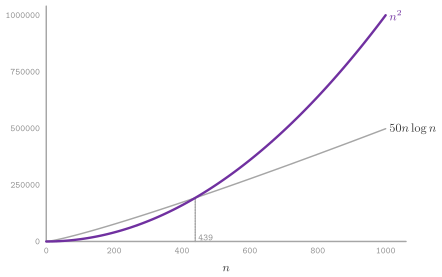
Two costs of the same order cannot be ranked by their orders, since the constants hidden by (1.10) depend on the machine. Two costs of different orders can, but only for \(n\) "large" enough, and the threshold may matter in practice. Figure 1.5 compares \(50 n \log n\), the count of a sort of order \(n \log n\) with a "large" constant, with \(n^2\), that of a quadratic sort with a small one. Here the quadratic sort is the faster up to \(n \approx 439\) (where \(n = 50 \log n\)), and the slower beyond. This is why the quicksorts of chapter 12 switch to the insertion sort on the "short" ranges, where its "small" constant usually wins.
1.5.4 Randomization and probability¶
We call randomized the structures of the library that make random choices that depend neither on the items they store nor on the operations they receive (the levels of a skip list, the priorities of a treap, the function of a universal hash), and the running time of an operation is then a random variable. For a discrete random variable \(X\) on a countable set \(U\), its expected value is
In the analyses of this manual we take the probabilities over the random choices of the structure, never over its input, unless the contrary is said (as for the average cases of chapter 12). The property that the analyses use most is the linearity of expectation, i.e., \(\mathrm{E}[ X_1 + \cdots + X_k ] = \mathrm{E}[ X_1 ] + \cdots + \mathrm{E}[ X_k ]\) for any random variables, independent or not (Motwani and Raghavan 1995, §1.3). It is often applied to a count written as a sum of indicator variables, each one 1 when an event happens and 0 otherwise, whose expected value is the probability of its event.
Lemma 1.7. Let the \(n\) distinct items of a vector be in an order drawn uniformly among the \(n!\) orders, and let a scan keep the least item seen so far. The expected number of times that the least item changes (the first item included) is the harmonic number \(H_n = 1 + 1/2 + \cdots + 1/n\), and \(\ln( n + 1 ) \le H_n \le 1 + \ln n\).
Proof. Let \(I_i\) be 1 when the item of the place \(i\) is smaller than all the items before it (the places counted from 1, so that \(I_1 = 1\)). In a uniform order the relative order of the first \(i\) items is uniform, and their least is in any of the \(i\) places with the same probability; hence \(\mathrm{E}[ I_i ] = \Pr\{ I_i = 1 \} = 1 / i\), and by the linearity of expectation the number of changes \(X = I_1 + \cdots + I_n\) has \(\mathrm{E}[ X ] = H_n\). The bounds follow by summing \(\int_k^{k+1} \mathrm{d}x / x \le 1 / k\) for \(k = 1 , \ldots , n\), which gives \(\ln( n + 1 ) \le H_n\), and \(1 / k \le \int_{k-1}^k \mathrm{d}x / x\) for \(k = 2 , \ldots , n\), which gives \(H_n - 1 \le \ln n\). \(\square\)
The proof needs neither the distribution of \(X\) nor the independence of the
\(I_i\) (which happen to be independent), and the same device also bounds the
expected depth of a node of a treap and the expected cost of a randomized
quicksort (chapters 8 and 12). A bound
that holds with high probability holds with probability at least \(1 -
n^{-c}\) for a constant \(c > 0\), and it is stronger than a bound on the
expected value (when, as usual, the cost is also bounded in the worst case).
In ADS, the random choices come from the generators of
ADS/numeric/RandomGenerators.h (chapter 17), seeded
by the caller, and a run can thus be repeated exactly; the tests fix their
seeds.
1.6 The model of computation¶
We count the costs in the word-RAM with words of \(w\) bits (Hagerup
1998; Morin 2013,
§1.4). This is a random access machine
(Cook and Reckhow 1973) whose memory is a
sequence of cells of one word each, any of which is read or written in
constant time. All the operations on words take constant time, i.e., the
arithmetic (\(+\), \(-\), \(\cdot\), the division and the remainder), the
comparisons, the bitwise operations (and, or, exclusive or, negation) and the
shifts. We assume that a block of \(k\) words is allocated (and initialized) in
\(O( k )\) time, and that its address fits in one word. Our only assumption on
\(w\) is \(w \ge \log n\), where \(n\) is the number of items of the structure at
hand, since otherwise a word could not even count the items. A model in which
\(w\) grows with \(n\) in this way is called transdichotomous (Fredman and
Willard 1993). The space is counted in
words, and an item counts as one word. In ADS an item is of any type T, and
the costs count each copy, move or comparison of an item as one operation.
Thus, the cost of a structure of strings, say, is its count of operations
multiplied by the cost of one operation on two strings.
On the machines that the library targets \(w = 64\), and the model usually fits
them rather well. There is one exception, which the library meets quite
often: the product of two words is a number of \(2 w\) bits, which the
processors give in one instruction and C++20 does not (the integers of 128
bits are an extension of GCC and Clang). In ADS, the headers ADS/Portable.h
and ADS/Wide.h hide the difference behind a few tools in the namespace
ADS::detail, out of the API reference. These are wideProduct( a , b , hi ),
the product of two words of 64 bits, whose low word it returns and whose high
word it writes in hi, wideDivide( u1 , u0 , v , r ), the quotient of a
number of two words by one word (and the remainder in r), byteSwap( x ),
the 8 bytes of a word in the reverse order, and the signed integer Int128.
With ADS_WITH_BOOST the product is that of Boost.Multiprecision, which
Boost computes by the instruction of the processor where there is one (on
x86-64 the code is the same as that of unsigned __int128), and otherwise
(and in a constant expression) a computation on halves of 32 bits, which is
also wideProductHalves( a , b , hi ); the division is the division of two
digits of 32 bits by one, twice (Warren 2012, section
9-4). The swap is the builtin of GCC and
Clang, else the std::byteswap() of C++23, else the intrinsic of MSVC, and
else three exchanges by masks (of
the bytes, of the pairs of bytes and of the halves of the word). With \(a =
a_1 2^{32} + a_0\) and \(b = b_1 2^{32} + b_0\), where \(0 \le a_0 , a_1 , b_0 ,
b_1 < 2^{32}\), one has
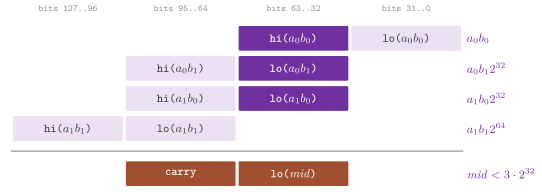
i.e., four products of 32 bits, each of which fits in a word (Figure 1.6 and Algorithm 1.4).
Algorithm 1.4. The product of two words by the products of their halves (after Knuth 1998, Algorithm 4.3.1M).
Lemma 1.8. The computation of
wideProductHalves() (Algorithm 1.4) gives the product \(a b\) exactly, i.e., its low
word and its high word, with no overflow of an intermediate word.
Proof. Each partial product \(p_{ij} = a_i b_j\) is below \(( 2^{32} - 1 )^2 < 2^{64}\); write \(p_{ij} = h_{ij} 2^{32} + l_{ij}\) with \(0 \le h_{ij} , l_{ij} < 2^{32}\). The middle sum \(\mathit{mid} = h_{00} + l_{01} + l_{10}\) adds three numbers below \(2^{32}\), and is thus below \(3 \cdot 2^{32} < 2^{64}\); write it as \(\mathit{mid} = m_1 2^{32} + m_0\), with \(0 \le m_0 < 2^{32}\). Substituting in (1.13), one has
where \(m_0 2^{32} + l_{00} < 2^{64}\); hence \(m_0 2^{32} + l_{00}\), which line 5 returns, is the low word of \(a b\), and \(p_{11} + h_{01} + h_{10} + m_1\), which line 4 writes in \(\mathit{hi}\), is \(\lfloor a b / 2^{64} \rfloor < 2^{64}\), the high word. Since its terms are not negative, each partial sum of the high word is below \(2^{64}\) as well, and no intermediate word overflows. \(\square\)
The signed integer of 128 bits is a pair of words in two's complement. It
is built from any integer by extending its sign, and it has the sums, the
differences and the products of the integers modulo \(2^{128}\) (exact when
the result fits), its equality and its
order (the high words compared as signed and then the low ones as unsigned),
and an explicit conversion to long double.
Lemma 1.9. Let \(a = a_h 2^{64} + a_l\) and
\(b = b_h 2^{64} + b_l\), with \(0 \le a_h , a_l , b_h , b_l < 2^{64}\), be
the two pairs of words of two values of Int128, which stand for \(a\) and
\(b\) minus \(2^{128}\) when the bit 63 of the high word is set. The low word of
\(a + b\) is \(r_l = ( a_l + b_l ) \bmod 2^{64}\), and the carry into the high
word is 1 if and only if \(r_l < a_l\); the low word of \(a - b\) is \(( a_l -
b_l ) \bmod 2^{64}\), with a borrow if and only if \(a_l < b_l\); and
\(a b \bmod 2^{128} = a_l b_l + ( ( a_l b_h + a_h b_l ) \bmod 2^{64} )
2^{64} \bmod 2^{128}\). Moreover, the order of the high words read as
signed words, and then of the low words read as unsigned ones, is the order
of the values.
Proof. Since \(0 \le a_l + b_l < 2^{65}\), the sum of the low words is
either below \(2^{64}\), and then \(r_l = a_l + b_l \ge a_l\), or at least
\(2^{64}\), and then \(r_l = a_l + b_l - 2^{64} < a_l\), since \(b_l < 2^{64}\);
the carry is 1 exactly in the second case. In the same way, \(a_l - b_l\) is
negative, and is then increased by \(2^{64}\), exactly when \(a_l < b_l\). As
for the product, \(a b = a_l b_l + ( a_l b_h + a_h b_l ) 2^{64} + a_h b_h
2^{128}\), and modulo \(2^{128}\) the last term vanishes, while of the middle
one only \(( a_l b_h + a_h b_l ) \bmod 2^{64}\) counts; the low word and the
part of \(a_l b_l\) beyond it are those of wideProduct()
(Lemma 1.8 for its portable form). Finally,
the value of a pair is \(\hat{a}_h 2^{64} + a_l\), with \(\hat{a}_h\) the high
word read as a signed word, and \(0 \le a_l < 2^{64}\). If \(\hat{a}_h <
\hat{b}_h\), then the value of \(a\) is at most \(\hat{b}_h 2^{64} - 2^{64} +
a_l < \hat{b}_h 2^{64} \le\) the value of \(b\); if the high words are equal,
the order is that of the low words. \(\square\)
The sums, the differences and the products are thus those of the integers
modulo \(2^{128}\), exact when the result fits. The random
queue of chapter 4 uses wideProduct() (for its draw of
an index), and the integers of any length of chapter
17 use it, or wideProductHalves() under
ADS_BIGINT_PORTABLE, for their products of digits; the learned index of chapter 6 and the branch
and bound of chapter 20 use Int128, and the sorts
of strings of chapter 12 and the search of several
patterns of chapter 15 use byteSwap().
The word-RAM ignores the memory hierarchy, which (as §1.1 recalls) may make two equal counts of operations differ by one order of magnitude in time. Instead, the external-memory model of Aggarwal and Vitter 1988 counts the transfers of blocks of \(B\) words between a memory of \(M\) words and a disk. Furthermore, the cache-oblivious model (Frigo et al. 2012) requires algorithms that are efficient in that model without knowing \(B\) and \(M\). Chapter 23 uses both, and the engineered structures of the other chapters cite them where their design follows them, while the models of the parallel computations (work and span, the shared memory and the passing of messages) are introduced in chapters 24 to 26.
1.7 Correctness, time and space¶
Three properties of a realization matter (Morin 2013, §1.5): the first is correctness, i.e., that it realizes its interface, the second is the time of its operations, and the third its space, both of which should be as small as possible. Of course, the three may conflict, since a structure may be faster in more space, or smaller and slower. Some structures (e.g., the filters of chapter 10) even trade a controlled probability of a wrong answer for space. Apart from those, we take correctness for granted in the analyses, and the library checks it at run time by contracts.
1.7.1 Correctness and contracts¶
A contract of an operation \(\mathit{op}\) is a pair of a precondition \(P\)
and a postcondition \(Q\), written \(\{ P \}\ \mathit{op}\ \{ Q \}\) after Hoare
1969. Here the caller ensures \(P\), and the
operation, under \(P\), ensures \(Q\). A structure also has an invariant \(I\), a
property of its representation that each operation which changes the
structure may assume at its start and must restore at its end, i.e., \(\{ P
\land I \}\ \mathit{op}\ \{ Q \land I \}\). In the design by contract of
Meyer 1992, a violated precondition is a
defect of the caller, and a violated postcondition or invariant a defect of
the operation. In ADS, the header ADS/Contract.h checks the contracts at
run time by four macros. They mirror the pre, post and contract_assert
of the contracts of C++26 (Berne et al.
2025), by which they can be replaced when
the compilers have them. Among them, ADS_PRE( c ) states a precondition,
ADS_POST( c ) a postcondition, ADS_INVARIANT( c ) the invariant of a
structure, and ADS_AUDIT( c ) a precondition or a postcondition that costs
more than the operation (e.g., that a vector is sorted, before a binary
search).
Checking a contract costs time, and the costs may differ by orders of
magnitude. For instance, \(\mathrm{empty}()\) before a \(\mathrm{pop}()\) costs
\(O( 1 )\), the order of a heap after an insertion \(\Theta( n )\), and the order
of a vector before a binary search \(\Theta( n )\) against the \(O( \log n )\) of
the search. The library therefore sorts its checks by their cost with respect
to the operation, and the macro ADS_CONTRACTS chooses which are evaluated
(Table 1.2).
Table 1.2. The contracts of Contract.h and
the level of ADS_CONTRACTS from which each is evaluated; the default level
is 1, and 0 when NDEBUG is defined (as for assert).
| Macro | Contract | Its cost | Level |
|---|---|---|---|
ADS_PRE |
a precondition | at most that of the operation | 1 |
ADS_POST |
a postcondition | at most that of the operation | 2 |
ADS_INVARIANT |
the invariant of a structure | usually \(\Theta( n )\) | 3 |
ADS_AUDIT |
a precondition or a postcondition | more than the operation | 3 |
Lemma 1.10. A check of cost \(g( n )\) added to an operation of cost \(t( n )\) makes it cost \(O( t( n ) + g( n ) )\), which is \(O( t( n ) )\) if and only if \(g( n ) = O( t( n ) )\). Hence at the levels 1 and 2 the bounds of the operations hold as stated, while at the level 3 a sequence of \(k\) operations of \(O( 1 )\) time that each check an invariant of \(\Theta( n )\) takes \(\Theta( k n )\) time.
Proof. The first claim follows from the definition (1.10), since \(t( n ) +
g( n ) \le 2 \max\{ t( n ) , g( n ) \}\). The second rests on the rule of
Table 1.2, which the library follows and its tests cannot prove, i.e., a condition checked by ADS_PRE or ADS_POST costs at
most as much as its operation. The third follows from the first, with \(t(
n ) = O( 1 )\) and \(g( n ) = \Theta( n )\), summed over the \(k\) operations.
\(\square\)
The level 3 is thus meant for the tests, which are all compiled at it (both
the CMake files and the makefile define ADS_CONTRACTS=3 for them), since a
linear algorithm may become quadratic there. Each macro expands to one check,
ADS_CONTRACT_CHECK( level , kind , cond ), which calls detail::violated()
when the condition is false
(Algorithm 1.5).
Algorithm 1.5. The check of a contract, the
body of the macro ADS_CONTRACT_CHECK.
The test of the level is an if constexpr. A condition is therefore compiled
at each level, and stays correct C++ (a change of the code that breaks it is
noticed at once), but it is evaluated only from its level up. Hence a
condition must have no side effects, since a program must behave in the same
way at all the levels. A violated contract throws ADS::contract_violation,
a std::logic_error whose message names the kind of contract, the condition,
the function and the place in the source; a test can thus check that a
precondition is enforced. Two helpers of the namespace ADS::detail serve
the conditions. The first, equal( a , b ), is a == b when the items have
an equality, and true otherwise, two items unequal to themselves (as two NaN)
counting as equal, so that a postcondition on a stored NaN holds. The second,
snapshot( x ), is a copy of x, wrapped in a std::optional, made only at
the level 3 (below it, std::nullopt), for the audits that compare a
structure with its state before the operation.
1.7.2 Running times¶
We meet three kinds of bounds on the running time (Morin 2013,
§1.5). A worst-case bound \(f( n )\) holds
for each single operation, which never takes longer. An amortized bound
\(f( n )\) holds on average over each sequence of operations: any sequence of
\(m\) operations that starts from an empty structure takes at most \(m f( n )\)
time, although some of its operations may take longer (Tarjan
1985). An expected bound \(f( n )\)
bounds the expected value of the running time, which is a random variable
over the choices of the structure (§1.5.4).
These kinds may combine; for instance, the insertion into a hash table that is
rebuilt when it grows takes \(O( 1 )\) expected amortized time (chapter
7, and the Bag of Lemma
1.4).
We usually prove an amortized bound by a potential, i.e., a function \(\Phi \ge 0\) of the state of the structure, equal to \(0\) on the empty one, and then the \(i\)-th operation, of actual cost \(c_i\), has the amortized cost \(c_i + \Phi_i - \Phi_{i-1}\), where \(\Phi_{i-1}\) and \(\Phi_i\) are the potentials before and after it. Consider, for instance, a vector that starts empty with capacity \(c = 0\), and doubles its capacity when it is full (from 0 to 1 at the first insertion), with the potential \(\Phi = 2 n - c\) when it holds \(n\) items.
Lemma 1.11. If each operation of every sequence that starts from the empty structure has amortized cost at most \(f( n )\), then any \(m\) such operations cost at most \(m f( n )\) in all. On the vector that doubles, every sequence of \(m\) insertions costs at most \(3 m\), counting one per item written or moved, and \(n \le c \le 2 n\) after the first insertion.
Proof. Summing the amortized costs, the differences of \(\Phi\) telescope, and \(\sum_i c_i \le m f( n ) - \Phi_m + \Phi_0 \le m f( n )\), since \(\Phi_m \ge 0 = \Phi_0\). On the vector, \(n \le c \le 2 n\) holds after the first insertion, which leaves \(n = c = 1\), and it is kept by each insertion: one that finds \(n < c\) makes \(n + 1 \le c\), and one that finds \(n = c\) doubles \(c\) to \(2 n < 2 ( n + 1 )\); hence \(\Phi \ge 0\). An insertion that finds \(n < c\) costs 1 and raises \(\Phi\) by 2, i.e., it has amortized cost 3. One that finds \(n = c \ge 1\) moves the \(n\) items and writes one, at the cost \(n + 1\), while \(\Phi\) goes from \(2 n - n = n\) to \(2 ( n + 1 ) - 2 n = 2\), i.e., the amortized cost is \(n + 1 + 2 - n = 3\); the first insertion costs 1 and leaves \(\Phi = 1\). The first part, with \(f( n ) = 3\), gives the bound. \(\square\)
The growth of std::vector by any constant factor \(\gamma > 1\) behaves in
the same way (Lemma 3.3). A worst-case bound is
the strongest of the three, and the other two are accepted since they often
(but not always) give "simpler" structures, or a lower cost on average, or
both. An amortized bound suits a program that needs a bound on the total
time of its operations, not one with a deadline on each response. An
expected bound, on the other hand, may be exceeded by an "unlucky" run, with
a probability that the analysis bounds.
1.7.3 Space¶
We count the space of a structure in words. It comprises the space of its items and that of the data it adds (pointers, indices, capacities, the free places of a vector), and the latter is its overhead. Typically, a list with pointers takes one or two words per item besides the items, and a vector that doubles its capacity up to twice the words of its items (Lemma 1.11). In chapter 2 the rootish and tiered arrays bring the "wasted" free places down to \(O( \sqrt{n} )\), and the blocked lists bring the overhead down to \(O( b + n / b )\), with blocks of \(b\) items. On the other hand, the succinct structures of chapter 22 count the space in bits, against the information-theoretic minimum \(Z\) of the objects they represent, and take \(Z + o( Z )\) bits, while answering their queries in constant or almost constant time.
1.8 Iterators and the standard interface¶
Beside the operations of their interfaces, the containers of ADS have the
interface of the standard library, i.e., begin() and end() of the
same type, the usual member types, and iterators of the strongest
category that the representation allows. An iterator is a position in a
container that can be read and moved. The standard library sorts the
iterators into categories by the moves they allow in constant time
(Stroustrup 2013, ch. 33): a
forward iterator moves on, a bidirectional one also back, and a
random-access one by any number of places, while a contiguous one reads
items that lie one after the other in memory. An algorithm states the
category it needs (std::sort() a random-access iterator,
std::reverse() a bidirectional one). In ADS, the iterators of
ADS/Iterators.h give the containers of the library the category of
their representation. Hence the range-for, the algorithms of std and of
std::ranges, and those of Boost visit them as they visit the containers
of the standard library (Table 1.3); the
tests interop.* check the category of each container at compile time
and run those algorithms on it.
Table 1.3. The iterators of Iterators.h,
what they walk, their categories and the cost of a step; \(m\) is the number
of places of a table, \(n\) the number of its occupied places and \(h\) the
height of a tree.
| Iterator | Walks | Category | Cost of a step |
|---|---|---|---|
LinkedIterator |
cells linked by pointers | forward | \(O( 1 )\) |
IndexIterator |
cells of a vector linked by indices | forward | \(O( 1 )\) |
CircularIterator |
a circular vector | random access | \(O( 1 )\) |
RankIterator |
a container read by rank, c[ i ] |
random access | that of c[ i ] |
IndirectIterator |
a vector of pointers, read through them | random access | \(O( 1 )\) |
SlotIterator |
the occupied places of a table | bidirectional | \(O( m / n )\) amortized over a whole visit |
KeyIterator |
the keys of the pairs that another iterator reads | that of the other, up to bidirectional | that of the other |
PathIterator |
a binary tree in symmetric order, by the path from the root | bidirectional | \(O( 1 )\) amortized over a whole visit, \(O( h )\) at most |
WalkIterator |
the nodes of a tree, by a policy | forward | that of the policy |
LinkedIterator walks cells linked by a pointer, its template parameters
naming the members of the link and of the item, with nil as the end. It is
the iterator of the singly linked lists, queues and stacks. In turn,
IndexIterator walks cells of a vector linked by an index (an int), with
\(-1\) as the end, any two ends being equal; it is the iterator of the
structures whose cells are a vector with a free list (e.g., the stacks of
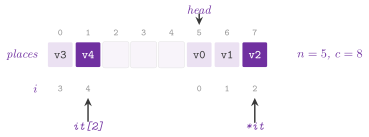
MultiStack, §3.4). CircularIterator reads a
circular vector of capacity \(c\) whose first item is at the place
\(\mathit{head}\), where the item of index \(i\), counted from the head, is at
the place
It keeps \(i\) instead of the place, and its moves, its differences
and its comparisons are thus those of the integers, and the order of
the items is that of the queue instead of that of the places
(Figure 1.7). RankIterator is a rank
with a pointer to its container, which computes the place of a rank,
as the rootish, dual and cubish arrays of chapter
2 do. IndirectIterator reads through a
random-access iterator on pointers, smart or not, as the heaps of
handles of chapter 9 need, and KeyIterator
reads the member first of what a forward iterator reads, i.e., the
keys of a dictionary as the items of a set, with the category of
that iterator up to bidirectional. Each iterator also gives what it
keeps, i.e., cell() for LinkedIterator, cells() and index()
for IndexIterator, base(), head(), capacity() and index()
for CircularIterator, owner() and rank() for RankIterator,
base() for IndirectIterator and place() for SlotIterator.
SlotIterator walks the places \(0 , \ldots , m - 1\) of a table, skipping
those that a policy declares empty (or deleted, for the open addressing with
lazy deletion), and reads each place through the policy. Since the static
functions size(), occupied() and read() of the policy take the owner
and the place, a policy nested in its owner can read its private fields
(Algorithm 1.6).
Algorithm 1.6. The steps of SlotIterator,
\(i\) the place and \(m\) the size of the table.
Lemma 1.12. On a table of \(m\) places, \(n
\ge 1\) of them occupied, a whole visit by SlotIterator, from the place 0
to the end, tests each place once, and takes \(\Theta( m )\) time, i.e.,
\(O( m / n )\) amortized time per item; a single step tests at most \(m\)
places.
Proof. The constructor and each next() (Algorithm
1.6) only increase \(i\), by one at each test
of a place that is not occupied and by one at each step, and the visit
stops at \(i = m\); hence each of the places \(0 , \ldots , m - 1\) is tested
once, and the \(n\) steps read \(n\) items. A single step tests the places
between two consecutive occupied ones, at most \(m\). \(\square\)
The bound is \(O( 1 )\) per item when the load \(n / m\) is bounded from below
by a constant, as in the hash tables that halve their table when they get
"too empty"; a single step, however, may test \(\Theta( m )\) places, and
prev(), which tests the places backward, behaves in the same way.
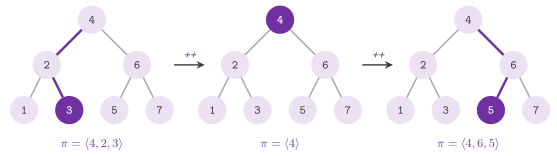
PathIterator visits a binary tree in symmetric order keeping the
path \(\pi\) from the root to the current node, the end being the
empty path. It therefore needs no link to the parent in the nodes,
and it goes both ways (a step back from the end reaching the last
node), and a policy gives the root, the children (nil for none) and
the reading of a node (Algorithm 1.7
and Figure 1.8).
Algorithm 1.7. The steps of PathIterator,
\(\pi\) the path from the root to the current node.
In the code, we write the two steps once, with the side as a parameter,
since prev() is next() with the two children exchanged.
Lemma 1.13. The next node in symmetric order
is the leftmost node of the right subtree of the current node \(x\) if \(x\)
has a right child, and otherwise the lowest ancestor of \(x\) whose left
subtree contains \(x\). A whole visit of a tree of \(n\) nodes by PathIterator
costs \(\Theta( n )\), i.e., \(O( 1 )\) amortized per step. A single step makes
at most \(h + 1\) pushes or pops, and the path takes \(O( h )\) space.
Proof. In symmetric order the nodes of each subtree are consecutive, those
of the left subtree of a node \(z\) before \(z\) and those of its right subtree
after it. If \(x\) has a right child, the nodes that follow \(x\) within its
subtree are those of its right subtree, the leftmost first. Otherwise \(x\) is
the last node of its own subtree. It stays the last node of the subtree
of each ancestor reached going up from a right child; the first ancestor \(y\)
reached from a left child has \(x\) as the last node of its left subtree, and
hence follows \(x\) (if there is no such ancestor, \(x\) is the last node of the
tree). The code of step() does exactly this. It descends from the right
child pushing the left path (lines 4 and 5 of next()), or it pops \(\pi\) as
long as the node popped is the right child of the new last node of \(\pi\)
(lines 7 to 9), leaving \(y\) last, or \(\pi\) empty at the end. Hence \(\pi\) is always the path from the root to the current node. In a whole visit, from
the first node to the end, each node is pushed once, when the visit first
reaches it going down from its parent (or as the root), and popped once,
when the visit leaves its subtree, and the visit therefore makes \(n\) pushes and \(n\) pops. A single step pushes or pops nodes of one path from the root,
at most \(h + 1\) of them, and \(\pi\) never holds more. \(\square\)
The amortized bound holds for a whole visit (or for a visit of \(s\)
consecutive steps, at \(O( s + h )\)), not for any sequence of steps, since a
sequence that goes forward and back across the root of a tall subtree pays
\(\Theta( h )\) at each step. We note that the path takes \(O( h )\) space,
against the \(\Theta( n )\) space of the links to the parents that an iterator
without a path needs, and on a balanced tree \(h = O( \log n )\). Finally,
WalkIterator follows the nodes of a tree (pointers or indices) by a policy,
whose next( o , n , root ), with o a pointer to the owner (nil if the
nodes need none), gives the node after \(n\) in a walk below \(\mathit{root}\),
or the end none. Such policies give the children of a node, and the
preorder and the symmetric order by the links to the parents, with no stack.
LinkedIterator, IndexIterator, CircularIterator and RankIterator
have a constant and a mutable form, by the parameter Const, and the
mutable one converts to the constant one. IndirectIterator,
SlotIterator, KeyIterator and PathIterator read constant items, while
WalkIterator gives the nodes by value. Containers that keep an invariant
on their items (a heap, an ordered set, a dictionary) expose only the
constant form, since the operations of their interfaces are then the only
"safe" way to change them, and an iterator stays valid as long as the cells
(or the vector) it refers to do. In some containers the item read is built
on the fly (a pair of references, a key rebuilt along a trie, the number of
a node). Such an iterator models the concepts of C++20, but it declares
the category of an input iterator to the older algorithms, as the views of
the standard library do; with it, one should use std::ranges::prev and
the algorithms of std::ranges. Also, the iterators are adaptors with no
contracts, and the containers check theirs.
The pair that the iterators of a dictionary read is a PairRef< A , B >,
two references into the dictionary (or a key rebuilt and a reference),
while the value_type of the iterator and of the dictionary is the pair
of the copies, std::pair< K , V >, as in the containers of the standard
library, which also give key_type and mapped_type. A vector of
std::ranges::range_value_t of a dictionary, or the one that
std::ranges::to< std::vector >() builds from it, thus holds copies, which
neither a rebuilding nor the destruction of the dictionary invalidates
(with a pair of references as its value type, it would hold references
into the dictionary, left dangling by either). Where C++23 declares the
common reference of a pair of references and of a pair of values,
PairRef is the std::pair itself; otherwise it is a class derived from
the pair that declares that common reference, so that the iterators model
the concepts of C++20, and it is tuple-like as the pair, for the
structured bindings, std::views::keys (of C++20) and std::format.
1.8.1 Boost and the standard library¶
We now describe the headers of ADS/interop/. By them, a program written
on Boost or on the standard library runs the algorithms of that library on
the structures of ADS, and those of ADS on the structures of that library,
usually by changing one type. The headers of ADS/interop/boost/ are
compiled only with ADS_WITH_BOOST (the component Boost of
find_package(ADS)), and no other header of the library includes them.
There is one header per library of Boost, since some of these may not share
a translation unit; for instance, boost/range/algorithm.hpp declares a
function boost::sort, which clashes with the namespace that
boost/sort/sort.hpp opens under the same name.
Graph.h specializes boost::graph_traits and boost::property_map for
StaticGraph and ArrayGraph, which then model the incidence, adjacency,
vertex-list and edge-list graphs of Boost.Graph with no copy. An edge is
the pair of its tail and of its place in the compressed rows, which is also
its edge_index (stable, since the graph is static); a scan of the
out-arcs is the scan of a row, and a weight is read where it lies. Hence
the visits, the algorithms of Dijkstra and of Bellman and Ford, the strong
components, the topological order and the three maximum flows of
Boost.Graph run on these graphs. (The flows of Boykov and Kolmogorov and
the push-relabel one need a separate reverse for each arc.) The tests
engineered_interop.bgl-row-graphs and
.bgl-max-flows compare their results with those on
compressed_sparse_row_graph and with the algorithms of ADS. Also,
ListGraph and ObservedGraph on it are mutable graphs of Boost.Graph,
whose edge is the pair ( tail , head ) and whose weight is looked up in
\(O( \deg u )\) time. Their add_edge(), remove_edge(), add_vertex(),
clear_vertex() and remove_vertex() are the operations of the graph;
hence, a program of Boost.Graph that edits an ObservedGraph sends the
events of §1.13 to its observers (e.g., to a
reoptimizing observer of the shortest paths, as in
engineered_interop.bgl-list-graphs).
Two choices of the adapter come from the graphs of ADS. First, the
orientation of an ADS graph is a flag at run time, and therefore each graph
is seen as oriented: an unoriented graph has both arcs of each edge, which
the oriented algorithms read correctly, while the algorithms that require
undirected_tag do not take it. Second, the names of the nodes are stable,
and a removed vertex leaves the other vertices with their names (unlike a
boost::adjacency_list on vecS); num_vertices() is then bound(),
which gives the maps of Boost indexed by vertex_index a place for each
name. The free functions are in the namespace ADS, where
argument-dependent lookup finds them whatever the order of the includes.
Note that edges( g ) of the two graphs in compressed rows is then that of
Boost.Graph, which is more specialized than the function of
§14.9 (written ADS::edges< G >( g ) in this
case).
The other direction is FromBGL< BG , WeightMap > of FromBGL.h, a view
of a graph of Boost.Graph with a vertex index as a Graph of ADS, the
weights read from a property map. The test
engineered_interop.bgl-from-bgl runs the shortest paths and the strong
components of ADS on it. On
a boost::adjacency_list on vecS the view is also a dynamic graph, and
an ObservedGraph on it changes the graph of Boost while it sends its
events; a deleted node keeps its vertex, isolated, since remove_vertex()
on vecS would rename the vertices after it. In Dijkstra.h,
UpdatableQueue makes any queue of the frontier of the shortest paths
(§14.8) the buffer of
boost::breadth_first_visit(). Since boost::dijkstra_shortest_paths()
does not let the caller replace its 4-ary heap, dijkstraShortestPaths()
is the algorithm of Dijkstra of Boost.Graph on such a buffer, i.e., the
visit with a visitor that relaxes the arcs. Heap.h makes the mutable
heaps of Boost.Heap queues that lower their keys natively, by the free
queue_decrease() of §1.14. This function
calls increase(): a heap of Boost has on top the largest item in the
order of its comparator, and with std::greater the fall of a distance
moves the item toward the top. Finally, Iterator.h gives Boost the
traversal of the iterators of ADS that build their item (that of their
concept of C++20, instead of the single pass of their legacy category),
and Boost.Range then takes the dictionaries and the search trees. It does
so only for the types of the namespace ADS, and it must be included
before the headers of Boost that read the traversal.
With the standard library, TieredVector, RootishArrayStack, Treque,
CubishArrayStack and DualArrayDeque have the members by iterator of a
sequence container (insert( p , x ), emplace( p , ... ), erase( p )
and erase( first , last )), each one operation by rank at the rank of the
iterator. Hence std::flat_set and std::flat_map of C++23 keep their
keys in them. StdSequence< S > of interop/std/FlatMap.h adds the same
members to another sequence that inserts by rank, such as
ContiguousDeque, whose iterators are pointers (with them, a member
insert( 0 , x ) would be ambiguous between a rank and a null pointer). On
TieredVector, TieredFlatMap keeps the binary search of a flat map and
inserts in \(O( \sqrt{n} )\) time instead of the \(O( n )\) of a
std::vector. Furthermore, PmrResource of interop/std/Pmr.h makes a
PoolResource (chapter 5) a
std::pmr::memory_resource, at the price of one virtual call per
allocation, and the sorts of chapter 12 take any sized
random-access range beside std::vector, in place when the range is
contiguous (and, for the sorts of the book, also when it is not). With ADS_WITH_GMP,
BigInteger::fromGmp(), toGmp() and the constructors from mpz_class
and mpq_class (and the same members of Rational) pass the numbers to
and from GMP without a string. The tests are engineered_interop.*; with
ADS_WITH_BOOST off, they check only the part of the standard library.
Appendix C shows these adapters at work, with those
of LEMON and of the runtimes of a program, by examples.
1.9 The two levels of the library¶
The library has two levels, written to be read and used side by side. At
the textbook level, ADS realizes each structure in the form of a
textbook. Our main one is Montresor
2025, whose exercises are tests of
the library, followed by Morin 2013,
Knuth 1997, Sedgewick
1998 and Cormen et al.
2022 for what that book does not cover.
At this level the names of the operations, the pseudocode in the comments
and the code follow the text line by line, and the contracts state its
preconditions. Its code is written to be portable and readable rather than
"tuned". At the engineered level, ADS realizes the variants of the
literature on algorithm engineering (Ferragina
2023; Sanders et al.
2019). These keep the interface of a
textbook structure and change its representation to use the caches, the
instructions on several items at once and the cores of a machine. For
instance, the hash table with open addressing of Montresor 2025,
§7.2.2 is OpenHashTable. Its
engineered counterpart is FlatHashTable, after the tables of Boost, with
groups of 15 places and a byte of fingerprint per place, compared all at
once. Similarly, the quicksort of the book stands beside ADS::sort, which
is compared with the sorts of the standard library and of Boost. Each
engineered structure cites the work it follows, and the benchmarks of
bench/ compare it with the best implementations available (appendix
B). Each chapter describes both levels, and says
what the second changes and why it is faster.
Also, the code follows a few conventions. We write each realization as one header, included by its path (e.g.,
#include "ADS/stack/ArrayStack.h"), which declares its classes and
functions with their contracts. At its end the header includes the
definitions of its templates, in the folder impl/ next to it (e.g.,
ADS/stack/impl/ArrayStack.tpp). All the names are in the namespace ADS,
and the details of the implementation in ADS::detail, out of the API
reference. Each operation states its cost in its comment, and the operations
of the textbooks also give there their pseudocode, in the conventions of the
front matter of this manual, from which the manual extracts it. Members of
the classes are named f_ followed by the name of the text, a return( x );
has its parentheses, and the code is formatted by the rules of the repository
code-style. In the code and in the text we always denote by \(n\) the number
of items of the structure at hand.
We test the library with GCC and Clang on Linux, macOS and Windows, and with
MSVC on Windows. Besides ADS/Portable.h, the few dependencies on the
platform are optional backends, each used only when it is found, i.e., GMP
for the integers of any length, a CBLAS for the products of matrices, the
headers of Boost for the four structures that delegate to it where it is
found (PointerTable, FlatHashTable, SmallVector and the generators
xoshiro256, §7.6) and for the product of two
words and the compare-and-swap of 16 bytes, hwloc for the placement of the
threads on the processors, OpenMP, oneTBB and FastFlow for the parallel
executors, the runtimes that a program
may already have (the parallel algorithms of the standard library, stdexec,
Taskflow, Kokkos and Boost.MPI) for the executors on them
(§25.4), and MPI for the distributed ones. The
library is also available as a module of C++20, ads, which exports all
the names that the headers declare in the namespace ADS, and as one
module for each of the sets that we describe next.
The flags of the compiler change some of the inline code of the library,
and in a few classes the layout, through four options: the matching of the
control bytes of the hash tables (ADS_FLAT_SIMD), the compare-and-swap of
16 bytes of ConcurrentFlatTable (ADS_FLAT_CAS16, that of Boost.Atomic,
free of locks on x86-64 under -mcx16 and -march=x86-64-v2), the
delegation of FlatHashTable to Boost, and the set of vector instructions
at which Google Highway compiles the kernels inlined in the searches. A
program often compiles a
hot file with -march=x86-64-v3 and the rest with the default, and its two
translation units then hold two definitions of one class, which the linker
merges without a word; an object of one unit may then run the code of the
other. For this reason ADS/Abi.h spells the four options in the name
of an inline namespace, e.g., abi_s1c1b0_N_AVX2, the last part being the
namespace that Highway gives to the set (none without Highway), in which
FlatHashTable,
DenseHashMap, ConcurrentFlatTable and FastHash are declared. Their
names in ADS stay the same, while the names that the linker sees change
with the options, and the two units get two distinct classes. We check it
by the test abi-units, which links two such units into one program and
checks that the tables of each hold what it put in them; without the
namespace the same program fails. It is fair to remark, however, that the
other macros of the configuration (e.g., the level of the contracts) must
still be the same in all the units of a program.
The vector kernels of ADS are written once on the portable operations of
Highway, with ADS_WITH_HIGHWAY, and the code of ADS has no branch on the
processor, the compiler or the system. The kernels that run on whole arrays
(the population counts, the intersections, the containers of
RoaringBitmap, the hash of the long strings, Stream VByte, the binary
packing and the sort, which is the quicksort of Highway) are those of
ADS/Simd.h. Highway compiles them for every set of instructions it knows
and chooses one when the program starts, at the cost of one call through a
table, and a program built without any flag of the machine thus runs the
vectors of the processor it finds. The kernels that run on a few bytes in
the middle of a search (the groups of the hash tables, the nodes of
AdaptiveRadixTree and of the B-trees, the blocks and the bins of the
filters, the rank in a line of a bit vector, the comparisons of lce() and
of StringSearcher) are inlined from ADS/SimdInline.h at the set given
to the compiler, which is why that set enters the name of the namespace
above. Without Highway every structure runs its scalar code, with the same
results. We leave the times of the kernels of Highway against those of the
intrinsics they replace to the campaign of bench/simd.py on an idle
machine, which also counts their instructions. No kernel of ADS runs on
the intrinsics of the target any longer: the strips of the edit distance,
the filter of the search of many patterns, the vector parts of the suffix
sorting and the back substitution of RibbonFilter are inlined from
ADS/SimdInline.h too.
The two levels are also two sets of headers, which a program may take
apart; we divide them by the origin of the code, whatever its speed. In the
base set lies what follows a textbook or an academic source (Montresor
2025, Knuth
1997, Morin
2013, and the book and the notes of
Ferragina 2023), even when the
result is fast. For instance, the Red-Black tree of SearchTree.h, the
B+-tree of BPlusTree.h and the hash tables of the book are base, and so
are BigInteger and Rational (which run on GMP where it is found), the
rank and select of RankSelect.h and the PGM-index. In the advanced set
lies what is written for speed beyond those sources (e.g., UnionFind,
DaryHeap, StaticGraph, CompactRankSelect, FastBitwise and
MultiwayMerge), with the concurrent and parallel structures, the
executors and the distributed layer. It also holds the typed modifications
and the observers (cf. §1.13), which no
textbook treats. Hence a structure of a textbook and its engineered
counterpart lie in different sets (e.g., MFSet and UnionFind,
HeapPriorityQueue and DaryHeap, ArrayGraph and StaticGraph,
DancingLinks and FastExactCover). An advanced structure extends a base
one through the same concepts and by composition, i.e., by algorithms
written once on a concept and by members of the base types. We do not
derive one from the other, since a hierarchy of classes with virtual calls
would cost the speed for which the advanced set exists.
A third set, the core, holds the infrastructure that both sets include
(the contracts, the iterators, the primitives of Portable.h, the
capabilities and the concept of the executors). It also holds a few
helpers of both levels, i.e., the pool of the nodes with its huge pages,
the random hashing of the randomized structures, the checks of the sorts,
the bits of the coders and the files of records. A base header may also
use an advanced one inside (e.g., SuffixArray.h sorts the ranks by
RadixSort.h, and ExternalSort.h merges its runs on a DaryHeap). We
list each use of this kind, with its reason, in the file of the sets; the
advanced header is then compiled with the base one, but its names are not
part of the base set. Five headers held a part of each set, and we split
each of them into a base header, which keeps its path, and a new advanced
one, which the base header includes; an include of the former thus gives
every name it gave before. Hence the push-relabel of MaxFlow.h is in
PushRelabel.h, the blossoms of Matching.h in BlossomMatching.h, the
components by one visit of Visit.h in StrongComponents.h, the
quicksort of Peters of EngineeredQuickSorts.h in PdqSort.h, and the
customization points of the queues of PriorityQueue.h in
QueueCustomization.h.
Each set has an entry point, a header that includes all the headers of
the set and the core. Thus #include "ADS/base.h" gives the base set,
ADS/advanced.h the advanced one, ADS/core.h the core and ADS/ADS.h
the three. Also, each header keeps its path, and one can still include any
of them as before. The modules follow the same division: ads.core,
ads.base and ads.advanced export the names of the headers of their sets
(the last two also those of ads.core, without importing it), and ads
exports the three. A
program that writes import ads; gets all the names as before, whereas one
that writes import ads.base; compiles neither the concurrent structures
nor the executors of OpenMP, oneTBB and MPI. The headers of ADS/interop/
(§1.8.1,
§14.14 and §25.4),
with distributed/BoostMPI.h, are a set of their own, interop, which no
entry point includes and no module exports, since each of them includes
the headers of another library and is included by the program that wants
it, next to them. The file cmake/ads_sets.txt
gives the set of each header, and from it the script cmake/ads_sets.py
writes the entry points and the table of the sets in the README. CMake, the
makefile and the continuous integration run the script, so a new header
with no set (or an include across the sets that the file does not allow)
stops the build. Finally, in Table 1.5 the
column Set gives the set of each header with classes, and the opening
paragraph of each chapter lists which of its headers are base and which are
advanced.
1.10 Building, testing and using the library¶
The library is header-only, and include/ is the whole of it. A program
that adds include/ to its path of headers (-I) and is compiled as C++20
can include any header. Its tests and benchmarks are built with CMake
(cmake -S . -B build, cmake --build build, ctest --test-dir build) or
with the makefile (make -j4 test). The file test/tests.txt lists the
tests, one per line, each with its program, its name and its source, and
ctest runs each one as <program>.<name>, e.g., ctest -R
ods_lists.ods-ex1.5.bag. A test program also runs one test by name and
lists its tests, and the test <program>.registry of each program checks
that tests.txt and the tests of the program agree. An installation
(cmake --install build --prefix <dir>) gives a package of CMake, used by
find_package(ADS) and the target ADS::ADS, and a file of pkg-config,
while the library is also distributed by several package managers, and can
be taken at configure time by FetchContent. Full instructions, with the
options of the backends and of the module, are in the sections Build and
test and Use of the README of the repository
(https://github.com/dmeoli/ADS#build-and-test), and the API reference,
generated from the comments of the headers, is at
https://dmeoli.github.io/ADS/.
1.11 How this manual is organized¶
In this manual we follow the order in which a course on data structures and algorithms meets its subjects, in four parts and some appendices. Part I, the foundations, has this chapter, the sequences (chapter 2), the stacks (chapter 3), the queues and the deques (chapter 4) and the management of the memory (chapter 5). Part II, on searching and ordering, has the searches in sorted data and the learned indexes (chapter 6), the hash tables, the tries and the structures on integers (chapter 7), and the trees (chapter 8). It goes on with the priority queues (chapter 9), the sets and the filters (chapter 10), the disjoint sets (chapter 11) and the sorts (chapter 12). Part III, on the algorithms, has the design of algorithms (chapter 13), the graphs (chapter 14), the strings (chapter 15) and the geometry (chapter 16), then the numerical algorithms (chapter 17), the combinatorial generation (chapter 18), the backtracking (chapter 19) and the intractable problems (chapter 20). Part IV, on engineering, has the compression (chapter 21), the succinct structures (chapter 22), the external memory (chapter 23), the concurrency (chapter 24), the parallelism (chapter 25) and the distributed computations (chapter 26). Then three appendices describe how to write a new structure (appendix A), the benchmarks (appendix B) and, by examples, the use of ADS with other libraries (appendix C), and the bibliography closes the manual.
Part I is needed by all the others, and Part II by most of Part III. In turn,
the chapters of Part IV need the structures that they compress, store or
share, and say so at their start. Each chapter covers the headers of one area
of include/ADS, named under its title (this one covers the headers at the
root of include/ADS and the interfaces of Morin), and has the same form.
For each structure it gives the abstract data type and its axioms, the
representation and its invariants, and figures of its state in memory before
and after the operations. Then come the pseudocode of the operations,
extracted from the headers, the analysis of the costs as lemmas with their
proofs, the declarations that a user calls with short examples of their
use, and the engineered variants with what they change. A section of
discussion and references and one of exercises, each solved by a test of the
library, close the chapter.
1.12 The map of the structures¶
In Table 1.4 we give the costs of the
operations of the realizations of the LIST, of the USet and of the SSet
that correspond to those of Morin 2013,
§1.7, as their headers state them and
their chapters prove them. Table 1.5 then
maps each class of the library to the chapter that describes it, one row
per header, and Table 1.6 lists by chapter
the headers that declare functions only. A script,
manual/build/structmap.py, writes the two tables from the headers
themselves. It lists a class when the class is defined at the scope of the
namespace ADS, or of a namespace nested in it other than ADS::detail,
outside the sections hidden from the API reference, and lists an alias of
such a class with it (e.g., UnionFind, the DisjointSets of the default
parameters). It also checks that each header and class of the tables
appears in this chapter. The tables leave out the concepts, the
enumerations and the aliases of plain types, which are described with their
areas, and the helper structures AVLTreeNodes, JoinTreeNodes,
SearchTreeNodes and TreapNodes, which the trees of chapter
8 define in their files impl/ to hold the operations
on their nodes.
Table 1.4. The costs of the realizations of the LIST, of the USet and of the SSet that correspond to those of Morin 2013, §1.7; A marks an amortized bound, E an expected one, \(b\) is the size of a block, \(w\) the length of a word and \(t \ge 2\) the minimum degree of a B-tree (with \(t\) a constant, both bounds are \(O( \log n )\)), and for the USet and the SSet the realizations are those of the DICTIONARY on the same representation.
| Realization | Read, write | Insert, remove | Chapter |
|---|---|---|---|
ArraySequence |
\(O( 1 )\) | \(O( 1 + n - i )\) A | 2 |
RingDeque |
\(O( 1 )\) | \(O( 1 + \min\{ i , n - i \} )\) A | 4 |
DualArrayDeque |
\(O( 1 )\) | \(O( 1 + \min\{ i , n - i \} )\) A | 2 |
RootishArrayStack |
\(O( 1 )\) | \(O( 1 + n - i )\) A | 2 |
List |
\(O( 1 + \min\{ i , n - i \} )\) | \(O( 1 + \min\{ i , n - i \} )\) | 2 |
SEList |
\(O( 1 + \min\{ i , n - i \} / b )\) | \(O( b + \min\{ i , n - i \} / b )\) A | 2 |
SkipListSequence |
\(O( \log n )\) E | \(O( \log n )\) E | 2 |
ChainedHashTable |
\(O( 1 )\) E | \(O( 1 )\) A, E | 7 |
OpenHashTable |
\(O( 1 )\) E | \(O( 1 )\) A, E | 7 |
SkipList |
\(O( \log n )\) E | \(O( \log n )\) E | 7 |
Treap |
\(O( \log n )\) E | \(O( \log n )\) E | 8 |
ScapegoatTree |
\(O( \log n )\) | \(O( \log n )\) A | 8 |
RedBlackTree |
\(O( \log n )\) | \(O( \log n )\) | 8 |
BinaryTrie |
\(O( w )\) | \(O( w )\) | 7 |
XFastTrie |
\(O( \log w )\) E | \(O( w )\) A, E | 7 |
YFastTrie |
\(O( \log w )\) E | \(O( \log w )\) A, E | 7 |
BTree |
\(O( t \log_t n )\) | \(O( t \log_t n )\) | 8 |
Table 1.5. Every class of the library, by
header (relative to include/ADS), and the chapter that describes it.
| Header | Set | Classes | Chapter |
|---|---|---|---|
Algebra.h |
advanced | SumOf, MinOf, MaxOf |
1 |
Capabilities.h |
core | forwarding_query, stable_references_t, thread_safe_reads_t, rank_complexity_t, event_set_t |
1 |
Contract.h |
core | contract_violation |
1 |
Modification.h |
advanced | Refused, no_rebuild_t, effect, Value, Key, Cost, Upper, Lower, Supply, last, min, max, sum, reduction_of, list, Inserted, Erased, Changed, Relocated, Permuted, BulkInserted, BulkErased, Shifted, Replaced, Cleared, Rebuilt, Group, Counts, Direct, Via, coalesce_traits, NoObservers, Static, Dynamic, Both, Batch, Quiet, UndoLog, Shadow, Assigned, KeyChanged, Reopt, ReoptStats, RatioPolicy, NeumaierSum |
1, 14 |
Iterators.h |
core | LinkedIterator, IndexIterator, CircularIterator, RankIterator, IndirectIterator, SlotIterator, KeyIterator, PairRef, PathIterator, WalkIterator |
1 |
interop/boost/Dijkstra.h |
interop | UpdatableQueue |
1 |
interop/boost/FromBGL.h |
interop | FromBGL |
1 |
interop/boost/Graph.h |
interop | Arc, RowWeightMap, ArcIndexMap, Edge, ListWeightMap |
1 |
interop/std/FlatMap.h |
interop | StdSequence |
1 |
interop/std/Pmr.h |
interop | PmrResource |
1 |
set/Bag.h |
base | Bag |
1 |
set/SetInterfaces.h |
base | ArrayUSet, ArraySSet |
1 |
sequence/ArraySequence.h |
base | ArraySequence |
2 |
sequence/ContiguousDeque.h |
base | ContiguousDeque |
2 |
sequence/CubishArrayStack.h |
base | CubishArrayStack |
2 |
sequence/CursorList.h |
base | CursorSpace, CursorList |
2 |
sequence/DualArrayDeque.h |
base | DualArrayDeque |
2 |
sequence/Fenwick.h |
advanced | Fenwick, FenwickObserver |
1 |
sequence/List.h |
base | List |
2 |
sequence/ObservableArray.h |
advanced | ObservableArray |
1 |
sequence/OrderMaintenanceList.h |
base | OrderMaintenanceList |
2 |
sequence/RootishArrayStack.h |
base | RootishArrayStack |
2 |
sequence/SEList.h |
base | SEList |
2 |
sequence/SequenceRange.h |
base | SequenceRange |
2 |
sequence/SinglyList.h |
base | SinglyList |
2 |
sequence/SkipListSequence.h |
base | SkipListSequence |
2 |
sequence/SmallVector.h |
advanced | SmallVector |
2 |
sequence/TieredVector.h |
advanced | TieredVector |
2 |
sequence/TreapList.h |
base | TreapList |
2 |
sequence/Treque.h |
base | Treque |
2 |
sequence/XorList.h |
base | XorList |
2 |
stack/ArrayStack.h |
base | ArrayStack |
3 |
stack/MinStack.h |
base | MinStack |
3 |
stack/MultiStack.h |
base | MultiStack |
3 |
stack/SequenceStack.h |
base | SequenceStack |
3 |
queue/ArrayQueue.h |
base | ArrayQueue |
4 |
queue/Dequeue.h |
base | Dequeue |
4 |
queue/LinkedQueue.h |
base | LinkedQueue |
4 |
queue/MinDeque.h |
base | MinDeque |
4 |
queue/MinQueue.h |
base | MinQueue |
4 |
queue/RandomQueue.h |
base | RandomQueue |
4 |
queue/RealTimeMinDeque.h |
base | RealTimeMinDeque |
4 |
queue/RealTimeMinQueue.h |
base | RealTimeMinQueue |
4 |
queue/RingDeque.h |
advanced | RingDeque |
4 |
queue/SlidingAggregate.h |
advanced | Amortized, WorstCase, SlidingAggregate |
1 |
queue/UniqueQueue.h |
base | UniqueQueue |
4 |
memory/Allocators.h |
base | BoundaryTagAllocator, BuddyAllocator |
5 |
memory/Arena.h |
advanced | Arena, ArenaResource |
5 |
memory/CellHeap.h |
base | CellHeap |
5 |
memory/ConcurrentPool.h |
advanced | ConcurrentPoolResource |
5 |
memory/HugePageAllocator.h |
core | HugePageAllocator |
5 |
memory/ObjectPool.h |
core | ObjectPool |
5 |
memory/PoolAllocator.h |
advanced | PoolResource, PoolAllocator |
5 |
memory/Prefetch.h |
core | Locality |
5 |
memory/SizeClassAllocator.h |
advanced | SizeClassAllocator |
5 |
search/CompressedPGMIndex.h |
advanced | CompressedPGMIndex |
6 |
search/DynamicPGMIndex.h |
advanced | DynamicPGMIndex |
6 |
search/PGMIndex.h |
base | PGMIndex |
6 |
search/RangeMinimum.h |
advanced | SparseTable, PlusMinusOneRangeMinimum, RangeMinimum |
6 |
search/StaticSearch.h |
advanced | SPlusTree |
6 |
search/WordRangeMinimum.h |
advanced | WordRangeMinimum |
6 |
dictionary/AdaptiveRadixTree.h |
advanced | AdaptiveRadixTree |
7 |
dictionary/BinaryTrie.h |
base | BinaryTrie, SimpleBinaryTrie |
7 |
dictionary/BitmapTrie.h |
base | BitmapTrie |
7 |
dictionary/BucketCuckooTable.h |
advanced | BucketCuckooTable |
7 |
dictionary/ChainedHashTable.h |
base | ChainedHashTable |
7 |
dictionary/CuckooHashing.h |
base | CuckooHashTable |
7 |
dictionary/DenseHashMap.h |
advanced | DenseHashMap |
7 |
dictionary/DirectTable.h |
base | DirectTable |
7 |
dictionary/FastHash.h |
advanced | Product128, FastHash |
7 |
dictionary/FingerprintPerfectHash.h |
advanced | FingerprintPerfectHash |
7 |
dictionary/FlatHashTable.h |
advanced | FlatHashTable |
7 |
dictionary/IndexedSkipList.h |
base | IndexedSkipList |
7 |
dictionary/KnuthHashing.h |
base | CoalescedHashTable, BrentHashTable |
7 |
dictionary/MinimalPerfectHash.h |
advanced | MinimalPerfectHash |
7 |
dictionary/OpenHashTable.h |
base | Probing, OpenHashTable |
7 |
dictionary/PatriciaTrie.h |
base | PatriciaTrie |
7 |
dictionary/PerfectHashing.h |
base | PerfectHashTable, OrderedMinimalPerfectHash |
7 |
dictionary/PointerTable.h |
advanced | StateEqual, PointerTable |
7 |
dictionary/PositionIndex.h |
advanced | PositionIndex |
7 |
dictionary/RandomHashing.h |
core | SplitMix64, ZobristTable, TabulationHash |
7 |
dictionary/RecSplit.h |
advanced | RecSplit |
7 |
dictionary/SkipList.h |
base | SkipList |
7 |
dictionary/SortedArrayDictionary.h |
base | SortedArrayDictionary |
7 |
dictionary/SuccinctPatriciaTrie.h |
advanced | SuccinctPatriciaTrie |
7 |
dictionary/Trie.h |
base | Trie, RadixTree |
7 |
dictionary/TwoLevelDictionary.h |
base | TwoLevelDictionary |
7 |
dictionary/UniversalHashing.h |
base | CarterWegmanHash, DotProductHash, MultiplyShiftHash, StringHash, MultiplicativeHash, CompoundHash, SequenceHash, DLeftHashTable |
7 |
dictionary/XFastTrie.h |
base | XFastTrie, ListXFastTrie |
7 |
dictionary/YFastTrie.h |
base | YFastTrie |
7 |
tree/AVLTree.h |
base | AVLTree |
8 |
tree/ArrayBinaryTree.h |
base | ArrayBinaryTree |
8 |
tree/BPlusTree.h |
base | BPlusTree |
8 |
tree/BTree.h |
base | BTree |
8 |
tree/BTreeMap.h |
advanced | BTreeMap |
8 |
tree/BinaryTree.h |
base | BinaryTree |
8 |
tree/ChildListTree.h |
base | ChildListTree |
8 |
tree/CursorBinaryTree.h |
base | CursorBinaryTree |
8 |
tree/CursorTree.h |
base | CursorTree |
8 |
tree/FingerTreap.h |
base | FingerTreap |
8 |
tree/HashedTreap.h |
base | HashedTreap |
8 |
tree/JoinAlgorithms.h |
advanced | AVLJoin, RedBlackJoin, WeightBalancedJoin, TreapJoin, JoinAlgorithms, TakeSecond, TakeFirst, Joinable |
8 |
tree/JoinTree.h |
advanced | AVLBalance, RedBlackBalance, WeightBalance, TreapBalance, NoAugmentation, SumAugmentation, MaxAugmentation, JoinTree, JoinAVLTree, JoinRedBlackTree, WeightBalancedTree, JoinTreap, AugmentedMap |
8 |
tree/LeftLeaningRedBlackTree.h |
base | LeftLeaningRedBlackTree |
8 |
tree/LinkCutTree.h |
advanced | LinkCutTree |
8 |
tree/MaterializedAggregate.h |
advanced | MaterializedAggregate |
8 |
tree/MeasuredSearchTree.h |
base | MeasuredSearchTree |
8 |
tree/ParentTree.h |
base | ParentTree |
8 |
tree/PartialRebuildingTree.h |
base | PartialRebuildingTree, WeightRebuildTree, CountdownTree, DynamiteTree |
8 |
tree/PreorderArrayTree.h |
base | PreorderArrayTree |
8 |
tree/RandomizedSearchTree.h |
base | RandomizedSearchTree |
8 |
tree/ScapegoatTree.h |
base | ScapegoatTree |
8 |
tree/SearchTree.h |
base | NotJoinable, SearchTree, BinarySearchTree, RedBlackTree |
8 |
tree/SplayTree.h |
advanced | SplayTree |
8 |
tree/ThreadedTree.h |
base | ThreadedTree |
8 |
tree/Treap.h |
base | Treap |
8 |
tree/Tree.h |
base | Tree |
8 |
priority/BucketQueue.h |
advanced | BucketQueue, BucketHeap, LargestSecondKey, LeastSecondKey |
9 |
priority/DaryHeap.h |
advanced | DaryHeap |
9 |
priority/DialQueue.h |
advanced | DialQueue |
9 |
priority/FibonacciHeapPriorityQueue.h |
base | FibonacciHeapPriorityQueue |
9 |
priority/HeapPriorityQueue.h |
base | HeapPriorityQueue |
9 |
priority/IndexedDaryHeap.h |
advanced | IndexedDaryHeap |
9 |
priority/IndexedHeapPair.h |
advanced | IndexedHeapPair |
9 |
priority/LinkedHeapPriorityQueue.h |
advanced | LinkedHeapPriorityQueue |
9 |
priority/ListPriorityQueue.h |
base | ListPriorityQueue |
9 |
priority/LoserTree.h |
base | LoserTree |
9 |
priority/MeldableHeap.h |
base | MeldableHeap |
9 |
priority/MinMaxHeap.h |
advanced | MinMaxHeap, IntervalHeap |
9 |
priority/MultiwayMerge.h |
advanced | FlatLoserTree |
9 |
priority/PairingHeap.h |
advanced | PairingHeap |
9 |
priority/RadixHeap.h |
advanced | RadixHeap |
9 |
priority/SequenceHeap.h |
advanced | SequenceHeap |
9 |
priority/TreePriorityQueue.h |
base | TreePriorityQueue |
9 |
set/BinaryFuseFilter.h |
advanced | BinaryFuseFilter |
10 |
set/BlockedBloomFilter.h |
advanced | BlockedBloomFilter |
10 |
set/BloomFilter.h |
base | BloomFilter |
10 |
set/BloomVariants.h |
base | SpectralBloomFilter, PartitionedBloomFilter |
10 |
set/BoolSet.h |
base | BoolSet |
10 |
set/CuckooFilter.h |
advanced | CuckooFilter |
10 |
set/DictionarySet.h |
base | DictionarySet, ChainedHashSet, OpenHashSet, TreeSet |
10 |
set/GrafiteFilter.h |
advanced | GrafiteFilter, BucketingFilter |
10 |
set/HashMultiset.h |
base | HashMultiset |
10 |
set/LinkedHashSet.h |
base | LinkedHashSet |
10 |
set/ListSet.h |
base | ListSet |
10 |
set/PrefixFilter.h |
advanced | PrefixFilter |
10 |
set/RibbonFilter.h |
advanced | RibbonFilter |
10 |
set/RoaringBitmap.h |
advanced | RoaringBitmap |
10 |
set/SortedIntersection.h |
base | PermutedBuckets |
10 |
set/SortedListSet.h |
base | SortedListSet |
10 |
set/SpaceEfficientSortedSet.h |
base | SpaceEfficientSortedSet |
10 |
mfset/ListMFSet.h |
base | ListMFSet |
11 |
mfset/MFSet.h |
base | MFSet |
11 |
mfset/RemUnionFind.h |
advanced | RemUnionFind |
11 |
mfset/RollbackUnionFind.h |
advanced | RollbackUnionFind, ConnectivityOp |
11 |
mfset/UnionFind.h |
advanced | DisjointSets, UnionFind |
11 |
sort/QuicksortAdversary.h |
advanced | QuicksortAdversary |
12 |
algorithm/MasterTheorem.h |
base | Growth |
13 |
algorithm/MaximumSegments.h |
base | Segment |
13 |
optimization/GridPaths.h |
base | GridSquare |
13 |
optimization/OptimalSearchTree.h |
base | OptimalSearchTree |
13 |
optimization/WeightedIntervals.h |
base | WeightedInterval |
13 |
graph/AllPairsShortestPaths.h |
base | AllPairs |
14 |
graph/ArrayGraph.h |
base | ArrayGraph |
14 |
graph/Assignment.h |
advanced | Assignment |
14 |
graph/Graph.h |
base | GraphNodes |
14 |
graph/GraphBuilder.h |
advanced | GraphBuilder |
14 |
graph/GridGraph.h |
advanced | GridGraph |
14 |
graph/IncidenceGraph.h |
base | IncidenceGraph |
14 |
graph/ListGraph.h |
base | ListGraph |
14 |
graph/MatrixGraph.h |
base | MatrixGraph |
14 |
graph/MaxFlow.h |
base | FlowNetwork, BoundedEdge |
14 |
graph/MinimumSpanningTree.h |
base | WeightedEdge, MergeCounts |
14 |
graph/Observable.h |
advanced | NodeInserted, NodeDeleted, EdgeInserted, EdgeDeleted, WeightChanged, GraphEvents, coalesce_traits, ObservedGraph, Observable |
14 |
graph/PointerGraph.h |
advanced | PointerGraph |
14 |
graph/Reoptimization.h |
advanced | EventQueue, ShortestPathsObserver, SpanningForestObserver, AugmentEngine, MaxFlowObserver, AssignmentObserver |
14 |
graph/ShortestPaths.h |
base | ShortestPathTree, FrontierCounts, PriorityFrontier, QueueFrontier, StackFrontier, DequeFrontier |
14 |
graph/StaticGraph.h |
advanced | WeightedArc, StaticGraph |
14 |
graph/Visit.h |
base | VisitCounts, DfsSchema |
14 |
interop/Csr.h |
interop | CsrInput, Partition |
14 |
interop/graphblas/GraphBLAS.h |
interop | Matrix |
14 |
interop/kahip/KaHIP.h |
interop | Options, Input |
14 |
interop/lemon/Digraphs.h |
interop | StaticDigraphBase, StaticDigraphView, GraphView |
14 |
interop/lemon/Heaps.h |
interop | CmpKey, DaryHeap, MonotoneHeap |
14 |
interop/lemon/Maps.h |
interop | DenseMap, IndexMap, ObservedMap |
14 |
interop/lemon/Observers.h |
interop | Ends, LemonTap, LemonMirror |
14 |
interop/lemon/Warm.h |
interop | PreflowEngine, NetworkSimplexAssignment, MinCostFlowObserver |
14 |
interop/metis/Metis.h |
interop | Options, Input |
14 |
interop/networkit/NetworKit.h |
interop | NetworKitMirror |
14 |
string/AhoCorasick.h |
advanced | AhoCorasick |
15 |
string/FrontCoding.h |
base | FrontCodedDictionary |
15 |
string/LongestCommonExtension.h |
advanced | LceIndex |
15 |
string/MultiSearch.h |
advanced | MultiSearcher |
15 |
string/Palindromes.h |
base | Eertree |
15 |
string/PrefixSearch.h |
base | BinnedSearch, BinnedStringSearch |
15 |
string/RearCoding.h |
base | RearCodedDictionary |
15 |
string/StringSearch.h |
advanced | StringSearcher |
15 |
string/SuffixApplications.h |
base | CopyPhrase |
15 |
string/SuffixArray.h |
base | SuffixArray |
15 |
string/SuffixAutomaton.h |
advanced | SuffixAutomaton |
15 |
string/SuffixTree.h |
base | SuffixTree |
15 |
geometry/ConvexHull.h |
base | Point |
16 |
geometry/IntervalTree.h |
advanced | IntervalTree |
16 |
geometry/RangeTree.h |
advanced | RangeTree |
16 |
numeric/BigInteger.h |
base | BigInteger |
17 |
numeric/Combinatorics.h |
base | FibonacciCache |
17 |
numeric/CsrMatrix.h |
advanced | BasicCsrMatrix, CsrMatrix |
17 |
numeric/DenseMatrix.h |
advanced | DenseMatrix |
17 |
numeric/DynamicCsr.h |
advanced | DynamicCsr, DynamicCsc |
17 |
numeric/NumberTheory.h |
base | Montgomery64 |
17 |
numeric/RSA.h |
base | RsaKey |
17 |
numeric/RandomGenerators.h |
advanced | Xoshiro256T, WyRand, PhiloxT, AliasTable, Xoshiro256, Xoshiro256StarStar, Philox4x32, Philox4x64 |
17 |
numeric/RandomNumbers.h |
base | LinearCongruential, LinearCongruentialT, MinStd, Mmix |
17 |
numeric/Rational.h |
base | Rational |
17 |
numeric/SellMatrix.h |
advanced | SellMatrix |
17 |
numeric/SparseAssembly.h |
advanced | AssemblyWorkspace |
17 |
numeric/SparseMatrix.h |
base | SparseMatrix |
17 |
backtrack/DancingLinks.h |
base | ExactCover |
19 |
backtrack/FastExactCover.h |
advanced | FastExactCover |
19 |
backtrack/SatSolvers.h |
base | BasicCdcl, Cdcl |
19 |
complexity/Domino.h |
base | Tile |
20 |
complexity/Nondeterminism.h |
base | Chooser |
20 |
intractable/Heuristics.h |
base | Buckets |
20 |
intractable/Pseudopolynomial.h |
base | Piece |
20 |
compression/ArithmeticCoding.h |
base | RangeEncoder, RangeDecoder |
21 |
compression/BurrowsWheeler.h |
base | BWT |
21 |
compression/CanonicalHuffman.h |
base | CanonicalHuffman |
21 |
compression/DirectAccessCodes.h |
advanced | DirectAccessCodes |
21 |
compression/FMIndex.h |
base | FMIndex |
21 |
compression/HuffmanFMIndex.h |
advanced | HuffmanFMIndex |
21 |
compression/IntegerCodes.h |
base | PForDeltaBlock |
21 |
compression/LempelZiv.h |
base | LZ77Phrase, LZSSPhrase, LZ78Phrase |
21 |
compression/MoveRIndex.h |
advanced | MoveRIndex |
21 |
compression/PPM.h |
base | PPMModel |
21 |
compression/PackedBits.h |
core | PackedBitWriter, PackedBitReader |
21 |
compression/RIndex.h |
advanced | RIndex |
21 |
interop/arrow/Arrow.h |
interop | ArrowColumn |
22 |
succinct/BPTree.h |
base | BPTree |
22 |
succinct/BVGraph.h |
base | BVGraph |
22 |
succinct/BalancedParentheses.h |
base | BalancedParentheses |
22 |
succinct/BitStream.h |
base | BitWriter, BitReader |
22 |
succinct/BitVector.h |
base | SubscriptIterator, BitVector |
22 |
succinct/CompactRankSelect.h |
advanced | CompactRankSelect |
22 |
succinct/EliasFano.h |
base | BasicEliasFano, EliasFano, LazyEliasFano |
22 |
succinct/EliasFanoGraph.h |
base | EliasFanoGraph |
22 |
succinct/HuffmanWaveletTree.h |
base | HuffmanWaveletTree |
22 |
succinct/InterleavedRankSelect.h |
advanced | InterleavedRankSelect |
22 |
succinct/JacobsonTree.h |
base | JacobsonTree |
22 |
succinct/K2Tree.h |
base | K2Tree |
22 |
succinct/LAVector.h |
advanced | LAVector |
22 |
succinct/LoudsTree.h |
base | LoudsTree |
22 |
succinct/MoveStructure.h |
advanced | MoveStructure |
22 |
succinct/PackedArray.h |
advanced | PackedArray, TritArray |
22 |
succinct/PartitionedEliasFano.h |
advanced | PartitionedEliasFano |
22 |
succinct/RRRBitVector.h |
advanced | RRRBitVector |
22 |
succinct/RankSelect.h |
base | RankSelectOptions, BasicRankSelect, RankSelect, LazyRankSelect |
22 |
succinct/WaveletMatrix.h |
advanced | WaveletMatrix |
22 |
external/BlockBTree.h |
base | BlockBTree |
23 |
external/BlockStore.h |
base | BlockStore |
23 |
external/MappedFile.h |
core | PersistError, MappedFile, MappableAllocator |
23 |
external/Persistence.h |
core | PersistWriter, PersistReader |
23 |
external/RecordFile.h |
core | RecordFile, RecordWriter, TempDirectory |
23 |
external/TwoLevelMemory.h |
base | TwoLevelMemory, MemoryLease, DiskFile, DiskReader, DiskWriter |
23 |
concurrent/Backoff.h |
advanced | Backoff |
24 |
concurrent/ConcurrentCuckooTable.h |
advanced | ConcurrentCuckooTable |
24 |
concurrent/ConcurrentFlatTable.h |
advanced | ConcurrentFlatTable, ZeroingClear, EpochClear |
24 |
concurrent/ConcurrentUnionFind.h |
advanced | ConcurrentUnionFind |
24 |
concurrent/EventCount.h |
advanced | EventCount |
24 |
concurrent/LockFreePriorityQueue.h |
advanced | LockFreePriorityQueue |
24 |
concurrent/MPMCQueue.h |
advanced | MPMCQueue |
24 |
concurrent/MPSCInbox.h |
advanced | MPSCInbox |
24 |
concurrent/MPSCQueue.h |
advanced | MPSCQueue |
24 |
concurrent/MinBoard.h |
advanced | MinBoard |
24 |
concurrent/MultiQueue.h |
advanced | MultiQueue, MultiQueueHeap |
24 |
concurrent/SPSCQueue.h |
advanced | SPSCQueue |
24 |
concurrent/SingleWriterFlatTable.h |
advanced | SingleWriterFlatTable |
24 |
concurrent/StealablePriorityQueue.h |
advanced | StealablePriorityQueue, StealingFrontier |
24 |
concurrent/WorkStealingDeque.h |
advanced | WorkStealingDeque |
24 |
parallel/Channels.h |
advanced | ChannelPort, LockedChannels, InboxChannels, LaneChannels, MeshChannels, ChannelsOf |
25 |
interop/parallel/KokkosExecutor.h |
interop | KokkosExecutor |
25 |
interop/parallel/SenderExecutor.h |
interop | SenderExecutor |
25 |
interop/parallel/StdParExecutor.h |
interop | StdParExecutor |
25 |
interop/parallel/TaskflowExecutor.h |
interop | TaskflowExecutor |
25 |
parallel/Executor.h |
core | Sequential |
25 |
parallel/FastFlowExecutor.h |
advanced | FastFlowLock, FastFlowExecutor |
25 |
parallel/Mailbox.h |
advanced | Mailbox, NoCoalescing, CoalesceBy |
25 |
parallel/OpenMPExecutor.h |
advanced | OpenMPLock, OpenMPExecutor |
25 |
parallel/SpeculativeFor.h |
advanced | Reservation, SpeculativeCounts |
25 |
parallel/TBBExecutor.h |
advanced | TBBExecutor |
25 |
parallel/ThreadPool.h |
advanced | ThreadPool |
25 |
distributed/MPIExecutor.h |
advanced | MPIEnvironment, MPIExecutor, DistributedMin |
26 |
distributed/BoostMPI.h |
interop | BoostMPICodec |
26 |
distributed/MPIMailbox.h |
advanced | MPICodec, MPIByteMailbox, MPIMailbox |
26 |
Table 1.6. The headers that declare functions only, by chapter.
1.13 Typed modifications¶
A structure often has dependents, i.e., objects derived from it that must
follow its changes (e.g., an index of its items, an aggregate of their values,
or a certificate that a solution computed on it is still optimal). The pattern
Observer (Gamma et al. 1994) lets the
structure inform them, and Modification.h (beyond the book) gives the form
in which a structure of ADS does it, at no cost when nobody listens. We call
event the value by which a change is sent, an aggregate of one of the
templates of the namespace ADS::mod. An event carries the state before the
change as well as the state after it; hence, an observer that reads the
events, without reading the structure, stays correct whatever happens to the
structure later. The events of the item of handle \(h\) are
Inserted< H , K , V > and Erased< H , K , V >, with its key and its value
(none when V is void), and Changed< A , H , V >, a change of its
attribute A from from to to. The aliases Assigned and KeyChanged
stand for the attributes Value and Key, while Cost, Upper, Lower,
Supply or any other tag name the others. We call global the events of the
structure as a whole, i.e., Relocated, Permuted, BulkInserted,
BulkErased, Shifted< A , D > (each value of A moved by delta),
Replaced< A >, Cleared and Rebuilt, the last of which means that
anything may have changed. Each template has a static mask effects, a subset
of effect::grows, shrinks, up and down in which a bit not set is a
guarantee (e.g., an insertion makes no value decrease). Also, the changes and
the shifts have direction(), and inverse( e ) gives the event that undoes
\(e\). A structure declares the events it emits as a list,
using modifications = mod::list< ... >.
An observer of a structure is any object with an on( e ) for at least one of
its events. Its other parts are optional, and the subject finds them at
compile time by the design by introspection of Alexandrescu. They are
on( s ) for a std::span of one kind, or of the variant of all the kinds,
which a batch prefers to the events one by one, and the group hooks
group_begin() (possibly with the versions before and after the batch) and
group_end(). Furthermore, an observer may have prepare( e ), which may
refuse a change before it is made, audit( s ), a check of the observer
against the structure \(s\), and mask(), a filter of the kinds at run time.
Each of these members is tested by a concept of the namespace mod:
observes< O , E > for on( e ) on the event E, observes_span< O , E >
for on( s ) on a span, groups, refuses, auditable< O , S >,
masked< O >, lazy< O > for an observer that queues the events and works at
its next flush(), and counted< O > for one that reports counts of its own
by counts(); observer_of< O , L > holds when \(O\) observes at least one
event of the list \(L\), and an event with an inverse (cf. UndoLog below)
satisfies invertible< E >. The kinds of an event, as seen by the coalescing
of a batch, are the values of the enumeration mod::Role, and
mod::variant_t< L > is the std::variant of the events of \(L\), i.e., the
type Event of a subject and the type of the buffer of a batch. A subject
policy (NoObservers, Static< O... >, Dynamic< L > or Both) gives the
subject of a structure of the events \(L\) as its member template bind< L >.
Two lists complete it, requires_modifications, of the events without which
the observer cannot work, and depends_on, of the static observers that must
precede it. An on() may also return Keep::Detach to leave with no
exception. We remark that a wrong attachment does not compile. This is the
case of an object with an on() for none of the events, of one that requires
an event the structure never emits, and of one whose on() of an erasure, a
clearing, a rebuilding or a replacement may throw, since an observer left half
updated by these could not be repaired.
The observers that listen are a parameter of the type of the structure, its
subject policy (Alexandrescu
2001), which takes one of four forms.
NoObservers, the default, is an empty member, and Static< O... > holds
references to the observers, which are called directly in the order of the
arguments. Dynamic<> holds the observers attached at run time by attach(),
each kept as a pointer together with the pointers to the functions that
restore its type, while Both< Static< O... > , Dynamic<> > combines the two
and calls the static ones first. Before a mutator builds the event, or reads
the old state that only the event needs, it tests listened< E >, a constant
of the subject, and then live< E >(), i.e., whether someone wants \(E\) now.
With NoObservers, and with static observers that do not want \(E\), the first
test is false at compile time; hence, the change is the code of the plain
structure. With Dynamic<> and nobody attached, the change costs a load and a
test of the union of the masks, since the path that sends the event is a cold
function out of line. We check both claims with the script
bench/zerocost.py, by the instructions that callgrind counts and by the code
of the changes, compared byte for byte. GridGraph takes the subject as a
parameter of its own, for the changes of the costs of its cells
(§14.13.3). A structure whose code cannot change
(e.g., one of another library) is wrapped instead, as ObservedGraph wraps
the graphs (§14.13.1); JoinTree, instead, tells
its changes from inside its mutators (§8.12.7).
batch( s ) opens a group of RAII on the structure \(s\). Its events are
collected until the outermost group closes (the nested ones only count the
depth), and then they are sent coalesced into their net effect, as one span
per observer of the kinds that it wants, between its group hooks. We model the
structure as a partial map \(\sigma\) from the handles to the states of the
items; the net effect of a batch \(B\) is then a sequence that leads from the
state before \(B\) to the state after it. The coalescing drops everything before
the last Cleared or Rebuilt and keeps the global events in place, adding
up consecutive shifts and merging consecutive replacements. Between two global
events, it reduces the events of each handle by pushing them on a list \(N\) of
the handle, with the rules
where the state \(s\) of an item is its key and its value, the second rule
holds for the key and the value, the product of the fifth runs over these
two attributes (and has thus at most two factors), the third vanishes
when \(a = c\), and a change with \(a = b\) (a touch) is dropped. The changes of
different attributes of one handle commute. Note that the last rule applies
only when the structure emits the changes that it needs; otherwise, the
erasure and the insertion stay. In the third rule \(c\) is the value of the
reduction of the attribute, which is the last value by default, and the
least, the largest or the sum of the differences for an attribute that declares
reduce::min, reduce::max or reduce::sum. These are the reductions of
the parallel Boost Graph Library (Gregor and Lumsdaine
2005) and the duplicate operator of
GraphBLAS (Davis 2019). A structure with a
rule of its own specializes coalesce_traits, as the graphs do.
Lemma 1.14. Let \(B\) be a history of a
structure (a sequence of events each of which starts from the state that
the previous ones leave) whose attributes have the reduction last, and \(C\)
its net effect by (1.15). Then \(C\) is a history that leads from the state
before \(B\) to the state after it, \(\lvert C \rvert \le \lvert B \rvert\),
and \(C\) is built in \(O( \lvert B \rvert )\) expected time when the number of
kinds of event is a constant.
Proof. The events after the last Cleared or Rebuilt start from any
state; hence, the part before it does not change the state after \(B\).
Between two global events, the events of different handles commute, since
each reads and writes the state of its handle only. Thus, it suffices
that each rule of (1.15) replace two steps at one handle by steps from the
same state to the same state, which one checks rule by rule. The first rule
goes from \(\bot\) to \(s\) and back, the second inserts the state after the
change, and the third composes two changes of one attribute; the fourth
erases from the state before the change, with the attribute restored, and
the fifth goes from \(s\) to \(t\) by one change per attribute that differs. No
rule leaves more events than it takes. A list \(N\) holds at most one
insertion or erasure and one change per attribute, plus an erasure and an
insertion when the changes are missing (i.e., a constant number of events),
and a hash table on the handles finds the list of each event in \(O( 1 )\)
expected time. \(\square\)
The global events stay in place, instead of going last, since an item inserted with an absolute key after a shift would otherwise be shifted twice; for the same reason, a relocation and a permutation, which change the meaning of the handles, bound the runs. The bulk events carry spans, which a batch copies; hence, the caller may reuse its arrays.
The events have three further uses, i.e., (i) the safety under exceptions,
(ii) the suppression of the events, and (iii) the versions and the audits. As
for (i), outside a batch an insertion and a change are sent after they are
made, and an erasure before it. If an on() throws, emit( e , undo ) sends
inverse( e ) to the observers already informed, in the reverse order, then
calls the undo of the structure and lets the exception go on. This is the
strong guarantee of Abrahams 2000,
provided that the undo does not throw. prepare() gives the same guarantee
with no undo, since it refuses (by Refused) before anything changes, as the
indices of Boost.MultiIndex do. A batch sends its events only at its close;
hence, a batch left by an exception is discarded. The structure then goes back
to its checkpoint if it has checkpoint() and rollback() (also called by
Batch::rollback()), and otherwise the observers get Rebuilt. Furthermore,
UndoLog< L > records the events, which carry the old states, and brings any
structure with apply() back to one of its checkpoints by the inverses in the
reverse order, in one batch (a hole in the log at an event with no inverse,
such as the deletion of a node of a graph); the graph wrapper is undoable in
this way within its batches (§14.13.4). As for
(ii), quiet( s ) suspends the events while it lives and sends Rebuilt at
its end, while quiet( s , no_rebuild ) is the promise that nobody needs to
know, checked by the audits of the observers at its end. Inside a batch, the
events collected before a mute are replaced by Rebuilt. As for (iii), the
subject keeps a revision per kind of event (the events of that kind sent to
someone) and version(), their sum. A lazy observer, which queues the events
and works at its next query, can therefore tell by one comparison whether
anything it depends on changed. At the level 3 of the contracts
(cf. §1.7.1), the subject calls audit() of
each observer after each event outside a batch and after each batch, and it
counts the events, the batches and the rebuildings that each observer
receives. Finally, Shadow< Inc , Scratch > sends every event to an
incremental observer and to one that computes from scratch, and compares their
answers at each query, i.e., the audit by recomputation of Frangioni and
Manca 2006. An observer that keeps a
solution decides between a repair and a computation from scratch by a
recompute policy of its own (ReoptPolicy, RatioPolicy by default), on
counts of work and never on times, and the subject sends it Rebuilt in place
of a batch when the policy asks so at the close; we describe it with the
observers of the graphs, in §14.13.4.
1.14 Capabilities¶
An algorithm that takes a structure as a parameter of its type may choose its
faster path at compile time from what the structure offers, and
Capabilities.h (beyond the book) gives the vocabulary of these choices,
shared by all the areas. A concept of C++20 decides a matter of syntax but not
one of meaning, since a rank() that scans the items satisfies the same
concept as one that reads a counter. Hence we distinguish three kinds of
capability. A syntactic capability is a concept on members, e.g.,
splittable< S > and joinable< S > for split() and join2() of the trees
of §8.12, undoable< S > for the checkpoint() and
rollback( t ) that the batches of §1.13 use,
and addressable< Q > for the handles of a priority queue with decrease(),
increase() and erase(). The others of this kind are the bulk operations,
rank() and select(), prefetch(), the operations of the node tables of a
search (erasable< T >, epoch_clearable< T >) and those of the graphs
(in_arcs< G >, batch_updatable< G >). A semantic capability, which the
syntax cannot show, is an explicit opt-in of the structure, as
std::ranges::enable_borrowed_range is in the standard library. It is a
variable template that the structure specializes, such as
enable_stable_references< S > (the items keep their addresses, a handle may
be a pointer and the structure never emits Relocated) and
nonmonotone_values< T >, or a static member that it declares, such as
S::monotone, the only direction in which its values move, by which an
observer compiles out the path of the other direction. A structure that
declares none of them gets the conservative answer. We remark that a concept
whose members no structure of ADS has yet (e.g., shiftable_keys< Q > or
batch_extract< Q >) is defined all the same, since it is the name under
which the next structure will be found.
A third kind is a property that a wrapper must pass on without knowing it,
because a wrapper written today cannot list the properties of the structures
of tomorrow. We call it a query, s.query( tag ), after the environments of
P2300 (Dominiak et al. 2024). Its tag
derives from forwarding_query (stable_references_t, thread_safe_reads_t,
rank_complexity_t or event_set_t), the structure answers it by a static
member query( tag ) if it has one, the tag gives the default otherwise, and
query_v< S , Tag > reads the answer at compile time. ObservedGraph
forwards every query to the graph it wraps, except the events, which are those
of the wrapper. In turn, Shadow composes the answers of its two observers by
the meet of the tag, i.e., the conjunction for the stable references and for
the reads that may run with writes, and the worse of the two classes of time
for rank(). The customization point objects in the form of Niebler
2015 serve only the operations that a type
which ADS does not own may lack, each with a default (e.g., reserve( s , n )
does not act on a std::list, and insert_bulk( s , r ) inserts the items
one by one). Each of them calls the member if there is one, then a free
function found by argument-dependent lookup, and then the default.
Accordingly, we split the PRIORITY QUEUE of chapter 9
into two concepts. PriorityQueue requires the items, empty(), the item of
least priority read and removed, and an insertion with the keys of the order
of the queue (a priority, one or two keys, or none for items ordered by
themselves). It reads them through the customization points queue_min(),
queue_deleteMin() and queue_insert(), which try the members of the book
first and the spelling of the standard library last; hence DaryHeap,
BucketQueue, RadixHeap and std::priority_queue model it as they are.
AddressablePriorityQueue adds the handles of the book and decrease(), and
it is the former concept, with the same meaning for the queues with handles.
How a queue lowers a key is then a capability in its turn, which
decrease_key_of< Q >() returns: native when queue_decrease( q , h , p )
takes its handles (the member decrease() of a queue that declares a
Handle, else a free function found by argument-dependent lookup, the handle
type being queue_handle_t< Q >), lazy for a PriorityQueue without
them, and none otherwise. The customization point has no step on the
spelling of another library, since Boost.Heap calls increase() the move
of an item toward the top of its heap, i.e., what ADS calls a decrease
(§1.8.1). On a lazy
queue the item is inserted again with the lower key, and its stale copies are
skipped when they come out. An opt-in Q::decrease_key wins over the
inference, and MultiQueue, a relaxed queue with no exact min(), declares
by it that it is lazy (Algorithm 1.8).
Algorithm 1.8. The capability of a queue to lower a priority, computed at compile time.
Neither form is better in general. A lazy queue needs no handles and no table of positions, at the price of one copy per decrease instead of one per item, and on sparse graphs it is often the faster of the two (Chen et al. 2007). Hence the frontier of the shortest paths (§14.8) and Prim's algorithm take either form; in the lazy one they keep, for each node, whether it is in the frontier, and they skip a copy of a node that is not.
Lemma 1.15. Let the priorities of the copies be the pairs \(( d , v )\) of a distance and a node, where a copy of \(v\) is inserted at each fall of its distance. Then the lazy frontier extracts the same nodes, in the same order and with the same counts, as a native one.
Proof. The distance of a node only falls, and therefore the copy of \(v\) inserted last has the least priority among the copies of \(v\) in the queue; while \(v\) is in the frontier, that copy carries the priority \(( d_v , v )\) which the native queue holds. When \(v\) leaves the frontier, its other copies have larger priorities and are skipped, and if \(v\) enters it again (with negative weights) its new copy is again the least of its copies. Hence, at each extraction, the least copy of a node in the frontier is the least entry of the native queue (the pairs are distinct), and the stale copies before it are skipped and not counted; the additions and the decreases are the calls of the prototype, which are the same in both. \(\square\)
Table 1.7 lists all the names of
Capabilities.h, with what each one requires or answers; the
customization points reserve, prefetch and insert_bulk, and the
object query, are in the namespace ADS, as the concepts are.
Table 1.7. The names of Capabilities.h:
S marks a syntactic capability (a concept on members), O an opt-in, Q a
query or its tools, T a type or a customization point; \(S\) is a
structure, \(Q\) a queue, \(T\) a table of nodes and \(G\) a graph.
| Name | Kind | Requires or gives |
|---|---|---|
mod::list<E...> |
T | a list of event types (cf. §1.13) |
key_type_t<S> |
T | S::Key, else S::key_type, else S::value_type, else std::size_t |
modifications_of<S> |
T | S::modifications, else the empty list |
priority_t<Q> |
T | Q::Priority, else the items of \(Q\) |
enable_stable_references<S> |
O | the items keep their addresses (false by default) |
nonmonotone_values<T> |
O | the values of the nodes may also rise (false by default) |
monotone_of<S>(), declares_monotone<S> |
O | the bits up and down of S::monotone, all bits by default |
forwarding_query, forwarding_query_tag<T> |
Q | the base of the tags, and the concept of a tag |
stable_references_t, thread_safe_reads_t, rank_complexity_t, event_set_t |
Q | the four tags, and the objects stable_references, thread_safe_reads, rank_complexity, event_set |
complexity |
Q | constant, logarithmic, linear, the answer of rank_complexity_t |
query_v<S, T>, query |
Q | the answer of \(S\) to the tag \(T\), at compile time and as an object |
meetable_query<T>, query_meet_v<A, B, T> |
Q | a tag with a meet, and the answer of a composition |
reserve, prefetch, insert_bulk |
T | the member, else a free function found by ADL, else the default |
bulk_insertable<S>, bulk_erasable<S> |
S | insert_bulk(r), erase_bulk(r) |
splittable<S>, joinable<S> |
S | std::move( s ).split( k ), S::join2( l , r ) |
rankable<S>, selectable<S, G> |
S | rank(k), select(i) (and augSelect(p) with an augmentation \(G\)) |
prefetchable<S>, reservable<S> |
S | prefetch(k), reserve(n) |
augmented_by<S, G>, range_actionable<S, A> |
S | augRange(lo, hi) with S::Augmented equal to \(G\), applyRange(lo, hi, a) |
decrease_key_kind, decrease_key_of<Q>() |
T | none, lazy, native (Algorithm 1.8) |
addressable<Q> |
S | an AddressablePriorityQueue with increase(h, p) and erase(h) |
observes_values<Q> |
S | update(id), the key of an item read again from the table |
batch_extract<Q>, shiftable_keys<Q> |
S | extract(theta, out), shift_all(delta) |
monotone_extract<Q>, rekeyable<Q, F> |
S | a PriorityQueue with rebase(), rekey(f) |
erasable<T>, epoch_clearable<T> |
S | erase(k), the policy T::Clear with epoch() |
undoable<S>, snapshotable<S> |
S | rollback( s.checkpoint() ), snapshot() |
in_arcs<G>, stable_edge_ids<G>, batch_updatable<G> |
S | forEachIn(v, f), arcId(u, v), batch() |
1.15 Structures that tell their changes¶
We now describe the first structures of ADS that emit the events of
§1.13 from inside their mutators, namely the
indexed heap of §9.5 and an array. Such events
feed aggregates, of which we give two, the prefix aggregates of an array and
the aggregate of a sliding window. Each aggregate is written once for any
associative operation, and the rule by which it absorbs a change is chosen
at compile time from the algebra of the operation, which Algebra.h names
by concepts in the manner of Capabilities.h
(§1.14).
1.15.1 The indexed heap and the observable array¶
IndexedDaryHeap< K , D , Policy > takes a subject policy as its last
parameter, NoObservers by default, and declares the events
Inserted< int , K >, Erased< int , K >, KeyChanged< int , K >,
Relocated< std::size_t >, Cleared and Rebuilt. Its ids are the handles
of the events, which are stable while an id is in the heap. Hence, an observer
that needs the keys only (e.g., an index of the open nodes of a search,
usually by another order) may follow the heap through the first three events,
which push() sends, erase() and pop() send before the removal, and
decrease(), increase() and update() send. The places of the vector are
internal maintenance of the heap, which never travels on the optional channel;
Relocated carries them only to an observer that wants them, since otherwise
each level of a walk would build an event. We remark that a relocation is an
exchange, i.e., Relocated( p , q ) swaps the contents of the places \(p\) and
\(q\), an empty place included. Also, the event of the item comes before those
of its walk: the new item is at the place \(s\) after the last one, the key
changes where the item is, and an erased item leaves its place empty.
Lemma 1.16. Let an observer keep a copy \(M\) of
the vector of the ids of the heap, place an inserted id at the place \(s\),
empty the place of an erased id and exchange \(M[p]\) and \(M[q]\) at each
Relocated( p , q ), dropping the empty places at the end. Then, after each
operation, \(M\) is the vector of the ids of the heap, and the operation sends
at most \(\lceil \log_D ( ( D - 1 ) s + 1 ) \rceil + 1\) events.
Proof. A walk up from the place \(i\) with the item \(x\) moves the parent
\(p\) of \(i\) down to \(i\) and goes on from \(p\). If we think of \(x\) as being at
\(i\), this is the exchange of \(x\) with its parent, and the walk down is the
same with the least child. push() puts \(x\) at the place \(s\) and walks up
from it, while a change of key walks from the place of the item. An erasure
(and pop(), the erasure of the root) empties the place \(i\) of the item,
then moves the last item from the place \(s - 1\) to \(i\) and walks from
there. This move is the exchange of the last item with the empty place,
which the first Relocated carries. Hence the events of an operation are,
in order, the exchanges whose composition is the change of the vector, and
their number is that of the levels walked, i.e., at most the height of the
heap (§9.4), plus one. \(\square\)
The walk that emits is a second instance of the template of the walk, called
only on the path on which someone wants Relocated. As in the other
mutators, each operation of the heap tests listened of its events before it
tests live, and with NoObservers both tests vanish at compile time. By
the check of zero cost of bench/zerocost.py we compare the heap of today
with the heap of the tree before the subject policy. With NoObservers the
instructions that callgrind counts for one update, one pop() and one
push() are the same in the two trees (389.07 with GCC 13.3, 340.19 with
Clang 18.1), and the code of push(), decrease(), increase(), erase()
and pop() is the same byte for byte, the padding after the last instruction
excluded.
The simplest structure that emits is ObservableArray< T , Policy >, a vector
whose writes go through the subject policy, with the index as the handle and
as the key. set(i, v) and add( i , d ) send Assigned with the value
before and the value after, push_back() sends Inserted, and pop_back()
sends Erased before the removal; clear() and assign() send Cleared and
Rebuilt (Algorithm 1.9). Its reads are those
of the vector, and apply( e ) makes the change of an event, by which an
UndoLog of the array brings it back to a checkpoint. The array inserts and
erases at its end only; hence, an index never changes meaning between two
events of a batch, and the coalescing of (1.15) applies as it does to a
structure with stable handles (cf. Lemma 1.14).
For instance, two writes of one index become one Assigned, while an append
and a removal cancel.
// declarations of <ADS/sequence/ObservableArray.h>
template< class T , class Policy = NoObservers >
class ObservableArray
{
 public:
 using Assign = mod::Assigned< std::size_t , T >;
 using Insert = mod::Inserted< std::size_t , std::size_t , T >;
 using Erase = mod::Erased< std::size_t , std::size_t , T >;
 template< class... O >
 explicit ObservableArray( std::size_t n = 0 , const T & v = T() , O &... o );
 std::size_t size( void ) const;
 const T & operator[]( std::size_t i ) const;
 const std::vector< T > & values( void ) const;
 void set( std::size_t i , const T & v );
 void add( std::size_t i , const T & d );
 void push_back( const T & v );
 void pop_back( void );
 void clear( void );
 template< std::input_iterator I >
 void assign( I first , I last );
 void apply( const Assign & e );
 Subject & subject( void );
 template< class O >
 int attach( O & o )
  requires( Subject::dynamic );
 };
Algorithm 1.9. A write of the observable array, in the pattern of the mutators of §1.13.
With NoObservers a write of the array is that of the vector it holds: the
check of zero cost counts 10 instructions per write with GCC and 6 with
Clang, as for a plain std::vector, the code of set() is the same byte
for byte, and the same holds with a static observer that does not want
Assigned; with Dynamic<> and nobody attached, a write costs 14 and 15
instructions, the load and the test of the union of the masks included.
1.15.2 The algebra of the aggregates¶
An aggregate is the combination \(a_1 \oplus \cdots \oplus a_n\) of some values
by an associative operation with an identity \(e\), and its update after a
change depends on the algebra of \(\oplus\) rather than on the structure that
keeps it. Algebra.h (beyond the book) names the algebras by concepts on the
static members of a type G; they refine the augmentations of JoinTree
(§8.12), which are monoids as they are, and they are
those by which assign() of the tree and MaterializedAggregate choose their
updates (§8.12.7). A Monoid has identity() and
combine(), and a CommutativeMonoid declares the flag commutative. A
Group has inverse(), an AbelianGroup is both, and a Selective monoid
declares selective, the promise that \(a \oplus b\) is always \(a\) or \(b\)
(e.g., the least of two values). An Action< A , G > is a monoid of maps on
the values of \(G\), with the identity map, the composition and the application
of a map to the aggregate of \(n\) values, i.e., the ingredients of the lazy
updates of a range. Finally, exact_v< G > is false for the floating point
values, whose groups accumulate the rounding errors of the inverses. These
flags are opt-ins, since no syntax shows that an operation commutes or
selects. Of course, the concepts do not prove the laws; the tests check them
on SumOf< T > (an abelian group), on MinOf< T > and MaxOf< T >
(selective commutative monoids), and on operations that do not commute.
// declarations of <ADS/Algebra.h>
template< class G >
concept Monoid = requires( const typename G::Value & a )
{ ... };
template< class G >
concept CommutativeMonoid = Monoid< G > && detail::commutativeFlag< G >();
template< class G >
concept Group = Monoid< G > && requires( const typename G::Value & a )
{ ... };
template< class G >
concept AbelianGroup = Group< G > && CommutativeMonoid< G >;
template< class G >
concept Selective = Monoid< G > && detail::selectiveFlag< G >();
template< class G >
inline constexpr bool exact_v =
  ! std::is_floating_point_v< typename G::Value >;
template< class T >
struct SumOf
{
 using Value = T;
 static constexpr bool commutative = true;
 static constexpr Value identity( void );
 static constexpr Value combine( const Value & a , const Value & b );
 static constexpr Value inverse( const Value & a );
 };
template< class T >
struct MinOf
{
 using Value = T;
 static constexpr bool commutative = true;
 static constexpr bool selective = true;
 static constexpr Value identity( void );
 static constexpr Value combine( const Value & a , const Value & b );
 };
template< class T >
struct MaxOf
{
 using Value = T;
 static constexpr bool selective = true;
 static constexpr Value identity( void );
 static constexpr Value combine( const Value & a , const Value & b );
 };
Lemma 1.17. Let \(c = x \oplus a \oplus y\) be an aggregate whose operand \(a\) becomes \(b\), and \(c' = x \oplus b \oplus y\). Then (i) in an abelian group, \(c' = c \oplus a^{-1} \oplus b\); (ii) in a commutative monoid, if \(b = a \oplus d\) then \(c' = c \oplus d\); (iii) in a group, if \(x = e\) then \(c' = b \oplus a^{-1} \oplus c\), and if \(y = e\) then \(c' = c \oplus a^{-1} \oplus b\); (iv) in a selective monoid, the aggregate of any values is one of them, or \(e\) if there is none.
Proof. (i) By commutativity \(c = a \oplus x \oplus y\), and therefore \(c \oplus a^{-1} \oplus b = x \oplus y \oplus b = x \oplus b \oplus y\). (ii) Likewise, \(c \oplus d = x \oplus y \oplus a \oplus d = x \oplus ( a \oplus d ) \oplus y\). (iii) With \(x = e\), \(b \oplus a^{-1} \oplus c = b \oplus a^{-1} \oplus a \oplus y = b \oplus y\), by associativity alone, and symmetrically with \(y = e\). (iv) By induction on the number of operands, since each combination is one of its two operands. \(\square\)
Lemma 1.17 is the dispatch of the structures that follow. Its first part is
the update of a prefix sum by its difference, and the second the add() of a
commutative monoid (e.g., a maximum that is raised). The third is the removal
of the first value of a window and the insertion of the last one
(subtract-on-evict), which needs no commutativity, and the fourth is the
monotone deque of a window of minima. A monoid with none of these properties
can only recombine the parts that a change touches. For a group whose values
are not exact, the inverse does not undo the rounding of the combination, and
the aggregate may drift. In this case the structures recompute it from the
values after period() updates, at a cost of \(O( 1 )\) amortized per update
when the period is at least the number of values, while the audits of the
tests catch a drift beyond their tolerance.
1.15.3 Prefix aggregates¶
Fenwick< G > keeps the values \(a_0 , \ldots , a_{n-1}\) of a monoid \(G\) and,
for \(j = 1 , \ldots , n\), the nodes
where \(\lambda( j )\) is the lowest bit of \(j\), i.e., the largest power of 2
that divides it (Fenwick 1994). For any
monoid the tree answers prefix( r ), the aggregate
\(\pi_r = a_0 \oplus \cdots \oplus a_{r-1}\) (Algorithm
1.10). For a group it also answers
range( l , r ) \(= \pi_l^{-1} \oplus \pi_r\), which needs no commutativity
since \(\pi_r = \pi_l \oplus ( a_l \oplus \cdots \oplus a_{r-1} )\). A value
changes by set(), by add() in a commutative monoid, and at the end by
push_back() and pop_back().
// declarations of <ADS/sequence/Fenwick.h>
template< Monoid G >
class Fenwick
{
 public:
 using Value = typename G::Value;
 explicit Fenwick( std::size_t n = 0 );
 template< std::input_iterator I >
 Fenwick( I first , I last );
 std::size_t size( void ) const;
 const Value & get( std::size_t i ) const;
 Value prefix( std::size_t r ) const;
 Value range( std::size_t l , std::size_t r ) const
  requires Group< G >;
 void set( std::size_t i , const Value & v );
 void add( std::size_t i , const Value & d )
  requires CommutativeMonoid< G >;
 void push_back( const Value & v );
 void pop_back( void );
 template< std::input_iterator I >
 void assign( I first , I last );
 std::size_t period( void ) const;
 void period( std::size_t p );
 };
Algorithm 1.10. The prefix of length \(r\), by the nodes of the binary digits of \(r\).
Lemma 1.18. (i) For \(0 \le r \le n\), the sequence \(j_1 = r\), \(j_{k+1} = j_k - \lambda( j_k )\) reaches 0 after at most \(\lfloor \log_2 r \rfloor + 1\) steps, and \(\pi_r = t_{j_m} \oplus \cdots \oplus t_{j_1}\). (ii) For \(j \ge 1\), \(t_j\) is the combination of the nodes \(t_{j - 2^k}\), \(2^k < \lambda( j )\), by decreasing \(k\), and of \(a_{j-1}\). (iii) The nodes that contain \(a_i\) are those of the sequence \(j_1 = i + 1\), \(j_{k+1} = j_k + \lambda( j_k )\), while \(j_k \le n\), and they are at most \(\lfloor \log_2 n \rfloor + 1\).
Proof. (i) Each step clears the lowest bit set of \(j\), hence the steps are at most the bits of \(r\), and by (1.16) the node \(t_{j_k}\) covers the indices \([ j_{k+1} , j_k )\); these intervals are consecutive and, from \(k = m\) down to 1, they go from 0 to \(r\), so that their combination in this order is \(\pi_r\) by associativity alone. (ii) The indices \([ j - \lambda( j ) , j - 1 )\) split into the intervals \([ j - 2^{k+1} , j - 2^k )\) for \(2^k < \lambda( j )\), since the bits of \(j\) below \(\lambda( j )\) are zero, and \(\lambda( j - 2^k ) = 2^k\), so that each interval is that of \(t_{j - 2^k}\); by decreasing \(k\) they go from left to right, and \(a_{j-1}\) comes last. (iii) The value \(a_i\) is in \(t_j\) if and only if \(j - \lambda( j ) \le i < j\), and therefore the least such \(j\) is \(i + 1\). Let \(t_j\) contain \(a_i\). For \(j' = j + m\) with \(0 < m < \lambda( j )\) the lowest bit of \(j'\) is that of \(m\), and \(j' - \lambda( j' ) \ge j' - m = j > i\), so that \(t_{j'}\) does not contain \(a_i\). For \(j' = j + \lambda( j )\) the addition carries, hence \(\lambda( j' ) \ge 2 \lambda( j )\) and \(j' - \lambda( j' ) \le j - \lambda( j ) \le i\), so that \(t_{j'}\) contains it; since \(\lambda\) at least doubles at each step, the steps are at most \(\lfloor \log_2 n \rfloor + 1\). \(\square\)
Thus prefix( r ) takes \(O( \log n )\) combinations, and the nodes are built
by (ii) in increasing order in \(\sum_{j \le n} \log_2 \lambda( j ) = O( n )\)
combinations. A value appended gets its node in \(O( \log n )\), with no other
node changed, and the removal of the last value drops its node only.
Algorithm 1.11. The update of a value, by the difference in an abelian group and by the parts of the nodes in any other monoid.
Lemma 1.19. Let \(a_i\) become \(v\). (i) In an abelian group, combining each node of Lemma 1.18 (iii) with \(\delta = a_i^{-1} \oplus v\) gives the nodes of the new values, in \(O( \log n )\) combinations. (ii) In a commutative monoid, if \(v = a_i \oplus d\), the same holds with \(\delta = d\). (iii) In any monoid, recomputing those nodes by Lemma 1.18 (ii) in increasing order gives the new nodes, in \(O( \log^2 n )\) combinations.
Proof. A node that does not contain \(a_i\) does not change, and one that does is of the form \(x \oplus a_i \oplus y\), which (i) and (ii) update by Lemma 1.17 (i) and (ii). For (iii), the nodes that \(t_j\) combines have indices less than \(j\); hence those among them that contain \(a_i\) are recomputed before \(t_j\) when the nodes are taken in increasing order, while the others are unchanged. Each recomputation takes \(O( \log n )\) combinations, for at most \(\lfloor \log_2 n \rfloor + 1\) nodes. \(\square\)
FenwickObserver< G > is the tree of Algorithm
1.11 kept by the events of an ObservableArray
of the values of \(G\). It applies Assigned by set(), Inserted and
Erased by push_back() and pop_back(), and Cleared by emptying the
tree. Rebuilt carries no values; on it the observer marks its tree stale and
ignores the events until its next query, at which it builds the tree again
from the vector of the array, in \(O( n )\). For a static policy one builds the
observer before its array, and gives it the array by rebuild( a ).
Lemma 1.20. After each event sent outside a
batch, and after each batch, the tree of FenwickObserver is, at its next
query, the tree of the values of the array.
Proof. By induction on the events received. Outside a batch each event
starts from the state of the array that the observer knows, and Lemmas 1.18
and 1.19 keep the tree equal to that of the array. A batch delivers its net
effect, which by Lemma 1.14 leads from the
state before the batch to the state after it, with Cleared or Rebuilt
first if the batch had one. After Rebuilt the events are ignored, and at
the next query the tree is built from the array as it is then. This is the
state after the events delivered so far, i.e., the state that the ignored
events would have reached. \(\square\)
We check Lemma 1.20 by the test engineered_emitters.fenwick-observer, i.e.,
by the audit of §1.13. A Shadow sends each
event of an array to the observer and to one that recomputes each prefix by a
scan of its own copy of the values, and compares their answers at each query,
on random writes, appends, removals, batches, clearings and rebuildings. In
the example below, we attach the observer of the prefix sums at run time.
ADS::ObservableArray< long long , ADS::Dynamic<> > a( 8 , 1 );
ADS::FenwickObserver< ADS::SumOf< long long > > p( a );
a.attach( p );
a.set( 3 , 10 );                       // Assigned( 3 , 1 , 10 )
a.push_back( 5 );                     // Inserted( 8 , 8 , 5 )
const long long s = p.prefix( 9 );    // 1 + 1 + 1 + 10 + 1 + 1 + 1 + 1 + 5
const long long r = p.range( 3 , 4 );  // 10
1.15.4 The aggregate of a sliding window¶
SlidingAggregate< G , Policy > (in queue/) is a QUEUE of values
\(x_1 , \ldots , x_n\) of a monoid \(G\) with aggregate(), the combination
\(\alpha = x_1 \oplus \cdots \oplus x_n\) from the front to the back, which the
queues with the minimum of §4.8 and
§4.9 compute for \(\oplus = \min\). With the policy
Amortized, the default, the algebra chooses the algorithm, i.e.,
subtract-on-evict for a group, the monotone deque for a selective monoid whose
values compare by == (Algorithm 1.12), and
Two-Stacks Lite (Tangwongsan et
al. 2021) for any other monoid
(Algorithm 1.13). With WorstCase, any monoid
takes the real-time queue of Hood and Melville of RealTimeMinQueue, on
stacks whose cells hold aggregates instead of places. Its constant kind
names the algorithm chosen.
// declarations of <ADS/queue/SlidingAggregate.h>
struct Amortized
{ };
struct WorstCase
{ };
enum class window_kind {
 subtract_on_evict ,
 monotone_deque ,
 two_stacks ,
 real_time
 };
template< Monoid G , class Policy = Amortized >
class SlidingAggregate
{
 public:
 using Value = typename G::Value;
 static constexpr window_kind kind = detail::windowKindOf< G , Policy >();
 bool empty( void ) const;
 std::size_t size( void ) const;
 void enqueue( const Value & x );
 Value dequeue( void );
 const Value & top( void ) const;
 Value aggregate( void ) const;
 template< class F >
 void forEach( F && f ) const;
 void clear( void );
 };
Algorithm 1.12. The insertion into the monotone deque \(C\) of the candidates of a selective monoid.
Algorithm 1.13. The removal of Two-Stacks Lite, whose first part carries the aggregates of its suffixes.
Lemma 1.21. (i) In a group, the aggregate kept as \(s \gets s \oplus x\) at each insertion and \(s \gets x_1^{-1} \oplus s\) at each removal of \(x_1\) is \(\alpha\). (ii) In a selective monoid, let the deque \(C\) of the candidates lose from its back each \(c\) with \(c \oplus x = x\) before \(x\) is appended, and lose its front at the removal of the item it is; then the combination of the candidates from the \(l\)-th item on is \(x_l \oplus \cdots \oplus x_n\) for each \(l\), and the front of \(C\) is \(\alpha\). (iii) In any monoid, if the first \(m\) items carry the aggregates \(S_k = x_k \oplus \cdots \oplus x_m\) and \(b\) is the aggregate of the others, and a removal with \(m = 0\) first makes all the items the first part, then \(\alpha = S_1 \oplus b\). Each operation of (i) costs \(O( 1 )\), and those of (ii) and (iii) cost \(O( 1 )\) amortized.
Proof. (i) By induction on the operations from \(s = e\): an insertion of \(x\) makes \(s = x_1 \oplus \cdots \oplus x_n \oplus x\), and a removal makes \(x_1^{-1} \oplus x_1 \oplus ( x_2 \oplus \cdots \oplus x_n )\), i.e., Lemma 1.17 (iii). (ii) Let \(\Gamma_l\) be the combination of the candidates from the \(l\)-th item on. At an insertion of \(x\) each candidate \(c\) removed is the last one, so that \(\Gamma_l = \Gamma' \oplus c\) with \(\Gamma'\) the candidates before it, and \(x_l \oplus \cdots \oplus x_n \oplus x = \Gamma' \oplus ( c \oplus x ) = \Gamma' \oplus x\); once no candidate is removed, appending \(x\) gives the new suffix. At a removal, the suffixes from the second item on do not change, and the first item goes from \(C\) if it is there. Two candidates \(c , c'\) became consecutive when \(c'\) was appended with \(c\) last, and then \(c \oplus c' \ne c'\), i.e., \(c \oplus c' = c\) by selectivity. Hence, combining from the back, \(\Gamma_1\) is the front of \(C\); also, each item enters and leaves \(C\) once. (iii) \(S_1\) covers the first part and \(b\) the items after it, in the order of the queue; a removal drops \(x_1\) and \(S_1\), and \(S_2\) is the aggregate of the first part that remains, while an insertion extends \(b\) on the right. Each item enters the first part once, at the cost of one combination, which the potential \(n - m\) pays. \(\square\)
Lemma 1.22. Let the queue be kept as
RealTimeMinQueue keeps it (§4.9), with the fronts
\(F\) and \(N\) and the backs \(R\) and \(R'\), where each cell of a front holds
\(x \oplus \sigma\) and each cell of a back holds \(\sigma \oplus x\), \(x\) its
item and \(\sigma\) the aggregate of the cells below it. Let \(\hat P\) be the
aggregate in the top cell of the part \(P\), \(r_0\) the size of \(R'\) when the
rotation started, and \(\hat N_k\) the aggregate of the cell \(k - 1\) of \(N\),
\(k = \min( r_0 , \lvert N \rvert )\). Then
\(\alpha = \hat F \oplus \hat R' \oplus \hat N_k \oplus \hat R\), the empty
parts left out, and each operation costs \(O( 1 )\) in the worst case.
Proof. Indeed, the cost is that of the rotation of §4.9, with one combination more per move. The top cell of \(F\) holds the aggregate of the cells from 0 to its top, in the order of the queue, since the aggregate was computed when the cells were pushed and a move does not change it. This includes the bottom cells already moved into \(N\), whose items are still in the queue right after those that remain, and excludes the items removed from the top. In turn, the top of \(R'\) covers the items of the frozen back not yet moved, which precede in the queue those that were moved. The latter are the first \(k\) cells of \(N\), with the last item of the back at the bottom; hence, the aggregate of the cell \(k - 1\), with the item first, combines them in the order of the queue. Note that the cells of \(N\) above \(r_0\) hold items of \(F\), already counted in \(\hat F\), and the new back \(R\) follows. When the rotation ends, \(N\) becomes the front, and its top cell covers all its items. \(\square\)
The minimum of RealTimeMinQueue is Lemma 1.22 for the minima, where the
parts may overlap since \(\min\) is idempotent; this is why it may read the
least place of \(F\) in \(N\). MinQueue and RealTimeMinQueue stay as they
are, since they also take an order that is an object, not a type, and give
the least item by reference, which a monoid whose combination returns a
value cannot do. We check by the test engineered_emitters.sliding-minqueue
that the windows of the minima agree with them. In the example below the monoid
of the concatenations does not commute, and the window takes Two-Stacks
Lite.
struct Concat
{
 using Value = std::string;
 static Value identity( void ) { return( Value() ); }
 static Value combine( const Value & a , const Value & b ) { return( a + b ); }
 };
ADS::SlidingAggregate< Concat > w;
w.enqueue( "ab" );
w.enqueue( "c" );
w.dequeue();
w.enqueue( "d" );
const std::string s = w.aggregate();  // "cd"
static_assert( ADS::SlidingAggregate< Concat >::kind ==
               ADS::window_kind::two_stacks );
static_assert( ADS::SlidingAggregate< ADS::SumOf< int > >::kind ==
               ADS::window_kind::subtract_on_evict );
1.16 Discussion and references¶
The abstract data types go back to Liskov and Zilles 1974, after the principle of the hiding of information of Parnas 1972. Their algebraic specification, with the sufficient completeness of Lemma 1.1, goes back to Guttag and Horning 1978. Our specification by \(( D , F , A )\) and the realization of the types in C++, with the requirements of abstraction and protection, follow Montresor 2025, §3.2 and Cadoli et al. 1997, while the generic programming on which the concepts of C++20 rest is that of Musser and Stepanov 1989, and the design of libraries of concepts that of Sutton and Stroustrup 2012. The interfaces LIST, USet and SSet of Morin 2013, §1.2 are simplified versions of those of the Java Collections Framework, and ADS names them as the standard library of C++ does. Our contracts follow Hoare 1969 and Meyer 1992, and their levels the proposal of the contracts of C++26 (Berne et al. 2025). For the mathematics of §1.5 one may see Graham, Knuth and Patashnik 1994 and Lehman, Leighton and Meyer 2018, and, for the probability in the analysis of algorithms, Motwani and Raghavan 1995, while our asymptotic notation is that of Knuth 1976. Hagerup 1998 surveys the word-RAM and its algorithms, the amortized analysis is that of Tarjan 1985, and the models of the memory hierarchy are those of Aggarwal and Vitter 1988 and Frigo et al. 2012. The iterators and their categories are those of the standard library (Stroustrup 2013, ch. 33). Finally, the typed modifications carry the old values in the events, as the change propagation of Acar et al. 2002 does with its traces; their exception protocol is that of the notifier of LEMON (Dezső et al. 2011), with the rollback of an observer that throws; the counts of each observer follow the measures of the kinetic data structures of Basch et al. 1999; and the dispatch on a closed set of events by its index replaces the cascade of casts whose cost Solodkyy et al. 2012 measured. The capabilities follow the customization points of Niebler 2015 and the forwarded queries of Dominiak et al. 2024, and the lazy decrease of a key is compared with the native one in Chen et al. 2007.
1.17 Exercises¶
Each exercise names the test of the library that solves it (run it with
ctest -R <name>).
- Solve the nine problems on the lines of a text of Morin 2013, exercise
1.1, each with the interface it calls
for. They are (i) the lines in the reverse order, with a stack; (ii) the
blocks of 50 lines each reversed, keeping at most 50 lines, with a stack
of 50 places; (iii) at each blank line, the line 42 lines before it,
keeping at most 43 lines, with a queue; (iv) the first occurrence of each
line and (v) the later ones, in space proportional to the distinct
lines, with a USet (here a
Bag); (vi) the lines sorted by length and then in order, each once, with an SSet, and (vii) with their repetitions, with a bag; (viii) the lines of even rank and then those of odd rank, with two queues; (ix) the lines in a random order, with a random queue. Test:ods_lists.ods-ex1.1.lines. - Describe the relation between the Dyck words and the operations
push()andpop()of a stack (Morin 2013, exercise 1.2; Lemma 1.2). Test:ods_lists.ods-ex1.2.dyck. - Decide with a stack whether a string of \(n\) brackets
(),[]and{}is matched, in \(O( n )\) time (Morin 2013, exercise 1.3). Test:ods_lists.ods-ex1.3.matched. - Reverse the order of the items of a stack that has only
push()andpop(), using a queue and nothing else (Morin 2013, exercise 1.4). Test:ods_lists.ods-ex1.4.reverse-stack. - Using a USet, realize a BAG, whose
find( x )gives an item equal to \(x\) and whosefindAll( x )gives all of them (Morin 2013, exercise 1.5). Test:ods_lists.ods-ex1.5.bag. - Write simple realizations of the LIST, of the USet and of the SSet on a
vector, to be used as oracles for the faster ones (Morin 2013, exercise
1.6). Test:
ods_lists.ods-ex1.6.reference-sets; the LIST on a vector is theArraySequenceof chapter 2, checked byods_lists.ods-2.1.array-stack. - Improve the realizations of the previous exercise, i.e., the
find()of the SSet by a binary search, and the insertions and the removals by moving the items as one block (Morin 2013, exercise 1.7). Test:ods_lists.ods-ex1.6.reference-sets, which checksArraySSetagainststd::set. Furthermore, the faster LISTs of chapter 2, whose insertions and removals take \(O( 1 + \min\{ i , n - i \} )\) amortized time, are checked byods_lists.ods-2.4.array-dequeandods_lists.ods-2.5.dual-array-deque. - Check that the realizations of the LIST and of the DEQUE model the
concepts
IndexedListandIndexedDeque(thestatic_asserts of the programods_lists), and run one function template on all the realizations of the LIST. Test:ods_lists.ods-1.2.interfaces. - Check the axioms (1.1), (1.2) and (1.6), and those of the DICTIONARY, on
all the realizations of the STACK, of the QUEUE, of the SET and of the
DICTIONARY. Tests:
contract_stack.stack-axioms,contract_queue.queue-axioms,contract_set.set-axiomsandcontract_dictionary.dictionary-axioms. - Run the algorithms of
std, ofstd::rangesand of Boost on the containers of the library through their iterators, and check the category of each iterator at compile time. Tests:interop.sequences,interop.restricted,interop.dictionaries,interop.treesandinterop.nodes-and-graphs. - Write a structure of items with a key, a value and a cost that tells its
changes through a subject policy, and check that a batch delivers the
net effect of (1.15), that an observer that throws leaves the structure
and the observers already told as they were, and that
UndoLogbrings it back to a checkpoint (Lemma 1.14). Tests:engineered_modification.mod-coalesce,engineered_modification.mod-rollbackandengineered_modification.mod-batch. - Run the shortest paths and Prim's algorithm on a priority queue without
handles, which lowers a key by a new insertion, and check that they
give the distances, the trees, the order of extraction and the counts
of a queue with handles, also with negative weights (Lemma
1.15); then check the capability concepts,
the opt-ins and the queries on the structures of the library, and the
forwarding of the queries by
ObservedGraphand byShadow. Tests:engineered_capabilities.cap-lazy-frontier,engineered_capabilities.cap-queriesandengineered_capabilities.cap-queue-points. - Attach to an
IndexedDaryHeapan observer that keeps a copy of its vector from the exchanges alone, and check it after every operation (Lemma 1.16); then keep the prefix sums of anObservableArraybyFenwickObserverunder aShadowthat recomputes them from scratch (Lemma 1.20), and the aggregate of a sliding window of a monoid that does not commute by each algorithm ofSlidingAggregateagainst a scan of the window (Lemmas 1.21 and 1.22). Tests:engineered_emitters.emit-heap-relocated,engineered_emitters.fenwick-observerandengineered_emitters.sliding-aggregate.