5. Memory management¶
[Source: include/ADS/memory/Allocators.h, Arena.h, ObjectPool.h,
SizeClassAllocator.h, PageHeap.h, PoolAllocator.h,
ConcurrentPool.h, HugePageAllocator.h, CellHeap.h,
AllocatorAware.h]
We are concerned in this chapter with the dynamic storage allocation,
i.e., with the management of a memory from which a program takes blocks
of the sizes it needs, when it needs them, and to which it gives them
back in an order that the allocator does not know in advance. The headers
of ADS/memory first realize the general methods of Knuth 1997,
§2.5 on a memory simulated by a vector,
whose blocks and tags can thus be inspected
(§5.2 and §5.3). Then
come the allocators of today that descend from them: the arenas and the
pools of objects of one type (§5.4 and
§5.5), the size classes for one thread
(§5.6 and §5.7) and for
many (§5.8), and the huge pages
(§5.9). In §5.10 the
program never gives a block back, since a garbage collector finds the
cells it no longer reaches; §5.11 compares the
allocators on what each one is meant for, and
§5.12 gives them to the containers of the other
chapters. All the allocators but the
first two and the last one give real memory (those three give indices of a
vector). Most of them serve the structures of the other chapters (e.g.,
the nodes of the lists, of the search trees and of the hash tables). In the
sets of §1.9, Allocators.h and CellHeap.h
are base and the other headers of this chapter are advanced, while
AllocatorAware.h, HugePageAllocator.h and ObjectPool.h are in the core
that the two sets include.
5.1 Definitions and notation¶
An allocator manages a memory of \(N\) words (or bytes) and serves two
operations: allocate( n ) gives a block of at least \(n\) contiguous words
that no other block overlaps, and free() (or deallocate()) takes a block
back. The words not in a block given are free, and an allocator keeps the
free blocks on one or more free lists, which the free blocks themselves
hold, a word of each free block pointing to the next one (the list AVAIL of
Knuth 1997, §2.2.3). A block may carry a
header, i.e., some words that the allocator reads, such as the size of the
block; a sized deallocation (as that of std::allocator) gives the size
back with the block, which then needs no header.
We call fragmentation the memory that an allocator holds and does not give for use. It is internal when a block is larger than its request (because of the rounding to a size class or to a power of 2, or because of a header). It is external when the free memory is in pieces too small for a request, which then fails (or takes new memory from the system) although the free words would be enough. Merging adjacent free blocks (coalescing) fights the external fragmentation; giving each request a block of one of a few sizes (a size class) removes it within a class, at the price of an internal one; the allocators of the chapter are points between the two extremes (cf. Table 5.1). Throughout the chapter, \(n\) (or \(b\)) is the size of a request and \(a\) its alignment, \(s( p )\) is the number of words of the block at the address \(p\), \(F\) is a free list (\(F_k\) that of the blocks of \(2^k\) words, \(F_c\) that of the class \(c\)), and \(g = 8\) bytes is the step of the size classes of the pools.
Table 5.1. The allocators of ADS/memory
and the cost of their operations; \(f\) is the number of free blocks, \(m\)
the logarithm of the memory of the buddy system, \(k\) the largest number of
objects that a pool has held at once.
| Allocator | Blocks | Allocate | Free | Waste |
|---|---|---|---|---|
BoundaryTagAllocator |
any size | \(O( f )\) | \(O( 1 )\), merging both neighbors | 2 words of tags, external fragmentation |
BuddyAllocator |
powers of 2 | \(O( m )\) splits | \(O( m )\) merges | less than half of each block |
Arena |
objects of one type | \(O( 1 )\), a pointer bump | only all at once, by clear() in \(O( 1 )\) for a trivial destructor |
part of the last block |
ArenaResource |
bytes of any type and alignment | \(O( 1 )\), a pointer bump | only all at once, by release() |
part of each block, and the padding of the alignments |
ObjectPool |
objects of one type | \(O( 1 )\), but for a new block | \(O( 1 )\), and all at once by clear() in \(O( 1 )\) |
at most \(2 k + n\) slots |
SizeClassAllocator |
41 classes up to 32768 bytes | \(O( 1 )\) | \(O( 1 )\), sized | below 20% of a block past 128 bytes |
PoolResource |
classes of 8 bytes up to \(M\) | \(O( 1 )\) | \(O( 1 )\) | below \(\max( a , g )\) bytes a slot |
ConcurrentPoolResource |
as above, any thread | \(O( 1 )\) amortized | \(O( 1 )\), a CAS per batch of remote frees | as above, and 31 slots per class and thread in transit |
HugePageAllocator |
any, aligned to 2 MB from 2 MB | that of the system | that of the system, or kept from 8 MB | address space below a huge page |
CellHeap |
cells of two fields | \(O( 1 )\), a collection when none is free | by the collector | none |
The general allocators of Knuth 1997, §2.5 serve any size, and pay for it with a search of the free list and with the external fragmentation. Instead, the pools serve one size, or a few; they pay with the internal fragmentation and with the memory that a class keeps while another one needs it. Today's allocators are of the second kind, and they also care about the locality of the blocks. In fact, the blocks given one after another are usually next to each other in memory, and a block just freed (hopefully still in the cache) is the next one given (Wilson et al. 1995).
5.2 Boundary tags¶
BoundaryTagAllocator simulates a memory of \(N \ge 4\) words by a vector
\(M\) of \(N + 2\) words, the last two of which are the head of the list of
the free blocks. A block of \(s\) words at the place \(p\) has a tag at both
its ends: \(M[ p ] = M[ p + s - 1 ] = +s\) if the block is free, and \(-s\)
if it is in use (the boundary tags of Knuth 1997, Algorithm
2.5C). A free block also holds its
neighbors on the doubly linked free list, in \(M[ p + 1 ]\) and
\(M[ p + 2 ]\); hence, a block has at least 4 words. A request of \(n\) words
takes \(s_0 = \max( n + 2 , 4 )\) words, two of them for the tags, and the
address returned is \(p + 1\), the first word after the lower tag
(Algorithm 5.1).
A request chooses its block on the free list by one of three rules. The first
fit stops at the first block large enough (Algorithm 2.5A), and the
best fit reads all the list and takes the smallest such block. The
next fit starts where the last search stopped (the roving pointer of
Knuth), in order that the small pieces left by the splits do not gather
at the head of the list. We choose the rule by the argument fit of the constructor, one of Fit::FIRST (the default), Fit::BEST and
Fit::NEXT. When the rest of the block chosen has room for a free block (4
words at least), the block is split and the request gets its upper part;
hence, the lower part keeps its place on the list, and only its tags
change, while the rover moves to the block after it on the list. A request
that no free block can serve returns \(-1\), and so does at once a request of
more than \(N\) words, for which \(n + 2\) might not even fit in a long.
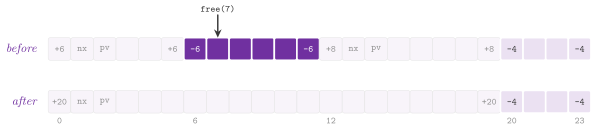
A freed block reads the tag just below it, which is the upper tag of the block below, and the tag just above it, which is the lower tag of the block above. These two reads give whether the neighbors are free and how large they are. Since the list is doubly linked, each free neighbor leaves it in constant time and merges with the block, and the merged block goes at the head of the list (Figure 5.1).
Algorithm 5.1. The operations of
BoundaryTagAllocator (Knuth 1997, Algorithms 2.5A and
2.5C); \(s( p )\) is the size of the block
at \(p\), read in its tags.
Lemma 5.1. After each operation of
BoundaryTagAllocator the blocks tile the memory \([ 0 , N )\), the free
list holds exactly the free blocks, and no two free blocks are adjacent.
Hence free() costs \(O( 1 )\) time, and allocate() costs \(O( f )\) time
on a list of \(f\) free blocks, besides \(O( \log u )\) time for the ordered
set of the \(u\) blocks in use; freeWords() and freeBlocks() take
\(O( f )\) time.
Proof. Initially, the three properties hold for the single free block
of the memory. A split replaces a free block by a free block and a block
in use that tile the same words, and a block taken with no split leaves
the list and becomes a block in use. When a block is freed, its neighbors
are free only if their tags are positive; if so, they are unlinked and
merged with it. By induction, the neighbors of a free neighbor were in
use, and the merged block is thus bordered by blocks in use (or by the
ends of the memory). There are at most two merges, each one an unlink in
\(O( 1 )\) time from the doubly linked list. In allocate(), the search reads each free block at most once (cf. line 3 of
Algorithm 5.1); the next fit reads the list from
the rover to its end, then from its head to the rover. As for the blocks in use, their set is an ordered set (a std::set), in which each operation
makes one insertion or one search and one removal, and the two queries
walk the free list once. \(\square\)
The audit tiled() checks the three properties of
Lemma 5.1 after each operation, in \(O( N )\) time,
when the contracts are at their highest level. Besides, the class keeps the set of the blocks in use, for the precondition that free() receives an
address given by allocate() and still in use; its \(O( \log u )\) time is
the price of the contract, since the method does not need it. Two queries, freeWords() and freeBlocks(), give the words in free blocks
(tags included) and the number of the free blocks. Apart from the
contracts, the code of free() follows
Algorithm 5.1 line by line.
Which fit is best cannot be told in general. Knuth 1997, §2.5 reports simulations in which the first fit was at least as good as the best fit. He also shows, as the fifty-percent rule, that under some assumptions of equilibrium the free blocks are about half as many as the blocks in use, whatever the fit. In practice, the best fit leaves the smallest pieces, which are often (but not always) "too small" for any later request. On the other hand, the next fit spreads the splits over the list, at the price of a (possibly much) worse locality (Wilson et al. 1995).
In ADS/memory/Allocators.h, the declarations of BoundaryTagAllocator
that a user calls are
// declarations of <ADS/memory/Allocators.h>
class BoundaryTagAllocator
{
 public:
 enum class Fit { FIRST , BEST , NEXT };
 explicit BoundaryTagAllocator( long N , Fit fit = Fit::FIRST );
 long allocate( long n );
 void free( long a );
 long freeWords( void ) const;
 long freeBlocks( void ) const;
 };
5.3 The buddy system¶
BuddyAllocator manages a memory of \(N = 2^m\) words, \(0 \le m \le 40\),
and gives only blocks of \(2^k\) words, each one at an address multiple of
its size (Knowlton 1965; Knuth
1997, Algorithms 2.5R and 2.5S). The
free blocks of \(2^k\) words are kept in the ordered set \(F_k\), and the
blocks in use in a map from their addresses to their sizes. A free thus
needs no size, and a block needs no tag.
Lemma 5.2. In the buddy system, a block of \(2^k\) words at the address \(a\), \(k < m\), was split from the block of \(2^{k+1}\) words at \(a \wedge \neg 2^k\), and its buddy (the other half of that block) is at
Proof. By induction on the splits. A block of \(2^{k+1}\) words at an address multiple of \(2^{k+1}\) has the bit \(k\) of its address equal to 0. Its halves are at \(a\) and \(a + 2^k\), which differ in that bit only and are multiples of \(2^k\); clearing the bit \(k\) gives the address of the block split, and flipping it gives the other half. \(\square\)
A request of \(n\) words takes \(k = \lceil \log_2 n \rceil\). It splits the free block of least size \(2^j \ge 2^k\) by halves until it has \(2^k\) words, each upper half joining its free list. A freed block finds its buddy by (5.1); if the buddy is free and whole (i.e., on \(F_k\)), the block merges with it and goes on upwards (Algorithm 5.2 and Figure 5.2).
Algorithm 5.2. The operations of
BuddyAllocator (Knuth 1997, Algorithms 2.5R and
2.5S); \(F_k\) is the set of the free
blocks of \(2^k\) words.

Lemma 5.3. In BuddyAllocator no two
free buddies are ever both on the free lists, and a block given is less
than twice its request, i.e., its internal waste is less than half of the
block. allocate() reads at most \(m + 1\) free lists and splits at most
\(m\) times, free() merges at most \(m\) times, and each one costs
\(O( m \log N )\) time in all.
Proof. A split puts on \(F_j\) only an upper half whose lower half is split further or given, and a free merges the block with its buddy for as long as the buddy is free; hence, after each operation no free block has a free buddy. Since \(2^{k-1} < n \le 2^k\), the block of \(2^k\) words is smaller than \(2 n\), and the waste \(2^k - n\) is less than \(2^{k-1}\). A request looks at the sets \(F_k , \ldots , F_m\), i.e., at most \(m + 1\) of them, after computing \(k \le m\) by at most \(m\) doublings, and splits \(j - k \le m\) times; a free merges at most \(m - k\) times, since each merge raises \(k\) by one and stops at \(m\). Each step is an operation on an ordered set of at most \(N\) addresses (or on the map of the blocks in use), in \(O( \log N )\) time. \(\square\)
In the code, the merge loop of free() is that of
Algorithm 5.2, with the buddy (5.1) computed by an
exclusive or.
The buddy system has no external fragmentation in the sense of the boundary
tags, since a free block of \(2^k\) words serves any request up to \(2^k\). Yet,
two free blocks of \(2^k\) words that are not buddies cannot merge, and a
request may therefore fail with enough free memory in total. Its audit
merged() checks that the free blocks are aligned to their sizes, that no two
free buddies exist, and that the free blocks and the blocks in use tile the
memory, in \(O( N \log N )\) time. As for the boundary tags, a request returns
\(-1\) when no block fits (at once if \(n > 2^m\)), and two queries read the
state: freeWords(), the words in free blocks, and blockSize( a ), the size
\(2^k\) of the block in use at \(a\). Finally, the constructor requires
\(0 \le m \le 40\), and that \(2^m\) fits in a long (i.e., \(m \le 30\) where a
long has 32 bits).
In ADS/memory/Allocators.h, the declarations of BuddyAllocator that a
user calls are
// declarations of <ADS/memory/Allocators.h>
class BuddyAllocator
{
 public:
 explicit BuddyAllocator( int m );
 long allocate( long n );
 void free( long a );
 long freeWords( void ) const;
 long blockSize( long a ) const;
 };
5.4 Arenas¶
An arena (also called a region) gives the objects of one type from large
blocks by the bump of a pointer, and frees them all at once with the arena
(Hanson 1990). Arena< T , A > keeps the
vector of its blocks, each of \(n\) places for objects of type T taken from
the allocator A (by default \(n = 2^{12}\) and A is std::allocator< T >),
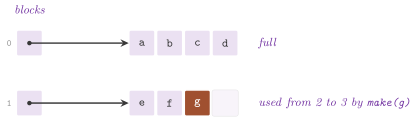
and the number \(\mathit{used}\) of the places used in the block in use. Then
make( args ) builds the object in the next place, after appending a new
block when the last one is full (Algorithm 5.3 and
Figure 5.3), or after moving to the next block kept by
clear(), if there is one (see below).
Algorithm 5.3. The construction of an object
in an Arena (Hanson 1990), and the
start of a new epoch by clear(); \(c\) is the index of the block in use and
\(\beta\) the number of the blocks.
We call an epoch of the arena the time from its construction, or from a
call of clear(), to the next call of clear() (or to the destruction).
Since make() builds the object as T( args... ), a call with no
arguments value-initializes it in every epoch, so that an object of trivial
type made on a place of an old epoch is all zeros, whatever the object of
that epoch held (the test engineered_memory.pool-epochs-value-init
checks it, and the same holds for ObjectPool below, on a freed slot as on
a slot of an old epoch).
Lemma 5.4. After \(z\) calls of make()
in an epoch that return an object, and any number of calls that throw, an
Arena of blocks of \(n\) objects whose block in use has the index \(c\)
satisfies \(z = c n + \mathit{used}\), with \(0 \le \mathit{used} \le n\)
(and \(z = 0\) while it has no block); the object made by the \(j\)-th of these
calls (from \(j = 0\)) is at the place \(j \bmod n\) of the block
\(\lfloor j / n \rfloor\) and keeps that address until the epoch ends.
Hence the epoch uses \(\lceil z / n \rceil\) blocks, or one more with no
object in it, and the arena takes a new block from A only when all the
blocks it has are in use in the epoch. Each make() costs \(O( 1 )\) time,
but for the allocation of a block and the amortized append to the vector of
the blocks.
Proof. By induction on the calls of the epoch, which starts with \(c = 0\)
and \(\mathit{used} = 0\) (by line 3 of clear(), or with no block at the
construction). A call that finds no block, or the block in use full
(\(\mathit{used} = n\)), moves to the block \(c + 1\) if the arena has it,
i.e., a block kept from an earlier epoch, and otherwise appends a block and
takes it as the block \(c + 1\) (the block 0 if there was none); then it sets
\(\mathit{used} = 0\), which keeps the equation. If the allocation or the
append throws, the block is given back to A and nothing changes. Then the
call builds the object at the place \(\mathit{used}\) of the block \(c\), and
increments \(\mathit{used}\) and \(z\); if the constructor throws, neither is
incremented, and the block taken (if any) stays with \(\mathit{used} = 0\).
An object made when \(z = j\) thus goes to the place \(\mathit{used} = j - c n
< n\) of the block \(c = \lfloor j / n \rfloor\). Only the block in use has
places not used in the epoch, besides the blocks after it, and it is empty
only if the calls after it was taken have all thrown. A block is appended
only when \(c + 1\) equals the number of the blocks. The vector
holds pointers to the blocks; hence, no block is moved or freed while the
arena lives, although the vector of the pointers may be moved by an append.
Besides the allocation and the append, the work of make() is a placement
new, an increment of the place and one of \(z\). \(\square\)
The destructor thus destroys exactly the objects built in the last epoch,
\(n\) in each block before the block in use and \(\mathit{used}\) in the block
in use, and the invariant checked after each make() is the equation of
Lemma 5.4.
An object of an arena costs no header and no search, and the objects made
one after another are next to each other. Their addresses never change,
which matters to the structures that point to their objects (e.g., the
nodes of a search, which keep a pointer to the node they come from). The
arena also gives a random access iterator over the objects in the order
in which they were made: the object of index \(j\) is in the place
\(j \bmod n\) of the block \(\lfloor j / n \rfloor\), and a new object only
moves the end of the sequence, by Lemma 5.4. An iterator holds the address of the vector of the
blocks, not that of the array
of its elements, which an append of a block may move,
and it reads a block through that vector at each access; hence, the
iterators stay valid for the whole life of the arena, as the pointers that
make() returns do, whatever blocks are appended. As a container in the sense of
the standard library, the arena has the types value_type,
size_type, difference_type, reference, const_reference, iterator
and const_iterator (the second a random access iterator over constant
objects, built also from the first), and the functions begin(), end(),
cbegin() and cend(). Besides, size() is the number of the objects made, and
bytes() the memory of the blocks, \(\#\mathit{blocks} \cdot n \cdot
\mathrm{sizeof}( T )\). An arena can be neither copied nor moved, since
its objects are reached by their addresses. All this has a price: an object cannot be freed apart from the others: the destructor of the arena destroys
all the objects and frees the blocks.
The objects may also die all together before the arena, by clear()
(Algorithm 5.3), which destroys the objects of the
epoch and keeps the blocks, so that the next objects take the same places in
the same order. A search restarted many times needs this (e.g., an incremental
search that gives up the repair of its solution and starts again from
scratch). It drops its nodes in \(O( 1 )\) time when they have a trivial
destructor, instead of giving the blocks back to A and taking them again
(cf. Lemma 5.6). Nothing of an epoch survives the next
one; a pointer to an object of an old epoch is stale, and its use violates
the contract, since its place may already hold an object of the new epoch. In
time linear in the blocks, fresh( p ) is true if \(p\) is the address of an
object made in the current epoch. It is false for a stale pointer until its
place is given again, and true afterwards; hence it is a necessary condition
only, since no test on an address can distinguish a stale pointer from a
pointer to the new object at the same place. When the program is built with
the sanitizer of addresses, clear() also marks as forbidden the places of
the epoch, and make() allows again only the place it gives; the first access
through a stale pointer to a place not given again thus stops the program
there. An arena belongs to one thread. Other threads may read its objects, but
each of their accesses must happen before the clear() of the owner (e.g., by
a barrier between the phases of a parallel search), since the arena takes no
lock and has no atomic. The iterators and size() cover the objects of the
current epoch, while bytes() counts all the blocks, those kept included.
In ADS/memory/Arena.h, the declarations of Arena that a user calls are
// declarations of <ADS/memory/Arena.h>
template< class T , class A = std::allocator< T > >
class Arena
{
 public:
 explicit Arena( std::size_t n = std::size_t( 1 ) << 12 ,
                 const A & alloc = A() );
 template< class... Args >
 T * make( Args &&... args );
 void clear( void ) noexcept;
 bool fresh( const T * p ) const;
 std::size_t size( void ) const;
 std::size_t bytes( void ) const;
 };
5.5 Pools of objects¶
ObjectPool< T , A > adds to the arena the free of one object. make( args )
builds an object in a slot; free( x ) destroys it and puts its slot at the
head of a free list \(F\) (the list AVAIL of Knuth 1997,
§2.2.3), from which the next make() takes
it again. The last slot freed is thus the first one used again, and its memory
is likely still in the cache. A slot is a union of the room of an object and
of the pointer to the next free slot; it needs no header, and takes
\(\max( \mathrm{sizeof}( T ) , \mathrm{sizeof}( \mathrm{void} * ) )\) bytes,
rounded up to a multiple of the larger of the alignments of T and of a
pointer. The slots never used are cut from the last block, from its place
\(\mathit{next}\) to its end (Algorithm 5.4).
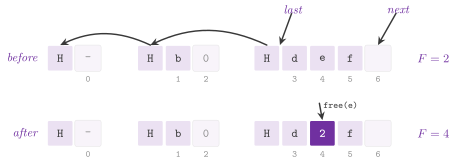
The blocks are taken from the allocator A; the first block has one slot,
and each next one has twice the slots of the last, up to \(n\) (by default
\(2^{24}\)). A block begins with a header, which holds its size in slots
and the address of the block before it. It takes the first
\(H = \lceil 2 \, \mathrm{sizeof}( \mathrm{void} * ) / \mathrm{sizeof}(
\mathit{slot} ) \rceil\) slots of the block (on a machine of 64 bits, two
slots of 8 bytes, or one of 16 or more); the pool reaches all its blocks
from the last one, and needs no vector for them. In fact, the pool is seven
words (the free list, the place \(\mathit{next}\) and the end of the block in
use, the last block, the first block kept by clear() and not yet used
again, \(n\) and the number of objects alive), besides its
allocator, which takes no room when it has no state (as
HugePageAllocator); it allocates only its blocks
(Figure 5.4).
Algorithm 5.4. The operations of
ObjectPool (the list AVAIL of Knuth 1997,
§2.2.3); \(F\) is the list of the free
slots and \([ \mathit{next} , \mathit{end} )\) the slots never used of the
last block, of \(k\) slots; \(R\) is the first of the blocks kept by
clear() that the epoch has not yet used again.
The slot of make() (lines 2 to 5) comes from one function, which also doubles the
blocks; allocate() gives a raw slot from the same function, for an
object that the caller builds (as with std::allocator).
If the constructor of the object throws, make() pushes the slot back on
\(F\) before passing the exception on, and the pool is then as it was, but
for the order of its free list.
Lemma 5.5. An ObjectPool with blocks of
at most \(n\) slots that has held at most \(k \ge 1\) objects at once (raw
slots of allocate() included) has at most
\(\max( 2 k - 1 , k + n - 1 ) \le 2 k + n\) slots besides the headers, in
\(O( \log \min( k , n ) + k / n )\) blocks. Each operation costs \(O( 1 )\)
time, but for the allocation of a block.
Proof. A block is taken only when no slot is free, i.e., when all the slots of the pool hold objects, and the new object goes into it. While the blocks double, they are of \(1 , 2 , \ldots , 2^j\) slots, and the last one was taken with \(2^j - 1\) objects alive plus the new one; hence, \(k \ge 2^j\), and the slots are \(2^{j+1} - 1 \le 2 k - 1\). Once the blocks have reached \(n\) slots, the last block was taken with all the slots before it in use. Then \(k\) is at least the number of these slots plus one, and the slots are at most \(k - 1 + n\). Hence the blocks double \(O( \log \min( k , n ) )\) times, and those of \(n\) slots are at most \(k / n + 1\). Each operation is a pop or a push of \(F\), or the bump of \(\mathit{next}\), besides the construction or the destruction of the object. \(\square\)
The bound counts as held the object of a make() whose constructor
throws, whose slot was taken before the exception; with this convention it
also holds for a pool whose operations throw. It does not hold, instead,
for a pool that has adopted the blocks of another one (see below), which
keeps those blocks whatever it holds.
We remark that the slots of a pool go back to A only with the pool; a structure that
shrinks thus keeps the memory of its largest size. This is the price of a
free list with no header in the slots, since a block could be given back
only when all its slots are free, which the pool does not count. Also, the pool does not destroy the objects still
alive when it dies.
Their owner destroys them before (or need not, if their destructor is
trivial), as the containers of the library do with their nodes. By
default, the blocks come from HugePageAllocator
(§5.9), which puts those of 2 MB or more on huge
pages, where the nodes of a "large" linked structure, reached in no
useful order, miss the translation lookaside buffer less often.
Unlike the Arena, the pool may be moved and swapped (the objects stay where
they are): the move constructor leaves the other pool empty, the move
assignment frees the blocks of the pool before taking those of the other one,
and swap() exchanges the slots of two pools in \(O( 1 )\) time. Furthermore,
adopt( other ) takes the blocks of other with the objects alive in them,
which become objects of this pool, to be freed by it, and leaves other
empty; the lists of the library use it to take the nodes of another list with
no copy (absorb() in §2.10). In both cases below,
the limit \(n\) of the blocks of this pool becomes the larger of the two limits,
and other keeps its own. If this pool has no block, it takes the blocks of
other as a swap() does, and the free slots of other stay free here.
Otherwise, the chain of the blocks of other is hung under the first block of
this pool, which is found by a walk of the chain, in time linear in the number
of the blocks of this pool (cf. Lemma 5.5), and the
free slots of other, and those it never used, are no longer given until the
pool dies. In adopt() the two allocators must be equal, since the blocks of
other go back to A with this pool. Finally, size() is the number of the
objects alive, and bytes() the memory of the blocks, headers included,
computed by a walk of the chain.
As the arena, the pool has epochs: clear() drops all the objects and the
free slots in \(O( 1 )\) time, with no destructor called (as at the death of the
pool), and keeps the blocks. The next epoch takes the slots of the last block
first and then those of the blocks before it, one block at a time, from the
block \(R\) that clear() sets to the block before the last one. Only when \(R\)
is nil does it take a new block from A (Algorithm
5.4). Hence a worker of a parallel search, which owns
its pool, drops its nodes at a restart without freeing them one by one, and a
sequence of epochs keeps the memory of the largest of them. A pointer of an
old epoch is stale, as in the arena, and fresh( p ) is true if \(p\) is a slot
given in the current epoch (alive or freed since). free() and deallocate()
check it at the level of the audits, which stops the free of a stale pointer
whose slot has not been given again. With the sanitizer of addresses the slots
dropped are forbidden until make() gives them again. While some blocks kept
wait to be used again, adopt( other ) cannot hang the blocks of other
under the first block, where \(R\) would give their slots again over the objects
alive in them. It puts them over the last block instead, after a walk of the
chain of other. A pool belongs to one thread, and an object is freed by the
thread that made it. An object that another thread wants to drop goes back to
its owner by a message (e.g., through the mailboxes of
§25), to be freed there after the next
synchronization, or is dropped by the next clear(). Other threads may read
the objects, each of their accesses happening before the clear() of the
owner; a pool shared by threads that free each other's objects is
ConcurrentPoolResource (§5.8). We now state what an
epoch guarantees for both structures.
Lemma 5.6. Let clear() be called on an
Arena or on an ObjectPool. (i) After the call no object of the earlier
epochs is alive (those of the arena destroyed, those of the pool dropped),
size() is 0, the pool has no free slot, and fresh( p ) is false for every
pointer \(p\) given before the call, until its place or slot is given again.
(ii) The blocks are kept, and the new epoch takes a block from A only when
it has given all the places (the slots) of the blocks kept. Hence, for the
pool the bound of Lemma 5.5 holds with \(k\) the largest
number of objects held at once in any epoch, and a slot never holds two
objects alive. (iii) The call costs \(O( 1 )\) time for the pool, and for the
arena \(O( 1 )\) when the destructor of T is trivial and \(O( z )\) otherwise,
\(z\) the objects of the epoch, besides one call of the sanitizer per block when
it is on. (iv) If each access of another thread to the objects happens before
the call, no write of the call or of the next epochs races with those
accesses.
Proof. (i) In the arena, clear() destroys the objects of the blocks
\(0 , \ldots , c\) (the \(z\) objects of the epoch, by Lemma
5.4), skipped when the destructor is trivial, and sets
\(c = 0\), \(\mathit{used} = 0\) and \(z = 0\). Then fresh( p ) looks for \(p\) in
the blocks up to \(c\) and accepts in the block \(c\) only the places before
\(\mathit{used}\), i.e., none, and afterwards only the places that make() has
given. In the pool, clear() sets \(F\) to nil and the count to 0, and makes
\([ \mathit{next} , \mathit{end} )\) all the slots of the last block, with \(R\)
the block before it. Then fresh( p ) walks the blocks from the last one down
to \(R\) excluded, and in the block in use accepts only the slots before
\(\mathit{next}\), i.e., none right after the call. (ii) A block is taken by the
arena only when \(c + 1\) is the number of the blocks (by Lemma
5.4), and by the pool only when \(F\) is nil,
\(\mathit{next} = \mathit{end}\) and \(R\) is nil, i.e., when the epoch has passed
all the blocks and given all their slots. Since a slot freed in the epoch is
on \(F\), all the slots then hold objects alive, which is the condition of the
proof of Lemma 5.5. A slot is given by the bump of
\(\mathit{next}\) only once in an epoch, since the blocks under \(R\) are reached
only through \(R\), which moves down. An adoption during the epoch puts the
blocks of other above the last block, out of that path, and thus no slot
with an object alive is given again. (iii) The pool writes four of its words;
the arena writes four words and, when the destructor is not trivial, destroys
\(z\) objects, and the sanitizer marks each block once. (iv) The call and the
later calls of make() write the places and the members of the structure in
the owner's thread alone, after the call in its program order. Since each
access of another thread happens before the call, it happens before each such
write by transitivity, and two accesses ordered by happens-before do not race
(by the definition of a data race in the memory model of C++). \(\square\)
We remark that (iv) does not cover the objects of the new epoch read by
another thread. These must reach that thread through a synchronization
after their make(), as any object written by one thread and read by
another; in a parallel search this is usually the release and the acquire
of the mailbox that carries the message, or the next barrier.
In ADS/memory/ObjectPool.h, the declarations of ObjectPool that a user
calls are
// declarations of <ADS/memory/ObjectPool.h>
template< class T , class A = HugePageAllocator< T > >
class ObjectPool
{
 public:
 explicit ObjectPool( std::size_t n = std::size_t( 1 ) << 24 ,
                      const A & alloc = A() );
 void adopt( ObjectPool & other ) noexcept;
 template< class... Args >
 T * make( Args &&... args );
 void free( T * x );
 T * allocate( void );
 void deallocate( T * x );
 void clear( void ) noexcept;
 bool fresh( const T * p ) const;
 std::size_t size( void ) const;
 std::size_t bytes( void ) const;
 };
5.6 Size classes¶
A size class serves all the requests between two sizes with blocks of
the larger one. SizeClassAllocator serves the requests of
\(1 \le n \le 32768\) bytes from 41 classes: the class of 8 bytes, the
multiples of 16 up to 128 (8 classes), and four classes for each power of
2 above,
i.e., 160, 192, 224, 256, 320, 384, and so on up to 32768 (the constant
LARGEST). A request of more than 32768 bytes goes to operator new. The deallocation is sized,
since the caller gives back the size of the request (as std::allocator
does), and a block thus needs no header.
Each class \(c\) has a free list \(F_c\) of the blocks given back, the last
one first, and a page whose rest \([ \mathit{next}_c , \mathit{end}_c )\) is
cut a block at a time. A request takes the first block of \(F_c\), or the
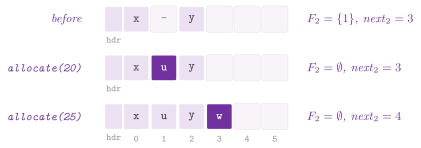
next one of the page, or a new page of \(\max( 2^{16} , s + 16 )\) bytes
from operator new. The first 16 bytes of a page hold its size and link
it to the pages taken before (Algorithm 5.5 and
Figure 5.5); since \(s \le 2^{15}\), every page has
in fact \(2^{16}\) bytes (the constant PAGE). A deallocation pushes the
block on \(F_c\). The blocks are aligned to 16 bytes, but for those of the
class of 8 bytes (as long as operator new aligns its memory to 16 bytes,
as it does on the usual platforms of 64 bits).
Algorithm 5.5. A request to
SizeClassAllocator (the lists of available blocks of Knuth 1997,
§2.5, by size class); \(F_c\) holds the
blocks given back of the class \(c\) and \([ \mathit{next}_c ,
\mathit{end}_c )\) is the rest of its page; sizeClass() gives the class
of a request (Lemma 5.7).
Lemma 5.7. A request of \(n > 128\) bytes
to SizeClassAllocator wastes less than 20% of its block, and less than
25% of the request; one of \(n \le 128\) bytes wastes less than 16 bytes.
The class of \(n\) is computed in \(O( 1 )\) time with no table and no loop,
and both operations cost \(O( 1 )\) time, but for the allocation of a page,
which loses less than one block of its class at its end. If operator new
aligns to 16 bytes, every block is aligned to 16, but for those of the
class of 8 bytes, which are aligned to 8.
Proof. Let \(2^e < n \le 2^{e+1}\), \(e \ge 7\). The classes of (5.2)
between \(2^e\) and \(2^{e+1}\) are \(2^{e-2}\) apart, and \(n\) gets the least
one not below it, i.e., \(2^e + j \, 2^{e-2}\) with
\(j = \lceil ( n - 2^e ) / 2^{e-2} \rceil\). Its waste is less than \(2^{e-2}\), while the block is at least \(5 \cdot 2^{e-2}\) and the request
is larger than \(2^e\), whence the two bounds. Up to 128 bytes the classes
are 16 bytes apart (8 bytes for the first one). As for the exponent, \(e = \lfloor \log_2 ( n - 1 ) \rfloor\) is the position of the leading bit of
\(n - 1\), which the processor gives in one instruction (through
std::bit_width), and \(j\) is a shift. Each operation is then the pop or
the push of a list, or the bump of a pointer. A page is cut from its
header on, a block of \(s\) bytes at a time, while the rest has \(s\) bytes at
least, and the rest left is thus shorter than \(s\). Since the header has 16 bytes and the sizes of all the classes but the first are multiples of 16, the blocks of these classes start at a multiple of 16 from the start
of the page, and those of the first one at a multiple of 8; a block given
back keeps the address it had. \(\square\)
The function sizeClass() of Algorithm 5.5 follows
the proof step by step. Conversely, classSize( c ) gives 8 for \(c = 0\),
\(16 c\) for \(1 \le c \le 8\), and \(2^e + j \, 2^{e-2}\) with
\(e = 7 + \lfloor ( c - 9 ) / 4 \rfloor\) and \(j = ( c - 9 ) \bmod 4 + 1\) for
\(9 \le c \le 40\).
When the rest of the current page of a class is shorter than a block, the
class takes a new page and the rest is lost. The pages go back to the system only with the allocator, or by
release(), which invalidates all the blocks given; bytes() is the
memory of the pages taken. This allocator cannot be copied, since its
blocks are in its pages, but it can be moved: the move leaves the other
allocator with no page, and the move assignment releases the pages of the
allocator before taking those of the other one. While the allocator
lives, its memory is thus not returned, as in a pool; however, the blocks
given back serve any later request of their class. This is the scheme of
TLSF (Masmano et al. 2004) and of
the allocators of today, which choose the block by its size class instead
of by a fit, in constant time.
In ADS/memory/SizeClassAllocator.h, the declarations of
SizeClassAllocator that a user calls are
// declarations of <ADS/memory/SizeClassAllocator.h>
class SizeClassAllocator
{
 public:
 static constexpr std::size_t LARGEST = 32768;
 static constexpr std::size_t PAGE = std::size_t( 1 ) << 16;
 SizeClassAllocator( void );
 void * allocate( std::size_t n );
 void deallocate( void * p , std::size_t n ) noexcept;
 static unsigned sizeClass( std::size_t n );
 static std::size_t classSize( unsigned c );
 std::size_t bytes( void ) const;
 void release( void ) noexcept;
 };
5.7 Free lists by page¶
The single free list of a class (as that of ObjectPool or of
SizeClassAllocator) gives the blocks back in the order in which they
were freed. After frees in a scrambled order (e.g., those of a hash table
or of a search tree that is emptied), the next blocks given are scattered
over the memory of the class, and the nodes of a structure built again are
far from each other. The free lists sharded by page of mimalloc (Leijen
et al. 2019) give them back a page at a
time instead.
PageHeap< C > (in the namespace ADS::detail) keeps \(C\) size classes of
slots of \(( c + 1 ) g\) bytes, \(c = 0 , \ldots , C - 1\). It takes segments of
\(2^{21}\) bytes, aligned to their size so that they may lie on huge pages
(§5.9), and cuts them into pages of \(2^{16}\) bytes.
A page holds the slots of one class after a header of 64 bytes. The header
keeps the free list of the page, its first slot never given, the end of its
slots, its class and its owner; it also keeps the link of the page on the list
of the pages of its class with free slots, and whether the page is listed
(current, or on that list). Since the pages are aligned to their size, the
page of a slot \(p\) is found by masking the low 16 bits of its address,
and a free needs neither a header in the slot nor its size. In the class, the
constants GRAIN, PAGE, SEGMENT and HEADER are \(g = 8\), \(2^{16}\),
\(2^{21}\) and 64, the static function pageOf( p ) is (5.3), and two queries
give the slots given but not yet freed (live()) and the memory of the
segments (bytes()). Each heap takes as argument an owner, which it writes
in the header of each of its pages, and it can be neither copied nor moved,
since its pages name it.
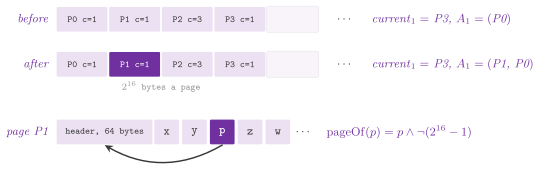
A class allocates from its current page, by the pop of the free list of the page or by the bump of its pointer. When the page is exhausted, it is marked as not listed, and the class moves to the next page of its list \(A_c\), or to a new page cut from the segment (a new segment when it is used up). A free pushes the slot on the list of its page, and puts the page back on \(A_c\) if it was not listed (Algorithm 5.6 and Figure 5.6). These are the slabs of Bonwick 1994, whose slabs of one size keep a free list each and whose partly free slabs are on a list apart.
Algorithm 5.6. The operations of PageHeap
(the free lists by page of Leijen et al.
2019 and the slabs of Bonwick
1994); \(P\) is the current page of the
class \(c\) and \(A_c\) the list of its other pages with free slots.
Lemma 5.8. A page on the list \(A_c\) has at
least one free slot. Hence more() makes at most two rounds, and each
operation of PageHeap costs \(O( 1 )\) time in the worst case, but for
the allocation of a segment (one every 32 pages), which also appends it to the
vector of the segments; a page of the class \(c\) wastes its header and less
than \(( c + 1 ) g\) bytes at its end.
Proof. A page enters \(A_c\) only in give(), when a slot is pushed on
its free list while the page is not listed. A page is not listed only
after more() has found it exhausted, when it was current; from then on,
no slot of it is given until it is popped from \(A_c\) and becomes current
again, while the frees only add to its list. A new page has at least 8
slots, since the classes are at most \(( 2^{16} - 64 ) / 8\) bytes (a static
assertion checks it). Therefore, the round of more() after a page was
popped from \(A_c\), or cut new, finds a slot. (At the start, every class
has as current page a sentinel with no slot, which the first round leaves
at once.) A page enters \(A_c\) only when it is not listed, and is listed
from then on; hence, no page is twice on \(A_c\), nor on \(A_c\) while it is
current, and each operation on \(A_c\) is the pop or the push of a stack.
A page has \(\lfloor ( 2^{16} - 64 ) / b \rfloor\) slots of \(b\) bytes, and
the rest is less than \(b\). \(\square\)
The place of a new segment in the vector of the segments is reserved before the segment is allocated, so that the append that follows cannot fail and lose it; when the vector is full, its room doubles. Thus \(s\) segments copy fewer than \(2 s\) addresses in all, i.e., \(O( 1 )\) amortized time per segment, a cost that belongs to the allocation of a segment (cf. Lemma 5.8) and is negligible next to the 32 pages that each segment serves.
PoolResource< M > serves the requests of \(1 \le b \le M\) bytes aligned to
\(a \le 16\) (the test pooled( b , a )) from a PageHeap of \(M / 8\) classes,
where \(M\) is a multiple of 16 between 16 and 4096 (256 by default); the
constants GRAIN, ALIGN, MAX and CLASSES are \(g = 8\), 16, \(M\) and
\(M / 8\). A request aligned to at most 8 bytes takes a slot of
\(8 \lceil b / 8 \rceil\) bytes, and one aligned to 16 takes a slot of
\(16 \lceil b / 16 \rceil\) bytes, whose class has its slots aligned to 16 (the
header has 64 bytes, and the pages are aligned to \(2^{16}\)). Any other
request, larger or more aligned, goes to operator new (Algorithm
5.7), with the alignment \(a\) when it exceeds that of a
plain operator new.
Lemma 5.9. A request of \(b \le M\) bytes
aligned to \(a \le 16\), \(a\) a power of 2, gets from PoolResource a slot
aligned to \(a\), whose waste is less than \(\max( a , g )\) bytes, i.e., less
than 8 for \(a \le 8\) and less than 16 for \(a = 16\), and none when \(b\) is a
multiple of \(\max( a , g )\).
Proof. The class \(c\) has slots of \(b_c = ( c + 1 ) g\) bytes, and the request takes \(b_c = 8 \lceil b / 8 \rceil\) for \(a \le 8\) and \(b_c = 16 \lceil b / 16 \rceil\) for \(a = 16\), i.e., the least multiple of \(\max( a , g )\) not below \(b\); hence the waste \(b_c - b\) is less than \(\max( a , g )\), and it is 0 when \(b\) is such a multiple. A page is aligned to \(2^{16}\), and its slots start after its header of 64 bytes, at the offsets \(64 + i \, b_c\); for \(a = 16\), \(b_c\) is a multiple of 16, and every slot is aligned to 16, while for \(a \le 8\) every slot is aligned to 8, since \(b_c\) is a multiple of 8. \(\square\)
The nodes of the containers, aligned to 8, thus waste no byte when their size
is a multiple of 8. A request takes one of two forms: allocate< b , a >()
and deallocate< b , a >( p ), whose size and alignment are known at compile
time, so that the test and the class are computed by the compiler, and
allocate( b , a ) and deallocate( p , b , a ), which compute them at each
call. In both, \(a\) is by default the alignment of std::max_align_t, i.e., 16
on the usual platforms of 64 bits, and a request that does not give it thus
takes the classes of 16 bytes. As a precondition, the deallocation checks that
the page of \(p\) belongs to the resource and has the class of the request. Two
queries give the objects alive in the classes (size()) and the memory of the
segments (bytes()); the resource cannot be copied (nor moved), since its
objects and its allocators point to it, and it frees its segments when it
dies, without destroying the objects still alive. The heap is kept apart from
the resource, behind a pointer: its state, read and written at each operation,
then never shares a line of cache with the variables around the resource
(e.g., on a stack).
Algorithm 5.7. A request to
PoolResource; \(c\) is the class of the request.
PoolAllocator< T , R > is the allocator of the standard library over the
resource R, which is PoolResource or the ConcurrentPoolResource of
§5.8. It holds a pointer to its resource, never nil,
given to the constructor PoolAllocator( r ), or taken from R::global() by
the default constructor, which exists only when R has that function (i.e.,
for ConcurrentPoolResource); resource() returns it. Two allocators, also
of different types, are equal when they share their resource, and
is_always_equal is therefore false. It is rebound to any type by
std::allocator_traits, e.g., to a node of std::list, std::map or
std::unordered_map, or to the control block of std::allocate_shared (which
then holds the counts and the object in one slot). A container copies, moves
and swaps its allocator with its contents, since the three
propagate_on_container traits are true; a node therefore always goes back to
the pool it came from. A request of one object (the case of the node
containers) finds its class at compile time, the size and the alignment of T
being constants, and costs the pop of a free list; a request of \(n\) objects
(e.g., the buckets of std::unordered_map) finds it from \(n\). Such a request
throws std::bad_array_new_length if \(n \, \mathrm{sizeof}( T )\) would
overflow a std::size_t (a request of no object goes to operator new, as
any request out of the classes). An allocator of a type U is built from that
of T over the same resource, as rebind and std::allocator_traits
require. Neither the resource nor its allocators synchronize: one thread at a
time uses a PoolResource, which must outlive the objects and the allocators
made from it. For instance, with the header ADS/memory/PoolAllocator.h, the
nodes of a list of the standard library come from the classes of a resource:
ADS::PoolResource<> r;  // M = 256
std::list< int , ADS::PoolAllocator< int > > L{ ADS::PoolAllocator< int >(
  r ) };
for( int i = 0 ; i < 1000 ; ++i )
 L.push_back( i );  // one slot a node
In ADS/memory/PoolAllocator.h, the declarations of PoolResource that a
user calls are
// declarations of <ADS/memory/PoolAllocator.h>
template< std::size_t M = 256 >
class PoolResource
{
 public:
 static constexpr std::size_t GRAIN = 8;
 static constexpr std::size_t ALIGN = 16;
 static constexpr std::size_t MAX = M;
 static constexpr std::size_t CLASSES = M / GRAIN;
 static constexpr bool pooled( std::size_t b , std::size_t a );
 PoolResource( void );
 template< std::size_t b , std::size_t a = alignof( std::max_align_t ) >
 void * allocate( void );
 template< std::size_t b , std::size_t a = alignof( std::max_align_t ) >
 void deallocate( void * p );
 void * allocate( std::size_t b ,
                  std::size_t a = alignof( std::max_align_t ) );
 void deallocate( void * p , std::size_t b ,
                  std::size_t a = alignof( std::max_align_t ) );
 std::size_t size( void ) const;
 std::size_t bytes( void ) const;
 };
and those of PoolAllocator are
// declarations of <ADS/memory/PoolAllocator.h>
template< class T , class R = PoolResource<> >
class PoolAllocator
{
 public:
 using value_type = T;
 PoolAllocator( R & r ) noexcept;
 PoolAllocator( void ) noexcept
  requires requires { R::global(); };
 template< class U >
 PoolAllocator( const PoolAllocator< U , R > & o ) noexcept;
 T * allocate( std::size_t n );
 void deallocate( T * p , std::size_t n );
 R * resource( void ) const noexcept;
 template< class U >
 bool operator==( const PoolAllocator< U , R > & o ) const noexcept;
 };
5.8 A pool shared by threads¶
ConcurrentPoolResource< M > has the classes of PoolResource, and an object
made by one thread may be freed by any other, e.g., a message made by the
thread that changes a model and released by the thread of a solver that has
read it. Each thread that uses the resource has a heap, i.e., a PageHeap
whose pages name the heap as their owner (the heaps of the threads of Hoard,
Berger et al. 2000). For each class, a
heap also has a batch of the slots that its thread has freed for another
heap, and a stack of the returns, i.e., of the slots that other threads have
freed into it. A thread finds its heap through a cache in its thread-local
storage, at the price of one comparison with the identity of the resource. The
first time, it finds the heap on a list of the heaps, which grows by a
compare-and-swap (CAS) and is read with no lock; the heaps leave the list only
when the resource dies.
A free of a pointer \(p\) finds its page by (5.3), and then the owner of
the page. If the owner is the heap of the calling thread, the slot goes on
the free list of its page with no atomic operation; a thread that frees
what it made thus pays what it pays in PoolResource. Otherwise, the
slot joins the batch of the calling thread for its class, which holds
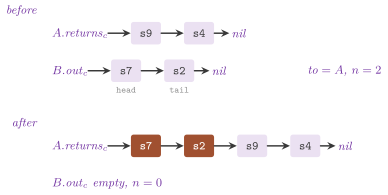
slots of one owner only. The batch goes back to its owner by one CAS,
which links it on the top of the stack of the returns of that class (a
stack of Treiber 1986). This happens
when the batch has 32 slots, when a slot of another owner arrives, or when
the current page of the class of the calling thread is exhausted or that
thread calls collect()
(Algorithm 5.8 and
Figure 5.7). When the current page of a class is
exhausted, the owner takes all the stack at once, by exchanging its top
with nil, and puts each slot back on the list of its page. These are the
batches of snmalloc (Lietar et al.
2019), on the free lists by page of
mimalloc (Leijen et al. 2019).
Algorithm 5.8. The operations of
ConcurrentPoolResource (the heaps of the threads of Berger et al.
2000 and the batches of Lietar et al.
2019); \(H\) is the heap of the calling
thread, \(c\) the class of the request and \(B\) the batch of \(H\) for \(c\).
Since the CAS of line 9 of send() has the order release, the links
written into the slots of the batch are visible to the owner, which takes
the stack with the order acquire. In the code, the test of line 3 of
deallocate() is the branch marked as likely.
Lemma 5.10. In ConcurrentPoolResource,
(i) a free by the owner of the slot makes no atomic operation, and the
frees by the other threads make one successful CAS per batch; (ii) each
thread holds at most 31 slots per class that it has freed and that are
not yet back to their owner; (iii) the stacks of the returns are free of
the ABA problem; (iv) an allocation costs \(O( 1 )\) amortized time. In
(iv), we leave out the allocation of a segment and the search of the heap
on the list, which a thread makes at its first call and after each call to
another resource of the same \(M\).
Proof. (i) and (ii): a batch is sent when it reaches 32 slots, and
otherwise holds at most 31. (iii): a CAS of a sender replaces the top \(t\)
that it has read with the head of its batch, after linking the tail of
the batch to \(t\). If the top is \(t\) again at the time of the CAS (possibly
after the owner has taken the stack and other senders have pushed), the
link to \(t\) is still correct, since the new value does not depend on the
next field of \(t\); the only removal is that of all the stack by an
exchange, which reads no link. (iv): when the cache of the thread holds the
resource, the heap is found by one comparison. Slots taken from a stack are pushed on the lists of their pages in time linear in their
number, and each slot is taken from a stack at most once per free; we
thus charge this work to the frees. Apart from this, there remain a send in \(O( 1 )\) time and
at most one call of more(), which costs \(O( 1 )\) time but for a segment
by Lemma 5.8. \(\square\)
The memory orders complete (iii). A sender writes the links of its batch with plain stores, before its CAS with the order release; a CAS that fails reads the top with the order relaxed, and the loop writes the link of the tail again before the next attempt. In turn, the successful CAS of the senders are read-modify-write operations on the same top, and they form a release sequence; hence, the exchange of the owner, with the order acquire, synchronizes with every sender whose batch it takes, and sees all the links of the stack. In the same way, the list of the heaps grows by a CAS with the order release, and is read with the order acquire.
A heap is never destroyed before the resource. A thread that ends leaves its
heap, whose returns keep coming, to the next thread that has the same identity
(std::thread::id); its memory goes back to the system with the resource. The
slots freed into the heap of a thread that has ended thus stay there until
such a thread comes. Also, the cache of the thread-local storage holds one
resource for each value of \(M\). A thread that alternates between two resources
of the same \(M\) walks the list of the heaps at each change, in time linear in
the number of heaps. Since the identities of the resources come from a counter
and are never reused, the cache never points to the heap of a resource that
has died. A thread that ends also leaves in its batches up to 31 slots per
class, which go back to their owners only when the next thread with the same
identity sends them. Finally, global() gives a resource that lives as long
as the program (it is allocated once and never destroyed), the default one of
PoolAllocator< T , ConcurrentPoolResource<> >.
Like PoolResource, this resource has the constants, the test pooled() and the two forms of allocate() and
deallocate(), and also SEGMENT, the \(2^{21}\) bytes of a segment of
its heaps. Its query heaps() is the number of its heaps, i.e., of
the identities of the threads that have used it, and bytes() the memory
of their segments, both read by a walk of the list of the heaps while no
other thread uses the resource. It cannot be copied, and its destructor
frees the heaps and their segments, without destroying the objects still
alive.
In ADS/memory/ConcurrentPool.h, the declarations of
ConcurrentPoolResource that a user calls are
// declarations of <ADS/memory/ConcurrentPool.h>
template< std::size_t M = 256 >
class ConcurrentPoolResource
{
 public:
 static constexpr std::size_t GRAIN = 8;
 static constexpr std::size_t ALIGN = 16;
 static constexpr std::size_t MAX = M;
 static constexpr std::size_t CLASSES = M / GRAIN;
 static constexpr std::size_t SEGMENT = detail::PageHeap< CLASSES >::SEGMENT;
 static constexpr bool pooled( std::size_t b , std::size_t a );
 ConcurrentPoolResource( void );
 static ConcurrentPoolResource & global( void );
 template< std::size_t b , std::size_t a = alignof( std::max_align_t ) >
 void * allocate( void );
 template< std::size_t b , std::size_t a = alignof( std::max_align_t ) >
 void deallocate( void * p );
 void * allocate( std::size_t b ,
                  std::size_t a = alignof( std::max_align_t ) );
 void deallocate( void * p , std::size_t b ,
                  std::size_t a = alignof( std::max_align_t ) );
 void collect( void );
 std::size_t heaps( void ) const;
 std::size_t bytes( void ) const;
 };
5.9 Huge pages¶
A structure whose nodes are reached in no useful order (e.g., the trees of a
heap or the buckets of a hash table) misses the translation lookaside buffer
(TLB) at nearly each step, when its memory spans more pages than the TLB has
entries. A TLB of \(E\) entries covers \(4 E\) KB of pages of 4 KB, and \(2 E\) MB
of huge pages of 2 MB, i.e., 512 times more. On Linux, the kernel gives the
huge pages (the transparent huge pages of Navarro et
al. 2002) to a region aligned to 2 MB,
to every large one under the policy always and only to those advised with
madvise() under the policy madvise. HugePageAllocator< T > gives a
request of at least one huge page (\(P = 2^{21}\) bytes) a block aligned to
\(P\) and rounded up to whole huge pages; a smaller request goes to
std::allocator (Algorithm 5.9 and Figure
5.8). It does not advise the kernel, since neither
the standard library nor Boost nor hwloc can ask for huge pages; under the
policy madvise, and on the other systems, the large requests are thus only
aligned. In any case, the allocators have no state, and are all equal,
also when they are of different types, the allocator of T being built from
that of any U. Its constant PAGE is \(P\), and a request of \(n\) objects
throws std::bad_array_new_length when its rounding to whole huge pages would
overflow a std::size_t.
Algorithm 5.9. A request to
HugePageAllocator (Navarro et al.
2002); \(P = 2^{21}\) is the size of a
huge page in bytes.
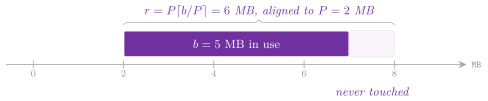
A block of 8 MB or more given back is kept by its thread, up to 16 blocks and 64 MB in all, and is given again to the next request of the same rounded size, as the allocators by size class keep their freed spans (Berger et al. 2002; Leijen et al. 2019). Its pages are already faulted in and made huge. A structure that is built and destroyed again and again, or that grows through the same sizes (a vector that doubles, a pool whose blocks double), therefore pays the faults of its pages once. A smaller block goes back to the allocator of the system, which serves it again from its heap. The blocks kept go back to the system when the thread ends, after which the blocks given back by the thread go to the system at once (the objects of static storage may die later than the cache). As any memory of an allocator, a block given again holds what its last owner left in it.
Lemma 5.11. A block of HugePageAllocator
of \(b \ge P\) bytes takes less than \(P\) bytes of address space beyond
\(b\), none of which is touched by the allocator, and each thread keeps at
most 16 blocks and 64 MB given back.
Proof. By the rounding, \(r = P \lceil b / P \rceil < b + P\) bytes, and the allocator writes nothing in the block (the advice to the kernel reads no page). As for the cache, it refuses a block when it has 16 already, when the bytes kept would exceed 64 MB, or when the block is smaller than 8 MB. \(\square\)
It is fair to remark that the aligned operator new of the C library may
reserve some more address space for the alignment, depending on its
implementation. This memory is not touched either, and costs no physical
memory.
In ADS/memory/HugePageAllocator.h, the declarations of
HugePageAllocator that a user calls are
// declarations of <ADS/memory/HugePageAllocator.h>
template< class T >
class HugePageAllocator
{
 public:
 static constexpr std::size_t PAGE = std::size_t( 1 ) << 21;
 HugePageAllocator( void );
 T * allocate( std::size_t n );
 void deallocate( T * p , std::size_t n ) noexcept;
 template< class U >
 bool operator==( const HugePageAllocator< U > & ) const noexcept;
 };
The prefetch. A structure that knows the next address before it needs
it (the slots of a group of a hash table while its control bytes are
compared, the next node of a search, the item a few steps ahead of a scan)
asks the processor to bring that line into its caches, and the load issued
later finds it there. ADS::prefetch( p ) and ADS::prefetch( p , l ) of
memory/Prefetch.h are the forms on a pointer of the customization point
prefetch of Capabilities.h, both noexcept. Every prefetch of ADS goes
through detail::prefetchLine(), which they call, and this is the only
place that issues one. A prefetch never faults, whatever \(p\) points to, and
changes nothing that the program can read. With ADS_WITH_HIGHWAY it is
hwy::Prefetch() of Google Highway, which keeps the line in every level of
the cache, and without it, it does nothing. The Locality (None, Low,
Moderate, High) tells how soon and how often the line is read again.
Highway has a single level and no prefetch for writing, hence every
locality and every prefetch for a write give the same instruction for now;
we leave to the next campaign on an idle machine whether the hints of the
processor are worth a backend of their own.
enum class Locality : int { None = 0 , Low = 1 , Moderate = 2 , High = 3 };
// the forms of the customization point ADS::prefetch on a pointer
void prefetch( const void * p ) noexcept;
void prefetch( const void * p , Locality l ) noexcept;
5.10 Garbage collection¶
In CellHeap the program never frees a block. The memory is a vector of \(n\)
cells of two fields, car and cdr (the memory of a LISP), each field
holding nil, an atom (the integer \(k \ge 0\), kept as \(-2 - k\)) or the
address of a cell (an index \(\ge 0\)). A set of roots names the cells that
the program holds; it is a multiset, since a cell may be a root more than
once, and the cells not reachable from the roots are garbage.
cons( a , d ) takes a cell from the free list, which is linked through the
fields car, and calls collect() when the list is empty. In turn,
collect() marks the cells reachable from the roots and sweeps the others
onto the free list (Algorithm 5.10).
A field is of the type CellHeap::Value (a long); the constant nil is
\(-1\), atom( k ) gives the atom \(k \ge 0\) and isCell( v ) is true when \(v\)
is the address of a cell. We read the fields of a cell in use by car( c )
and cdr( c ), and write them by setCar( c , v ) and setCdr( c , v ),
whose precondition is that \(c\) is a cell of the heap in use; addRoot( c ),
with the same precondition, adds one more occurrence of the cell \(c\) to the
roots, and removeRoot( c ) removes one of them, if there is one (and does
nothing otherwise). Finally, freeCells() is the number of the free cells,
and collect() returns the number of the cells that it frees, i.e., of the
cells in use before it that are unreachable. The heap relies on the program
for what it does not check: the fields of the cells in use hold only nil,
atoms and cells in use, and a root stays a cell in use until it is removed (a
free cell named by a root, for instance, would bring the free list into the
marking, which is why addRoot() refuses a free cell).
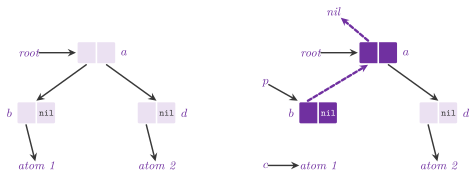
A marking by a visit in depth needs a stack as deep as the longest path of cells, which a collector (run when the memory is exhausted) cannot allocate. The marking of Deutsch, Schorr and Waite (Schorr and Waite 1967; Knuth 1997, Algorithm 2.3.5E) keeps the path of the visit in the fields of the cells themselves. It reverses each pointer that it follows and restores it on the way back, with one bit per cell (\(\mathit{side}\)) for the field that holds the reversed pointer (Figure 5.9).
Algorithm 5.10. The operations of
CellHeap (Knuth 1997, §2.3.5 and Algorithm
2.3.5E); \(F\) is the free list, linked
through the field car, and \(\mathit{side}( x )\) is true when the
reversed pointer of the cell \(x\) is in its cdr.
Lemma 5.12. During the marking by pointer reversal, let \(\mathrm{back}( x )\) be the field of the cell \(x\) named by \(\mathit{side}( x )\). Then the sequence
ends with nil and is, in reverse, the path of the visit from the root to \(p\), the cell whose field holds the current value \(c\) (a cell, an atom or nil). Each cell \(x\) of the path held, before the visit, the next cell of the path (or \(c\), for \(x = p\)) in its field \(\mathrm{back}( x )\), and the other fields of the cells of the path, and all the fields of the other cells, hold their values before the visit.
Proof. By induction on the three moves of the marking (cf.
Algorithm 5.10). Going down the car (line
12), the visit stores \(p\) in the car of \(c\), with \(\mathit{side}( c )\)
false, and makes \(c\) the new \(p\); the path grows by \(c\), whose car held
the new current cell. Going up from a cdr (line 14), the visit restores
in the cdr of \(p\) the cell it comes from and moves to
\(\mathrm{back}( p )\); the path loses its last cell, whose fields are now
both restored. Moving from the car to the cdr of \(p\) (line 17), the
visit restores the car of \(p\), puts \(\mathrm{back}( p )\) in its cdr
and sets \(\mathit{side}( p )\). Then the path is the same, and the field
that holds the next cell is now the cdr. Initially, \(p\) is nil and \(c\) is
the root, so that the sequence (5.4) is empty and the statement holds. Finally, the three moves are the only writes of the marking, and each one changes only
the fields named above, which proves the last part. \(\square\)
Theorem 5.1. collect() marks exactly
the cells reachable from the roots, leaves their fields as they were, and
frees the others. The marking takes time linear in the cells reached,
with no space besides one mark bit and one side bit per cell, and a
collection costs \(O( n + r )\) time on a heap of \(n\) cells with \(r\)
occurrences of roots.
Proof. By Lemma 5.12, the marking of a root
ends when \(p\) is nil, i.e., with an empty path, and hence with all the
fields restored. A cell is marked when the visit enters it, and a marked
cell is never entered again; hence, only reachable cells are marked, since
the visit only follows fields. A cell entered is left towards its cdr
once and left upwards once (the side bit distinguishes the second time from the first), and each move costs \(O( 1 )\) time; the marking thus takes time
linear in the cells marked, besides one step for each root. Conversely,
the visit leaves a cell upwards only after it has followed both its
fields, the car by the first loop and the cdr by the move of line 17;
hence, when it ends, each field of a marked cell holds nil, an atom or a
marked cell. By induction on the length of a shortest path from a root,
each cell reachable from a root is thus marked (by this marking or by that
of an earlier root). Finally, the sweep reads the \(n\) cells, unmarks the
marked ones and pushes the others on the free list, from the last cell to
the first, so that the free list is in the order of the addresses. A
collection thus costs \(O( n + r )\) time for \(r\) occurrences of roots,
i.e., \(O( n )\) when the roots are \(O( n )\). \(\square\)
The code of the marking is made of three loops, one for each move of the
induction, i.e., the loops of lines 10 and 13 and the move of line 17 of
mark() in Algorithm 5.10.
Lemma 5.13. A cons() costs \(O( 1 )\)
time, but for the collection. If each collection frees at least \(\alpha n\)
cells, for a constant \(0 < \alpha \le 1\), and the roots are \(O( n )\), then
any sequence of \(s\) calls of cons() costs \(O( s / \alpha + n )\) time,
i.e., \(O( 1 / \alpha )\) amortized time per call once \(s \ge n\).
Proof. A call that finds a free cell pops the free list and writes two fields. A collection is made only when the free list is empty, and by Theorem 5.1 it costs \(O( n )\) time; then it leaves at least \(\alpha n\) free cells, which the next \(\alpha n\) calls take before another collection is made. Hence among \(s\) calls there are at most \(1 + s / ( \alpha n )\) collections, of \(O( n )\) time each, i.e., \(O( n + s / \alpha )\) in all. \(\square\)
When the reachable cells fill the heap, cons() fails its precondition after
the collection, since no cell can be freed. For the comparison, the class also
keeps the marking with an explicit stack (collect( false )). At the highest
level of the contracts, collect() checks that it frees exactly the cells
that are not reachable (found by a plain visit), and that it leaves the fields
of the others as they were.
In ADS/memory/CellHeap.h, the declarations of CellHeap that a user
calls are
// declarations of <ADS/memory/CellHeap.h>
class CellHeap
{
 public:
 using Value = long;
 static constexpr Value nil = -1;
 static Value atom( long k );
 static bool isCell( Value v );
 explicit CellHeap( std::size_t n );
 Value cons( Value car , Value cdr );
 Value car( Value c ) const;
 Value cdr( Value c ) const;
 void setCar( Value c , Value v );
 void setCdr( Value c , Value v );
 void addRoot( Value c );
 void removeRoot( Value c );
 std::size_t collect( bool reversal = true );
 std::size_t freeCells( void ) const;
 };
5.11 The allocators compared¶
The allocators of the chapter are not interchangeable. Those of
§5.2 and §5.3 work on a
simulated memory, and are meant (rather) for the study of the methods (the fits,
the fifty-percent rule, the buddies) more than for serving a program; the
CellHeap of §5.10 is in the same position for
the garbage collection. Among the others, the choice depends on how the
objects die. If they die all together, an Arena costs no header and no work per
free. If they die one at a time and are all of one type, an
ObjectPool costs six words, with no header in its slots. If they are of
a few sizes and die one at a time in the thread that made them,
SizeClassAllocator serves them, and PoolResource (through
PoolAllocator) serves the containers of the standard library, giving the
slots back a page at a time after scrambled frees. If another thread frees
them, ConcurrentPoolResource is needed. Finally, HugePageAllocator is
the allocator of the blocks under the pools and the vectors of the large
structures. Berger et al. 2002 found
that most custom allocators of real programs are not faster than a good
general allocator, with the exception of the regions (our arenas); one can
thus expect the gains of the pools to come from the locality more than
from the cost of the operations. The
comparison of our allocators with the allocator of the system and with
mimalloc, on the workloads of the containers of the library, belongs to
Appendix B, where it will be made on an idle machine.
5.12 The allocators of the containers¶
The containers of the other chapters that manage their memory take an
allocator A as their last template parameter (see
Table 5.2). Hence the allocators of this chapter,
those of std::pmr and the general allocators of today reach their nodes,
places and blocks, which would otherwise come from the global
operator new. The containers follow the rules of the allocator-aware
containers of the standard library, which ADS/memory/AllocatorAware.h
writes once for all of them. A container rebinds A to the type of what it
allocates, by std::allocator_traits, and makes a copy on the allocator
that select_on_container_copy_construction() gives. A copy assignment, a
move assignment and a swap take the allocator of the other container only
when the corresponding trait of A is true, i.e.,
propagate_on_container_copy_assignment,
propagate_on_container_move_assignment or propagate_on_container_swap.
A move assignment between two containers whose allocators are not equal
and do not propagate cannot take the memory of its source, since that
memory must go back to the allocator that gave it. It thus moves the items
one by one into memory of the target, in time linear in their number, and
this is the only case that costs more than with std::allocator, whose
instances are all equal. A swap of two such containers is not allowed, as
in the standard, and a container whose allocator does not propagate on a
swap checks the equality of the two allocators as a precondition (see
§1.6 for the contracts).
The default allocator of each container is the one it used before it took a
parameter. This is std::allocator for most of them, and the
HugePageAllocator of §5.9 for the vector of
DaryHeap and for the containers that pool their nodes in an ObjectPool,
which then takes the allocator under its blocks. Such an allocator is empty,
and the container holds it as an empty base or as an empty member. The paths
that only a stateful allocator needs (a stored size, a move item by item, a
check of equality) are discarded at compile time. Hence the code and the
layout of a container with its default allocator are those it had before; in
fact, the instructions that Callgrind counts on the same work are equal to the
unit with and without the parameter. The one exception is IndexedDaryHeap
compiled by GCC 13 without Boost, whose push() executes one instruction more
since its registers are allocated differently (the same source gives equal
counts with clang and with Boost). The same holds for any allocator whose
instances are all equal and default-constructible (e.g., mi_stl_allocator of
mimalloc). We remark that a stateful allocator instead costs a pointer in the
container. For the hash tables of open addressing it also costs a call of the
allocator in place of the aligned operator new, which one may expect to
matter only for small tables rebuilt often.
Table 5.2. The containers that take an
allocator A, what they allocate from it and their default allocator;
"pool" means that the blocks of an ObjectPool come from A, and
"stateless" that A must have all its instances equal.
| Container | From A |
Default A |
|---|---|---|
FlatHashTable |
the places and the control bytes, in lines of 64 bytes (with Boost, the memory of boost::unordered_flat_map) |
std::allocator |
DenseHashMap |
the pairs and the groups | std::allocator |
BucketCuckooTable, CuckooHashTable |
the tags and the places | std::allocator |
PointerTable |
the places | std::allocator |
BTreeMap |
the leaves and the internal nodes, pools | HugePageAllocator |
JoinTree and its aliases |
the nodes, stateless | std::allocator |
PairingHeap, FibonacciHeapPriorityQueue |
the nodes, a pool | HugePageAllocator |
MeldableHeap |
the nodes | std::allocator |
DaryHeap |
the vector | HugePageAllocator |
RadixHeap, IndexedDaryHeap |
the vectors | std::allocator |
RootishArrayStack, TieredVector |
the blocks and the vector of the blocks | std::allocator |
SmallVector |
the items beyond the inner room | std::allocator |
Any allocator of the standard plugs in. With std::pmr::polymorphic_allocator
over a std::pmr::monotonic_buffer_resource, the memory of a container comes
from the buffers of the resource and goes back with it, while its copies are
made on the default resource, the one that
select_on_container_copy_construction() of std::pmr gives. With
mi_stl_allocator, which is stateless, the code is that of std::allocator
on the heaps of mimalloc. jemalloc has no allocator of the standard, but an
allocator of a few lines over its mallocx() and sdallocx() serves, and
passes back to jemalloc the size of each block it frees. The arenas of
§5.4 serve the containers through ArenaResource, an
arena of bytes of any type and alignment, which is a resource of the
PoolAllocator of §5.7. A request of \(b\) bytes
aligned to \(a\) moves a pointer in the current block, and a block of \(\max( n ,
b + a )\) bytes is taken from the allocator of the resource when the request
does not fit. A deallocation leaves the block as it is, and the blocks go back
only with release() or with the resource, as those of
std::pmr::monotonic_buffer_resource, though with no virtual call. The other
way round, PmrResource of ADS/interop/std/Pmr.h makes any resource of the
library, ArenaResource included, a std::pmr::memory_resource. For
instance, with the headers ADS/memory/Arena.h and
ADS/memory/PoolAllocator.h, a table on a monotonic buffer and a heap on an
arena are
#include "ADS/dictionary/FlatHashTable.h"
#include "ADS/priority/DaryHeap.h"
#include <memory_resource>
std::pmr::monotonic_buffer_resource m;
using PA = std::pmr::polymorphic_allocator< std::pair< const int , double > >;
ADS::FlatHashTable< int , double , ADS::DefaultHash< int > ,
                    std::equal_to< int > , PA >
  T{ PA( &m ) };
T.insert( 1 , 2.5 );  // the places from the buffers of m
ADS::ArenaResource<> r;
using AA = ADS::PoolAllocator< int , ADS::ArenaResource<> >;
ADS::DaryHeap< int , std::less< int > , 4 , false , AA > H( {} , AA( r ) );
H.push( 7 );  // the vector from the blocks of r
In ADS/memory/Arena.h, the declarations of ArenaResource that a user
calls are
// declarations of <ADS/memory/Arena.h>
template< class A = std::allocator< std::max_align_t > >
class ArenaResource
{
 public:
 explicit ArenaResource( std::size_t n = std::size_t( 1 ) << 16 ,
                         const A & alloc = A() );
 void * allocate( std::size_t b ,
                  std::size_t a = alignof( std::max_align_t ) );
 void release( void ) noexcept;
 std::size_t bytes( void ) const { ... }
 std::size_t size( void ) const { ... }
 };
We remark three limits of the scheme. First, the join trees of
chapter 8 take only a stateless allocator, since the
algorithms of ADS/tree/JoinAlgorithms.h build and free their nodes with
no tree at hand (and from many threads in the parallel set operations),
and a stateful allocator would thus have nowhere to be kept. Second, the
containers that build their items in the memory they manage (e.g., the
places of a hash table, the nodes of a pool and the blocks of
TieredVector) build them by a placement new, without construct() of
the allocator. The construction with an allocator of std::pmr thus does
not reach the items, and a key of type std::pmr::string usually keeps the
resource it was built with (cf. the vectors of the other containers, whose
construct() passes their resource on).
Third, the scratch arrays of a rebuild or of a bulk load live for one call
and come from operator new, e.g., the counts of the groups of
DenseHashMap and the levels that BTreeMap builds from a sorted range.
Only the memory that a container keeps comes from its allocator. We also left
MinMaxHeap and IntervalHeap with no allocator, since the programs that
pass them as a template template argument of two parameters would no longer
compile with clang 18, which does not match a template with a third
parameter to it.
5.13 Discussion and references¶
The dynamic storage allocation of Knuth 1997, §2.5, with the fits, the boundary tags, the buddy system of Knowlton 1965 and the fifty-percent rule, is the root of the chapter. The survey of Wilson et al. 1995 is the reference for what came after it; among other things, it argues that the simulations with random sizes and lifetimes are a poor model of real programs, which usually allocate few sizes and free their blocks in patterns. The arenas are those of Hanson 1990, the free list of the pools is the list AVAIL of Knuth 1997, §2.2.3, and the size classes with constant-time operations are in TLSF (Masmano et al. 2004). The structure of §5.7 and §5.8 comes from the slabs of Bonwick 1994, the heaps per thread of Hoard (Berger et al. 2000), the free lists sharded by page of mimalloc (Leijen et al. 2019) and the batches of remote frees of snmalloc (Lietar et al. 2019), on the lock-free stack of Treiber 1986. The transparent huge pages are those of Navarro et al. 2002, and the marking by pointer reversal is that of Schorr and Waite 1967, in the form of Knuth 1997, Algorithm 2.3.5E. We do not treat here the copying and the generational collectors, nor the collectors that run concurrently with the program, since the library has none of them.
5.14 Exercises¶
Each exercise names the test of the library that solves it (run it with
ctest -R <name>).
- Realize the dynamic storage allocation with boundary tags, with the
first, best and next fit, in which a free merges with both its free
neighbors in \(O( 1 )\) time; realize the buddy system on \(2^m\) words.
Check on random sequences of requests and frees that the memory is
one free block again at the end. Test:
taocp.allocators. - Realize a mark-and-sweep collector on cells of two fields, whose
marking uses no stack (the pointer reversal of Deutsch, Schorr and
Waite), and check on random structures with cycles and sharing that it
frees the same cells as a marking with a stack. Test:
taocp.cell-heap. - Realize an arena of objects of one type whose objects never change
their addresses, and which destroys them all with the arena, also when
a constructor throws. Test:
engineered.arena. - Realize a pool of objects of one type, with blocks that double up to a
limit, in which the last slot freed is the first one used again and the
slot of a constructor that throws stays free. Tests:
engineered.pool; for the raw slots ofallocate()anddeallocate(),memory.pool-raw-slots. - Realize an allocator by size classes whose class is computed with no
table and no loop, and whose waste is less than 20% of a block past 128
bytes. Test:
memory.size-class-allocator. - Realize a standard allocator over pages with free lists by page, and
use it in
std::list,std::map,std::unordered_mapandstd::allocate_shared, with the allocator copied, moved and swapped with the containers. Tests:engineered_memory.pool-resource,engineered_memory.pool-allocator-containers,engineered_memory.pool-allocator-propagation,engineered_memory.pool-allocate-shared. - Realize a pool whose objects may be freed by a thread other than the
one that made them, with one CAS per batch of remote frees. Tests:
engineered_memory.concurrent-pool,engineered_memory.concurrent-pool-threads. - Realize an allocator that gives the large blocks aligned to a huge
page, and keeps the large blocks given back for the next request of the
same size. Tests:
engineered.huge-page-allocator,memory.huge-page-cache. - Give an allocator to the hash tables of open addressing, to the heaps
and to the sequences of blocks, with the rules of the allocator-aware
containers of the standard, so that their memory comes from a
std::pmr::monotonic_buffer_resource, from an arena of bytes and from a stateful allocator whose ledger is empty when the containers die, while the default allocator leaves the code as it was. Tests:engineered_allocators.alloc-flat-hash,engineered_allocators.alloc-sequences,engineered_allocators.alloc-arena-resource.