Appendix A. Writing a new structure¶
[Source: include/ADS/stack/MinStack.h, stack/impl/MinStack.tpp,
ADT.h, Contract.h, docs/STYLE.md, docs/theory/stack.dox,
test/ods_lists.cpp, test/tests.txt, bench/queues.cpp,
cmake/ads_sets.txt, src/ADSBase.cppm]
We are concerned in this appendix with the steps by which a structure
enters ADS, from its header to the pages of this manual, in the order in
which a contributor takes them. Each step is described as the repository
does it at the time of writing. Our running example is MinStack, the
STACK with its least item of Morin 2013, exercise
3.14. It is small enough to be read in
full (a header of 167 lines and a .tpp of 66), and yet it goes through
almost all the steps: a concept that it models, contracts of three kinds,
two operations with pseudocode, a lemma on its theory page, a test in the
registry, a line of the module and one of the changelog. It has no
benchmark, and hence §A.7 takes as its
example the stacks that have one. A structure written for speed (the
engineered level of §1.9) goes through the
same steps, with the differences noted where they arise; the method of the
benchmarks is the subject of Appendix B.
A.1 The folder and the files¶
A structure goes in the folder of the abstract data type that it
realizes, which is also the area of its chapter. Thus, MinStack is a
STACK and lives in include/ADS/stack, next to ArrayStack and
MultiStack, while the queues and the deques with the minimum of
exercises 3.15 and 3.16 live in include/ADS/queue. A structure that
realizes no abstract data type of the book goes in the folder of the
problem it solves (e.g., succinct or external). A new folder needs a
new theory page (§A.5) and a row
in the map of the areas of manual/build/structmap.py.
Each structure is one header, here MinStack.h, which declares the class
with its contracts. At its end, the header includes the definitions of its
templates from the folder impl/ next to it, here impl/MinStack.tpp.
Small members (the observers, clear()) are defined in the class, while
the operations that carry pseudocode and contracts are defined in the
.tpp. Both files have the frame of all the sources of ADS, which opens
with a box of 78 columns holding the name of the file:
/*--------------------------------------------------------------------------*/
/*---------------------------- File MinStack.h -----------------------------*/
/*--------------------------------------------------------------------------*/
After it come the comment /** @file, which Doxygen shows as the
description of the header, and then the boxes DEFINITIONS, INCLUDES,
NAMESPACE and CLASS MinStack. We include the headers of ADS by their
path from include/ (e.g., "ADS/Contract.h"), before those of the
standard library in alphabetical order. Its guard is #ifndef
__ADS_MinStack, followed by the comment /* self-identification: #endif
constant */. A box IMPLEMENTATION precedes the line #include
"ADS/stack/impl/MinStack.tpp", and the box End File MinStack.h closes
the file. As for the .tpp, it has no guard and only three boxes, that of its
name, IMPLEMENTATION before the definitions and End File MinStack.tpp,
and its @file comment is one sentence ("The operations of MinStack [see
MinStack.h], with their contracts.").
Inside the class, the members are named f_ followed by the name of the text
(f_A the items, f_M the minima, f_less the order). Furthermore, the type
of the items is the alias Item, which the concepts require, and the order is
a parameter C with std::less<> as its default, stored as
[[no_unique_address]], whereby an empty comparator takes no room. We format
the code by the rules of the repository code-style, which the continuous
integration applies to each pull request
(§A.10).
In the @file comment a reader learns what the structure is before
reading any code, and it follows a fixed order: (i) what the header
realizes and from which source, with the section or the exercise ("The
STACK with the minimum of exercise 3.14 of Morin's book, beyond the book
[see ADT.h]"); (ii) the representation, its invariant and the costs,
each with its reason when that is not obvious (e.g., the minima are one
item per record low from the bottom, hence \(n\) at most); (iii) the order
of the items and the contracts, with the cost of the invariant; (iv) the
\see lines of the sources; (v) the author and the copyright. In it, the words
"beyond the book" mark a structure that the main textbook of the library,
Montresor 2025, does not describe.
Hence the tests of such a structure go in the programs of the source it comes
from (§A.6), not in those of the
chapters of that book (ch01 to ch19).
A structure at the textbook level follows its pseudocode line by line, and its comment states it. An engineered one, instead, cites the paper it follows, and its comment states what it changes with respect to the code of the textbook and why that change should be faster. Where the code of the textbook is available, the comment compares with it explicitly. For instance, the headers of the skip list, of the scapegoat tree, of the treap and of the left-leaning Red-Black tree each have a paragraph "Where it is meant to be faster than the ... of Morin, for the benchmarks to check", whose claims are tested by the campaign of §B.6.
A.2 The concept¶
A structure models the concept of its abstract data type, i.e., the names
and the types of its operations (the syntactic part of the specification,
in the terms of §1.2). We give the concepts
of the book in ADS/ADT.h (Sequence, Set, Dictionary, Stack and
Queue). Those of the interfaces of Morin's book are in
ADS/set/SetInterfaces.h (USet and SSet, with the KeyedDictionary
and OrderedDictionary on which DictionarySet builds them) and in
ADS/sequence/IndexedList.h (IndexedList and IndexedDeque). The
concept of the STACK is
template< class S >
concept Stack = requires( S s , const S cs , const typename S::Item & v )
{
 typename S::Item;
 { cs.empty() } -> std::same_as< bool >;
 s.push( v );
 { s.pop() } -> std::convertible_to< typename S::Item >;
 { cs.top() } -> std::convertible_to< typename S::Item >;
 };
and MinStack models it, since it has the type Item, empty(),
push(), top() and a pop() that returns the item removed. Its
min() is an addition that the concept neither requires nor forbids;
hence the algorithms written on Stack (e.g., those of
§3.7) run on a MinStack unchanged. A concept is
checked where this is cheapest, by a static_assert in the program of the
tests that includes the header:
static_assert( Stack< MinStack< int > > );
This line of test/ods_lists.cpp stands next to those of MinQueue and
RealTimeMinQueue on Queue and to those of the lists of Morin on
IndexedList and IndexedDeque. A wrong name or type makes the
static_assert fail at compile time. However, it does not check the meaning of
the operations: the axioms in the comment of each concept (for the STACK,
\(\mathrm{top}( \mathrm{push}( S , v ) ) = v\) and \(\mathrm{pop}( \mathrm{push}(
S , v ) ) = S\)) are checked by the tests
(§A.6), and the constructive part of the
specification by the contracts.
A.3 The contracts¶
In ADS, the contracts of an operation are its precondition, its postcondition
and the invariant of the structure, in the sense of Meyer
1992. ADS checks them at run time by
the four macros of ADS/Contract.h, which mirror the contracts of C++26
(Berne et al. 2025), so that the
compilers that support those can replace them. All four expand to the
macro ADS_CONTRACT_CHECK( level , kind , cond ), each with its level and
its kind, which tests the condition under if constexpr( ADS_CONTRACTS >=
level ) and, when the condition is false, calls a function of
ADS::detail with the kind, the text of the condition, the function, the
file and the line. ADS_PRE is checked from the level
1 and ADS_POST from the level 2, while ADS_INVARIANT and ADS_AUDIT
(a precondition or a postcondition that costs more than the operation,
e.g., that a vector is sorted before a binary search) are checked from the
level 3. This level is the macro ADS_CONTRACTS, which is 1 by default and
0 when NDEBUG is defined (as for assert); we compile the programs of
the tests at 3 and the benchmarks at 0. A violated contract throws
ADS::contract_violation, a std::logic_error whose message names the
kind, the condition, the function and the place. Since a condition is
compiled at every level but evaluated only from its level up, it must remain
correct C++ and have no side effect.
MinStack has contracts of three kinds (it needs no audit). The
precondition ! f_A.empty() opens top(), min() and pop(), the three
partial operations of the STACK with the minimum. Also, the postconditions
of push() and pop() check that the size grows or shrinks by one, at a
cost of \(O( 1 )\), as befits a postcondition. Finally, the invariant is
the private member ordered(), which checks in \(O( n )\) time that the
minima do not increase from the bottom and that their top is equivalent,
under the order, to the least item of the vector. Indeed, the tests rely on it,
since at the level 3 each push() and pop() of the test of
§A.6 checks it; it is also the statement
of Lemma A.1. Note that the copy of the
size that the postconditions compare, [[maybe_unused]] const std::size_t
n = f_A.size();, carries its attribute because the compiler would
otherwise warn at the levels where no contract reads it.
A.4 The pseudocode, the code and the references¶
Each operation that is an algorithm (i.e., not an accessor, nor a
constructor that only copies) carries its pseudocode in its comment,
after the description and before \pre and \post. Its conventions are
those of section 2 of docs/STYLE.md: one display \f[
\class{pseudocode}{ ... } \f], an array with the numbers of the lines in
its first column and its rows ended by \cr, the keywords in
\textbf{}, the calls in \mathrm{} and the assignment as \gets.
Also, the comment lines stay within 79 columns, and none of them may end with a
backslash. The paragraph before the display names the source ("In
pseudocode (Morin, exercise 3.14), \(A\) the items and \(M\) the minima:"),
and for a paper already cited by a \see line it reads "(Kahn's
algorithm, beyond the book)" or the like. We write all the pseudocode in
our own words, from the description of the algorithm and from the code of
ADS, whatever the license of the source (the book of Montresor, under CC
BY-NC 4.0, the books of Knuth, the notes of Ferragina, the papers), and
cite the source in place of copying it. For MinStack the two displays
read as in Algorithm A.1.
Algorithm A.1. The operations of MinStack
that change it (Morin 2013, exercise 3.14);
\(A\) is the vector of the items and \(M\) that of the minima.
Both procedures test \(\mathbf{not}\ \mathrm{top}( M ) < x\), rather than
\(x \le \mathrm{top}( M )\), since the class has only less, which is a
strict weak order. This test sends to \(M\) also an item equivalent to the
minimum, and this is why pop() is correct when two equal minima are on
the stack:
Lemma A.1. After any sequence of
operations of Algorithm A.1 on an empty
MinStack, \(M\) does not increase from its bottom, and if the stack is not
empty then \(\mathrm{top}( M )\) is a least item of \(A\). Moreover, \(M\) holds
one item for each item of \(A\) that is not larger than all those below it,
hence at most \(n\) items.
Proof. By induction on the operations, the claim being true of the empty
stack. A push() of \(x\) with \(\mathrm{top}( M ) < x\) leaves both the
least item and \(M\) as they were. Otherwise \(x\) is not larger than the
least item of \(A\), and it goes on top of \(M\), which remains not
increasing. A pop() of \(x\) finds \(\mathrm{top}( M ) \le x\) by the
inductive hypothesis. If \(\mathrm{top}( M ) < x\), then \(x\) never entered
\(M\) (an item enters \(M\) only when it is not larger than its top), and \(M\)
stays as it is. If instead \(x\) is equivalent to \(\mathrm{top}( M )\), then
\(x\) is the item that put it there or an equivalent one pushed later,
which entered \(M\) too; hence popping \(M\) leaves on its top the least of
the items below \(x\). Finally, the last claim follows, since an item enters \(M\)
exactly when it is a record low from the bottom of \(A\). \(\square\)
Hence min() costs \(O( 1 )\) in the worst case, and push() and pop() cost
\(O( 1 )\) but for the doublings of the two vectors (the header states "\(O( 1 )\)
amortized time"). On a decreasing input \(M\) has \(n\) items, while on a random
permutation (cf. the theory page) it has \(H_n = O( \log n )\) expected, the
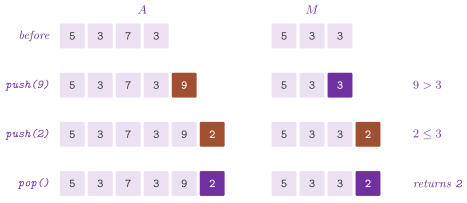
number of its records. Figure A.1 shows the
two branches of push() and a pop() that removes a minimum.
The code of the two operations is the pseudocode with the names of the class. We show it here, as the example of how a structure is written, without the contracts, which the text states (the chapters of the areas, instead, give only the pseudocode, the signatures and short examples of use, see §A.11):
f_A.push_back( x );
if( f_M.empty() || ! f_less( f_M.back() , f_A.back() ) )
 f_M.push_back( f_A.back() );
T x = std::move( f_A.back() );
f_A.pop_back();
if( ! f_less( f_M.back() , x ) )  // x is the least: it leaves
 f_M.pop_back();
These listings come from the .tpp, where two comments that change no
code, the markers //! [push] and //! [pop], delimit them. Such markers
are those of the command \snippet of Doxygen, and
§A.11 shows how the manual extracts
them.
Finally, each source of a header has its \see line, with the section,
the exercise or the pages, and with the DOI whenever the work has one
(e.g., doi:10.1109/2.161279 for the paper of Meyer in Contract.h).
A DOI is checked on doi.org, never guessed. Morin's book is cited by the
URL of its C++ edition, https://opendatastructures.org/ods-cpp.pdf,
which the code of ADS follows. Indeed, the DOI of the book belongs to its
edition in pseudocode (Morin 2013),
whose numbering of the exercises may differ.
A.5 The theory page¶
An area collects its definitions, its notation, its invariants and the
arguments behind its costs in a theory page, docs/theory/<folder>.dox.
Section 1 of docs/STYLE.md fixes its form: one Doxygen group
theory_<folder>, titled "Theory of" followed by the title of the area
and placed in the group area_<folder>, with sections
theory_<folder>_<name> for the definitions, the realizations and their
costs, each family of algorithms, and the references. A new structure
adds two things to it: (i) its row in the table of the realizations and
their costs, with the reason of each cost that is not obvious; (ii) the
statement on which its correctness rests, as a numbered paragraph in
italics followed by its argument.
For MinStack, docs/theory/stack.dox has the row of the table in its
section theory_stack_repr (two vectors, the items and the record lows).
Its statement is in the section theory_stack_ods, "The stacks of
Morin's book", as Lemma 3 (the minimum of a stack, exercise 3.14), with
the argument of Lemma A.1; also, the
theory page of the queues refers to it for the queue with the minimum,
which is made of two such stacks. A header refers to its theory page by
\ref, and the build of the two sites finds and links a new page with no
change of docs/apiref.py. This manual supersedes the
page without replacing it, since the page remains the documentation that
the API reference shows next to the headers.
A.6 The tests¶
The tests are programs of test/, grouped by their source: ch01.cpp to
ch19.cpp for the chapters of Montresor's book, ods_ints.cpp,
ods_lists.cpp and ods_trees.cpp for Morin's, taocp.cpp for Knuth's,
pearls_*.cpp for Ferragina's and exam_*.cpp for the exams of the course
(and conclusion.cpp for the conclusion of Montresor's book). Furthermore,
beyond.cpp tests what no book covers, lib_*.cpp the problems that the
library adds in an area (e.g., lib_graphs.cpp), contract_<area>.cpp the
contracts and the axioms of an area, interop.cpp the standard interface of
the containers, and engineered*.cpp (with a few programs by family, e.g.,
heaps.cpp, hashing.cpp, join_trees.cpp, ordered.cpp and sorting.cpp)
the engineered structures. A test is a function registered with a name by the
macro ADS_TEST of test/ADSTest.h. This header also gives CHECK( c ),
whose failure names its file and line, CHECK_THROWS( e , E ), which checks
that a precondition throws, and scaled( n , small ), the size of a case that
is there for its scale only (the build of the coverage makes it small through
ADS_TEST_SMALL).
A test is named after its source, and that of MinStack is
ods-ex3.14.min-stack, in test/ods_lists.cpp. It runs 4000 random
operations, about 60% of which are pushes (all of them on an empty stack)
of keys in \([ 0 , 50 )\), where equal minima occur often. A std::vector
holds the same items, and the test compares with it the item that each
pop() returns and, after each operation, the size, the top and min()
(the latter against std::min_element). Then it pushes 0 to 99 in increasing
order and checks by minima(), the size of \(M\), that a single minimum is
kept, i.e., the bound of
Lemma A.1 at its best. Since the
program is compiled with ADS_CONTRACTS=3, each operation also checks
the invariant of §A.3.
In test/tests.txt, the registry of the tests, there is one line per test
with its program, its name and its source, e.g.,
ods_lists ods-ex3.14.min-stack MinStack
Both builds read it. On one side, test/CMakeLists.txt makes a program
for each name of the first column and a ctest <program>.<name> for each
line; on the other, the makefile builds the same programs (make) and
runs the same tests (make test). Hence a new test, or a new program,
takes one line of the registry and no change of either build. Note that the two
build files are kept specular by hand only for what the registry cannot
express, i.e., the programs of MPI (engineered_mpi, run on 1 to 4
processes), the test of the order of the includes of FastFlow and the test
of the module, which both files list. Then the ctest <program>.registry (in
the makefile, the target test-<program>) checks that the tests of a
program, as <program> -l lists them, are those of the registry; thus,
no test can be written and never run.
One runs the test of MinStack by itself with ctest --test-dir build -R
ods_lists.ods-ex3.14.min-stack, or by build-make/ods_lists
ods-ex3.14.min-stack after make. An exercise of a chapter of this
manual names a ctest of this form, which must exist.
A.7 The benchmark¶
An engineered structure enters a benchmark of bench/, and so does a textbook
one that has a counterpart in the standard library or in a well-known library.
It goes in the program of its family, as one more structure measured on the
same cases as the others. MinStack has no benchmark, since no library that
ADS is compared with has a stack with the minimum; however, the other stacks of
the library show the pattern. For instance, the program bench/queues.cpp has
a function stack( who , n , r , make , push , pop ), which measures \(n\)
pushes followed by \(n\) pops (the case push-pop) on the structure that make
builds. Its main() calls it once per structure: std::stack on a
std::vector twice, under the labels std::vector and std::vector A/A, then
std::stack on a std::deque, boost::container::devector (if Boost is
found), ADS::ArrayStack, ADS::MultiStack and ADS::RingDeque. A new stack
would be one more call, with its label (e.g., "ADS::MinStack"), its
constructor and its two operations as lambdas.
Three functions of bench/Bench.h do the rest. First, skip( who ) leaves
out the cells of any structure other than the one that ADS_BENCH_WHO
names, and under ADS_BENCH_LIST it prints the labels instead; this
allows bench/run.sh to run each structure in a separate process.
Then, median( prepare , work , r , ops ) times work \(r\) times, on what
the untimed prepare returns, and gives the median in nanoseconds per
operation. Finally, print() writes the line of a cell, separated by
tabs, as ( benchmark , case , n , structure , ns/op ). A competitor that
may be missing goes under a macro of the form ADS_HAS_<LIBRARY> (which
the makefile sets from a variable naming its prefix or its sources) or
under __has_include; hence the program builds wherever ADS does. All the
benchmarks are compiled with the contracts off.
A new program bench/<name>.cpp takes four more lines. It goes in the
list BENCHES of the makefile and in the foreach of the benchmarks of
CMakeLists.txt, which are kept specular by hand. It also needs a line
run in bench/run.sh, without which no campaign measures it, and a row in
the list PAIRS of bench/summary.py for each structure of ADS that the
summary of the README compares with a library. Appendix
B gives the method by which these programs are
run.
A.8 The module¶
The C++20 module ads exports all the names that the headers declare in
the namespace ADS and in those nested in it, but for the namespaces
detail, through the modules of the three sets of
§1.9, ads.core, ads.base and
ads.advanced. Their interfaces (src/ADSCore.cppm, src/ADSBase.cppm,
src/ADSAdvanced.cppm and src/ADS.cppm) are not written by hand.
Instead, the script cmake/ads_module_exports.py reads the AST of all the
headers, as clang dumps it, and writes in the module of the set of each
header a block of using-declarations, e.g.,
// stack/MinStack.h
using ADS::MinStack;
The blocks of the core are also written in ads.base and ads.advanced,
which do not import ads.core, since Clang 18 does not compile a module
whose global fragment includes the headers of Highway and which imports
another module that included them too (the functions of Highway are
static, i.e., local to each translation unit).
A new header is first given its set by a line of cmake/ads_sets.txt
(e.g., stack/MinStack.h base), with a line uses if it is a base header
that includes an advanced one. A header that would hold a part of each set
is written as two, the base one including the advanced one at its end
(e.g., graph/MaxFlow.h and graph/PushRelabel.h); a header of
ADS/interop/, which includes the headers of another library, is given
the set interop, which no entry point includes and no module exports,
so that the script reads none of its names. Otherwise cmake/ads_sets.py stops the
configuration and the make, and the job sets of the continuous
integration fails. Then a new header, or one that gains or
loses a public name, needs the module script to be run again (python3
cmake/ads_module_exports.py, with the flags of the optional executors
when their names are to be exported). We build the modules by
-DADS_BUILD_MODULE=ON with CMake, or by make test ADSMOD=1, and the
tests module, module.core, module.base and module.advanced import
them in place of the headers; a
name that the script missed shows as a program that does not compile.
A.9 The changelog¶
CHANGELOG.md follows Keep a Changelog, with the changes since the last
release under ## [Unreleased] and its subsections ### Added,
### Changed, ### Removed and ### Fixed; the versions follow semantic
versioning. Each entry of a new structure names the header and the
classes, the source (the exercise or the paper), and the tests and the
benchmark that come with it. MinStack entered with the other structures
of Morin's exercises, in the item that lists "MinStack, MinQueue and
MinDeque (exercises 3.14 to 3.16)". An entry describes the library as it
is after the change, not the steps by which the change was made.
A.10 The checks before pushing¶
The workflow .github/workflows/ci.yml builds all the programs and runs
all the tests with g++ and clang++ on Linux, macOS and Windows (and with
MSVC by CMake only), by CMake and by the makefile, with and without the
backends of GMP and of a CBLAS. Its job sanitizers runs all the tests
under AddressSanitizer and UndefinedBehaviorSanitizer (make test with
-fsanitize=address,undefined and ADS_TEST_SMALL). Other jobs run the
concurrent structures under ThreadSanitizer (threads), measure the
coverage, build the module by CMake and by the makefile, run the programs
of MPI on 1 to 4 processes, and build the executors and the backends that
are optional (executors, backends); on a pull request, the
action of code-style also checks the formatting of the lines changed.
A push is expected to leave the workflow green, and usually the cheapest way to
ensure this is to run its steps first. These are make -j4 test with g++ and
with clang++ (the two compilers often diagnose somewhat different errors in the
templates), and the same with CXXFLAGS="-std=c++20 -O1 -g
-fsanitize=address,undefined -fno-omit-frame-pointer -Wall -Wextra
-DADS_TEST_SMALL", as the job does; a concurrent structure adds a run under
ThreadSanitizer. CMake and the makefile define ADS_SANITIZE_ADDRESS and
ADS_SANITIZE_THREAD when the options of the compiler turn a sanitizer on
(the headers ask the build, never the compiler, whether one runs), and the
tests of CMake are then built with ADS_TEST_SMALL; under ThreadSanitizer,
ctest passes the suppressions of test/tsan.supp, for the reports whose
stacks pass through OpenMP, oneTBB, Kokkos, FastFlow or Taskflow, which the
sanitizer does not instrument and whose synchronization it therefore cannot
see (OpenMPLock adds to the lock of OpenMP a release and an acquire that
the sanitizer sees); under AddressSanitizer, those of test/lsan.supp, for
the memory that Open MPI, hwloc under it and FastFlow keep until the
process ends, and the programs of MPI run there without the search of
leaks, since Open MPI unloads its components first and leaves their leaks
with no frame that a suppression could name. Also, the files must keep their
frame: no line may exceed 79 columns, and the boxes must be aligned, which a
checker of the boxes, where one has it, verifies on the files changed
(section 3 of docs/STYLE.md). Then the documentation must build
with no warning by bash docs/build.sh, which also fails on a comment line
that ends with a backslash. Section 3 of docs/STYLE.md adds the screenshots
of the pseudocode on both sites, in the light and in the dark theme.
A.11 The pages of this manual¶
A structure enters the chapter of its area (for MinStack, Chapter
3) with the parts that manual/MAINTENANCE.md and the
model chapter fix. These are the abstract data type and its axioms, the
the representation and its invariant, a figure of the state before and after
the operation that matters, the pseudocode, the lemmas and the theorems with
their proofs, the signatures of the operations that a user calls with short
examples of use, the engineered variants, and the exercises, each naming
its ctest. A chapter shows no extract of an implementation, which the
pseudocode replaces, and it copies neither pseudocode nor code: instead, the script manual/build/snarf.py (run by make snippets in
manual/build) writes into manual/generated two kinds of files: (i) a
file <File>-<name>.cpp for each pair of markers //! [name] of a .h
or a .tpp, dedented and without the contracts and the copies that only
they read; (ii) a file <File>-<name>.pseudo.md for each pseudocode of
the comments, named after its first procedure or function. A member of a
class not named as the file takes the class in front of its name, and a
name that occurs twice in a header takes -2, -3, and so on.
The chapter includes these files with a line --8<-- "generated/<file>",
in a separate paragraph for the pseudocode and as the only line of a
fenced cpp block for the code. On the site the line is expanded by
pymdownx.snippets, and in the PDF by build/snippets.lua. For instance,
§A.4 includes in this way
MinStack-push.pseudo.md and MinStack-pop.pseudo.md, and, as the example
of this appendix only, MinStack-push.cpp and MinStack-pop.cpp. A
function whose comment has no pseudocode gets one in its header (a change
of the comments only) before a chapter describes it.
A figure is a standalone TikZ file, manual/figures/<area>-<name>.tex
(here stack-min.tex), that loads lmodern, amsmath and amssymb,
tikz and lamalunga, and then inputs tikz-ads.tex. It draws with the
styles of that file only: touched (with its variants for nodes,
vertices and edges) for what the operation reads or follows, added for
what it adds, and cell, node, vertex, edge and free for the
rest, with no outline and no colour outside the palette that lamalunga
computes from the primary. Then make figures writes its .pdf and its
.svg, and the chapter shows it in a separate paragraph,
{#fig-N-M}.
A work that the chapter cites goes in manual/chapters/Z-bibliography.md,
in alphabetical order, with the anchor ref-<surname><year> and its DOI.
Two checks follow by make check: build/bibcheck.py verifies that the
bibliography holds all the works of the \see lines of the headers, of
the theory pages and of the README, and build/structmap.py that each
header and each public class appears in the map of the structures of
§1.12, whose tables it also writes. Then we
build the chapter with the others by make pdf, which must give no
overfull box and no undefined reference after a second run of LaTeX, and
by make html; we check its prose on the PDF against the conventions of
the front matter.
A.12 Checklist¶
Table A.1 collects the files that a new
structure touches, with the check by which one verifies each step;
its last column gives what MinStack has for each of them.
Table A.1. The files of a new structure,
in the order of this appendix, with the check of each step and the
corresponding file or entry of MinStack.
| Step | File | Check | MinStack |
|---|---|---|---|
| header | include/ADS/<area>/<Name>.h |
boxes, 79 columns | stack/MinStack.h |
| operations | include/ADS/<area>/impl/<Name>.tpp |
contracts at level 3 | stack/impl/MinStack.tpp |
| concept | a test program | static_assert |
Stack< MinStack< int > > |
| pseudocode | the comments of the header | docs/build.sh |
push(), pop() |
| theory | docs/theory/<area>.dox |
docs/build.sh |
Lemma 3 of stack.dox |
| test | test/<source>.cpp, test/tests.txt |
<program>.registry |
ods_lists.ods-ex3.14.min-stack |
| benchmark | bench/<family>.cpp, bench/run.sh, bench/summary.py |
a campaign (Appendix B) | none |
| set and module | cmake/ads_sets.txt, src/ADSBase.cppm |
the tests sets.* and module.* |
stack/MinStack.h base, using ADS::MinStack; |
| changelog | CHANGELOG.md |
under [Unreleased] |
exercises 3.14 to 3.16 |
| manual | manual/chapters/NN-<area>.md, manual/figures |
make check, make pdf |
stack-min.tex, two pseudocodes |