26. Distributed computing¶
[Source: include/ADS/distributed/DistributedSort.h, MPIExecutor.h,
MPIMailbox.h, BoostMPI.h]
We are concerned in this chapter with the computations whose data are
spread over the processes of MPI (Message Passing Interface Forum
2023), each with a separate memory, which exchange them only by messages. In ADS/distributed, the headers
are compiled only with ADS_WITH_MPI, the option of CMake of the same name
and the macro of the makefiles. It is off by default, as for the other
runtimes, since the target ADS::ADS built with it carries MPI to every
program that links it, and AUTO turns it on whenever an implementation of
MPI such as Open MPI or MPICH is found. They give a
sort of the items of all the processes (§26.2),
and the runtime that lets the processes act as the workers of one
computation: an executor and a distributed minimum
(§26.3), and a mailbox
(§26.4) that also detects the termination of
the computation (§26.5). The threads inside a process, and the mailbox of the threads of which the
one of the processes is the counterpart, are those of
chapter 25. In the sets of
§1.9, the headers of this chapter are
advanced, but for BoostMPI.h, which includes the headers of Boost.MPI
and is of the set interop.
26.1 The model¶
A distributed computation runs on \(P\) processes, numbered by their
ranks \(0 , \ldots , P - 1\) in a communicator, each with a separate memory and a part of the input; a process reads the data of another only
by receiving a message. A collective operation is one that all the
processes of the communicator call, each with its part, e.g., the
gathering of a value of each process in all of them (MPI_Allgather), or
the exchange in which each process sends a piece of its data to each of the others (MPI_Alltoall, and MPI_Alltoallv for pieces of different
sizes). We take the cost of a message of \(b\) bytes as \(\alpha + \beta b\),
where \(\alpha\) is the latency and \(\beta\) the time per byte. We then take as the cost of an algorithm its local work, its number of messages and its volume
of communication, all per process, i.e., along its slowest process.
Throughout the chapter \(n_i\) is the number of the items of the process \(i\)
and \(n = \sum_i n_i\).
The model leaves out the topology of the network, the contention of the messages on the links, and the overlap of the communication with the work (which the operations that do not block try to obtain, cf. §26.3 to §26.5); it is nevertheless the usual one for the analysis of the collective operations, and the costs below are stated in it. We leave the measurements on a cluster to the benchmarks of appendix B.
26.2 Sorting by regular sampling¶
A sort of the items spread over the processes leaves in the process of rank \(j\) a sorted vector whose items are not smaller than those of the ranks before \(j\); the vectors in the order of the ranks are then the sorted items of all, and their sizes change. Before the sort, a process typically holds items of all the parts of the final order, and hence any distributed sort moves most items to another process: the volume of communication is at least about \(n / P\) per process. Hence the aim is to send each item once, in one exchange, and to end with parts of about \(n / P\) items.
sort( comm , A , less ) of DistributedSort.h is the parallel sort by
regular sampling of Shi and Schaeffer 1992,
in one round of communication (Algorithm 26.1).
Each process sorts its \(n_i\) items and takes \(P - 1\) samples at the ranks
\(\lfloor ( j + 1 ) n_i / P \rfloor\), one every \(w = n_i / P\) items. The
samples, gathered in all the processes by MPI_Allgather and sorted into a
vector \(S\), give the \(P - 1\) splitters, the splitter \(j\) being
\(S[ \lfloor j |S| / P \rfloor ]\) (every \(( P - 1 )\)-th sample when all the
processes have items, since then \(|S| = P ( P - 1 )\)). Each process then cuts
its sorted items at the splitters by binary searches, sends to the process \(j\)
its piece \(j\) by one MPI_Alltoallv (after an MPI_Alltoall of the sizes of
the pieces), and merges the \(P\) sorted pieces that it receives by
multiwayMerge() of ADS/sort. Since the items travel as bytes, their type
must be trivially copyable. Figure 26.1 follows
the algorithm on three processes.
The sort is declared, in the namespace ADS::distributed, as
// declarations of <ADS/distributed/DistributedSort.h>
template< Executor E , class T , class C = std::less<> >
void sort( E & ex , MPI_Comm comm , std::vector< T > & A , C less = C() );
template< class T , class C = std::less<> >
void sort( MPI_Comm comm , std::vector< T > & A , C less = C() );
the second running the local work on Sequential, and each process calls
it on its part, e.g.,
#include "ADS/parallel/ThreadPool.h"

int rank;
MPI_Comm_rank( MPI_COMM_WORLD , &rank );
std::vector< int > A( 1000 );
std::mt19937 g( static_cast< unsigned >( rank ) );
for( int & x : A )
 x = int( g() % 100000 );
ADS::ThreadPool pool;
ADS::distributed::sort( pool , MPI_COMM_WORLD , A );
// A is sorted, and no item of the rank r exceeds one of the rank r + 1
Algorithm 26.1. Sort by regular sampling (Shi and Schaeffer 1992), on an executor \(\mathit{ex}\) inside each process, and without one.
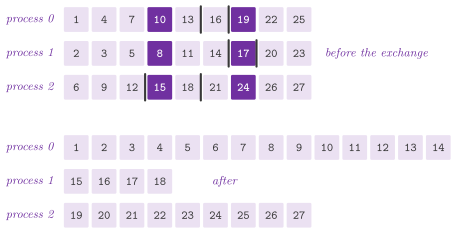
Since all the processes cut at the same splitters, the items received by the process \(j\) are those of all the processes in its interval, and their merge is sorted; hence the vectors in the order of the ranks are the sorted items. Regular sampling owes its name to the bound on the sizes of the parts.
Lemma 26.1 (regular sampling). With \(n / P\) items in each process, \(n / P\) a multiple of \(P\), and distinct keys, each process receives at most \(( 2 P - 1 ) n / P^2 < 2 n / P\) items.
Proof. With distinct keys a run of equal splitters has length 1, and line 10 sends the single item equal to the splitter \(j\) (if any) to the piece \(j\); hence the process \(j\) receives the items \(x\) with \(s_j \le x < s_{j + 1}\), where \(s_0 = - \infty\) and \(s_P = + \infty\). Since \(s_j\) and \(s_{j + 1}\) are the samples of the places \(j ( P - 1 )\) and \(( j + 1 ) ( P - 1 )\) of \(S\), the interval holds \(P - 1\) samples. Let \(t_i\) be those of the process \(i\), so that \(\sum_i t_i = P - 1\). The samples of the process \(i\) are its items of the places \(w , 2 w , \ldots , ( P - 1 ) w\), with \(w = n / P^2\), and the interval is a range of keys. Hence its items of the process \(i\) lie strictly between the sample of the process \(i\) just before its \(t_i\) samples in the interval (or the place \(- 1\), if there is none) and the one just after them (or the place \(n / P\)). These two bounds are \(t_i + 1\) gaps apart, and the items strictly between them are at most \(( t_i + 1 ) w\). Hence the interval holds at most \(\sum_i ( t_i + 1 ) w = ( 2 P - 1 ) n / P^2\) items. \(\square\)
The bound is tight up to a constant, but in practice the parts are
usually far closer to \(n / P\) (Shi and Schaeffer
1992). With repeated keys the lemma may
fail, since the items of one key all fall in one interval; sort()
therefore cuts the items equal to a run of \(k\) equal splitters into
\(k + 1\) parts whose sizes differ by at most one, the lowest part
being the smallest (line 10), and a key repeated many times is
thus spread over as many processes as it fills. Also, the merge keeps the result
sorted, since the parts of the run are of equal items.
A process with no items takes no samples (as its flag, gathered first, records), and the splitters come from the samples of the others; when no process
has items, all the cuts are at the end. Finally, the loop of line 11 makes the
cuts nondecreasing. It is a safeguard, which leaves them unchanged when less
is a strict weak order: the cut of a splitter \(x\) lies between the first
item equal to \(x\) and the place after the last one, and within a run of
equal splitters the cuts grow with \(j\).
Lemma 26.2. Under the hypotheses of
Lemma 26.1 and with \(n / P \ge P^2\), sort() makes \(O( ( n / P ) \log n )\) work per process,
and its communication takes
time with a direct all-to-all, i.e., \(O( \alpha P + \beta n / P )\).
Proof. The work is the local sort, \(O( ( n / P ) \log( n / P ) )\), the sort of the \(P ( P - 1 )\) samples, \(O( P^2 \log P )\), the \(P - 1\) pairs of binary searches, and the merge of \(P\) pieces of \(O( n / P )\) items in all (by Lemma 26.1), \(O( ( n / P ) \log P )\); with \(n / P \ge P^2\) the sum is \(O( ( n / P ) \log n )\). As for the volume of the communication, it is that of the samples, \(P^2\) items to each process, of the sizes of the pieces, one integer for each pair of processes, and of the pieces, each item sent once, i.e., \(O( n / P )\) items per process by Lemma 26.1. In a direct all-to-all each process sends \(P - 1\) messages, which gives (26.1). \(\square\)
Besides the gathering of the samples, the exchange of the sizes and that of
the pieces, which carry the volume, sort() makes two small collective
operations: the gathering of the flags of the empty processes, and a
reduction that checks that the bytes of each piece fit the counts of MPI
(the int before MPI 4, whose MPI_Alltoallv_c has counts of 64 bits).
If they do not fit in some process, all the processes throw
std::length_error, instead of passing MPI a number wrapped around or
leaving the others to wait in the exchange. An executor of threads
(chapter 25) may also be given: the local sort and
the merge then run on its threads, with MPI between the nodes and threads
within each, the hybrid scheme of the clusters of today.
Beyond some thousands of processes, the latency \(\alpha P\) and the \(P^2\) samples dominate (26.1). In this regime, the multi-level sorts of Axtmann et al. 2015 group the processes and exchange the items in \(O( \log P )\) levels, each item sent once per level, which trades the \(P\) messages of each process for \(O( P^{1 / \ell} )\) messages per level over \(\ell\) levels; ADS does not realize them.
26.3 Processes as workers¶
MPIEnvironment starts MPI for the life of the object, by MPI_Init_thread()
at the funneled level unless it is already started, and ends it by
MPI_Finalize() if it started it; the funneled level (only the thread that
started MPI calls it) suffices for the mailbox, and another level may be
requested by the third argument of the constructor, level() giving the one
that MPI provides (or MPI_THREAD_SINGLE, if the object did not start MPI).
The object cannot be copied, since MPI ends once. MPIExecutor holds a
communicator (MPI_COMM_WORLD by default, given back by comm()), requires
MPI to be initialized when it is built, and gives the rank of the process and
the number of the processes (rank() and size()), and its run( f ) makes
the call f( rank ), i.e., the worker of the process. A program written for
the workers of run() of the executors of threads thus runs with one worker
per process, all the processes calling run(); we remark that run() returns
when the worker of the calling process returns, and barrier() is the
synchronization of all of them.
A search in which each process improves a bound (e.g., the value of the best
solution found so far) needs the minimum over the processes of a value of
each. DistributedMin starts a reduction of the minimum that does not block,
MPI_Iallreduce (Hoefler et al. 2007),
and tests it while the process works (Algorithm
26.2); test() gives the minimum when the
reduction has completed, and wait() waits for it. Hence a process learns the
bounds of the others at most one reduction late, with no message for each
improvement. While a reduction is in flight (i.e., while inFlight() is
true), start( v ) starts none and returns false. Also, test() gives no
value when no reduction was started, wait() requires one in flight, and the
destructor waits for it. The values are of an arithmetic type, mapped to the
type of MPI of the same size (MPI_FLOAT, MPI_DOUBLE, MPI_LONG_DOUBLE,
and the integers of 8 to 64 bits). Since a reduction is a collective
operation, all the processes must start the same number of them, and destroy
the object after the last one has completed, which are the preconditions of
the class (which, as MPI writes into it, cannot be copied).
The three classes of MPIExecutor.h have the public members
// declarations of <ADS/distributed/MPIExecutor.h>
class MPIEnvironment
{
 public:
 MPIEnvironment( int & argc , char **& argv ,
                 int level = MPI_THREAD_FUNNELED );
 int level( void ) const;
 };

class MPIExecutor
{
 public:
 explicit MPIExecutor( MPI_Comm comm = MPI_COMM_WORLD );
 std::size_t rank( void ) const;
 std::size_t size( void ) const;
 MPI_Comm comm( void ) const;
 template< class F >
 void run( F && f ) const;
 void barrier( void ) const;
 };

template< class T >
class DistributedMin
{
 public:
 explicit DistributedMin( MPI_Comm comm = MPI_COMM_WORLD );
 bool start( T v );
 std::optional< T > test( void );
 T wait( void );
 bool inFlight( void ) const;
 };
Algorithm 26.2. Start of a reduction of
DistributedMin.
26.4 The mailbox¶
In a distributed computation each process typically owns a part of the data,
e.g., the items whose keys hash to its rank (ownerOf( k , P ) of Mailbox.h
in ADS/parallel), and it sends to the owner what concerns them, as the nodes
of a search that the other processes generate. Such messages are many, small,
and sent at unpredictable times, and a message of MPI for each of them would
pay the latency \(\alpha\) each time. The mailbox of MPIMailbox.h therefore
gathers the messages of a process for each rank into an outbox
\(O_{\mathit{to}}\), and sends it as one message of MPI when it holds batch
messages (Algorithm 26.3): \(k\) messages of \(b\)
bytes then cost \(\alpha + \beta k b\) instead of \(k ( \alpha + \beta b )\). Its
price is the latency of a single message, which grows by the time its batch
takes to fill; flush() sends the outboxes that are not empty, and cuts it.
The public members of MPIMailbox< Msg >, for a trivially copyable Msg, are
// declarations of <ADS/distributed/MPIMailbox.h>
template< class Msg , bool = std::is_trivially_copyable_v< Msg > >
class MPIMailbox
{
 public:
 explicit MPIMailbox( MPI_Comm comm = MPI_COMM_WORLD ,
                      std::size_t batch = 256 );
 std::size_t rank( void ) const;
 std::size_t size( void ) const;
 void send( std::size_t to , const Msg & x );
 void flush( void );
 template< class F >
 std::size_t poll( F && f );
 bool quiescent( void );
 void stop( void );
 bool stopped( void ) const;
 bool terminated( void ) const;
 template< class F >
 std::size_t leftovers( F && f );
 std::uint64_t sent( void ) const;
 std::uint64_t batches( void ) const;
 std::uint64_t received( void ) const;
 std::uint64_t waves( void ) const;
 MPI_Comm comm( void ) const;
 };
and a process works on it as a worker of run() does on Mailbox:
ADS::MPIMailbox< std::uint32_t > mb;  // on MPI_COMM_WORLD
std::vector< std::uint32_t > S;
if( mb.rank() == 0 )
 S.push_back( 1 );
long nodes = 0;
for( ; ; ) {
 mb.poll( [ & ]( std::uint32_t v ) { S.push_back( v ); } );
 if( S.empty() ) {
  if( mb.quiescent() )
   break;  // terminated everywhere
  continue;
  }
 const std::uint32_t v = S.back();
 S.pop_back();
 ++nodes;
 if( v < ( 1u << 12 ) )
  for( std::uint32_t c : { 2 * v , 2 * v + 1 } )
   mb.send( c % mb.size() , c );
 }
// the nodes of all the processes sum to 8191
Algorithm 26.3. Send, post, flush and poll
of MPIMailbox; \(s\) and \(r\) count the messages sent and received by the
process.
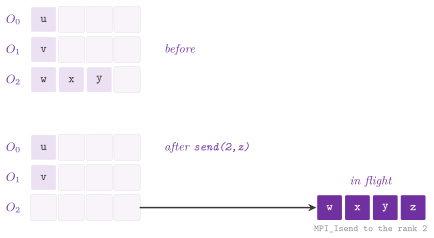
A batch is posted by MPI_Isend, which does not block: its buffer stays, with
its request, in a list of the sends in flight until MPI has completed it,
which MPI_Testsome finds at each poll (Figure
26.2). Hence a process never waits for a
receiver. Incoming batches are found by MPI_Iprobe from any source and
received by MPI_Recv, at most 64 batches per poll, and poll( f ) calls
f( x ) on each of their messages. The messages of a process to itself do not
go through MPI: a post to itself moves the outbox to a list, which the next
poll hands first. Each message is passed to \(f\) as const Msg &, read in
place in the buffer that MPI_Recv filled and that the next batch reuses;
hence \(f\) copies what it keeps. (Mailbox::poll() of the threads passes
instead Msg &&, since there a message is an object moved out of a queue.)
Note that the mailbox duplicates the communicator, and its messages and
reductions therefore never meet those of the program. This is the asynchronous
mailbox of the library YGM of Priest et
al. 2019; the exchange NBX of Hoefler et
al. 2010 solves instead a single round of
sparse messages, by synchronous sends and a barrier that does not block.
Forms of the messages. MPIMailbox< Msg > of a trivially copyable Msg
sends its batches as arrays of messages, which MPI copies as bytes (256
messages per batch by default); several kinds of such messages can travel as
one std::variant, which is trivially copyable as well. Messages of other
types, or of lengths that vary (e.g., the nodes of a search with a state of
variable size), are the records of MPIByteMailbox: each one a tag of 32
bits, a length of 32 bits and the bytes, padded to a multiple of 8, packed
into a batch until it holds batch bytes (65536 by default), Figure
26.3 and Algorithm
26.4. Finally, MPIMailbox< Msg > of a type that
is not trivially copyable is an MPIByteMailbox whose bytes are those of
MPICodec< Msg >, the customization point that encodes a message
(encode( x , out ) appends its bytes to out) and decodes it (decode( b )
rebuilds it from those bytes), given for std::string and for the vectors of
trivially copyable items. A program of Boost.MPI
(Gregor and Troyer) passes its
boost::mpi::communicator wherever the library takes a communicator, since
it converts to MPI_Comm implicitly. For its messages,
ADS/distributed/BoostMPI.h gives BoostMPICodec< Msg >, the bytes of a
message by Boost.Serialization in the packed archives of Boost.MPI; a
message that the program already serializes then goes through the mailbox
by one specialization, template<> struct MPICodec< Msg > : BoostMPICodec<
Msg > { };, as in the test engineered_boost_mpi. A record carries at most \(2^{32} - 1\) bytes. The
bytes \(b\) that poll( f ) of MPIByteMailbox passes to f( t , b ) are
valid during the call, at an offset multiple of 8 of a buffer that new
allocated (hence aligned for the types of up to 8 bytes). MPIMailbox< Msg >
of a type that is not trivially copyable sends its records with the tag 0, and
passes to \(f\) the message rebuilt by decode(), a temporary. Whatever their
form, the messages are counted one by one, and the waves of
§26.5 see all of them. Every form also gives
rank(), size(), the communicator of the mailbox (comm(), the duplicate),
the alias Message of Msg, and the counters sent(), received(),
batches() (those posted to other processes by MPI) and waves() (those
completed). None of them can be copied, since MPI holds their buffers.

The members of MPIByteMailbox are those of MPIMailbox but for the
send and the default batch, of 65536 bytes:
// declarations of <ADS/distributed/MPIMailbox.h>
class MPIByteMailbox
{
 public:
 explicit MPIByteMailbox( MPI_Comm comm = MPI_COMM_WORLD ,
                          std::size_t batch = 65536 );
 void send( std::size_t to , std::uint32_t t ,
            std::span< const std::byte > b );
 void flush( void );
 template< class F >
 std::size_t poll( F && f );
 bool quiescent( void );
 template< class F >
 std::size_t leftovers( F && f );
 };
and a codec of a type Msg that is not trivially copyable has the two
static members below, which the library gives for std::string and for
the vectors of trivially copyable items:
// declarations of <ADS/distributed/MPIMailbox.h>
template< class Msg >
struct MPICodec;
template<>
struct MPICodec< std::string >
{
 static void encode( const std::string & x , std::vector< std::byte > & out );
 static std::string decode( std::span< const std::byte > b );
 };
Algorithm 26.4. Send and poll of
MPIByteMailbox.
26.5 Termination¶
A process is active while it has work and passive otherwise; it
becomes active only by receiving, and it sends only while it is active.
The computation has terminated when all the processes are passive and no
message is on its way, a global condition that no single process can see. Each process counts the messages it has sent, \(s_i\), when it posts
their batch (or moves it to the messages to itself), and those it has
received, \(r_i\), when a poll hands them, both of which only grow. A wave reads the counters
of all the processes and sums them, \(S = \sum_i s_i\) and \(R = \sum_i r_i\);
here it is a reduction that does not block (MPI_Iallreduce), to which a
process contributes the pair \(( s_i , r_i )\) copied when it is passive,
i.e., from quiescent(). While the wave is in flight the process keeps
receiving and working, and it starts a wave only after the previous one
has completed in it, which happens only after all the processes have
contributed to it (Algorithm 26.5).
Algorithm 26.5. The detection of the
termination in quiescent(), where \(R'\) is the sum of the receipts of the
previous wave and \(\sigma\) the number of the processes stopped.
Lemma 26.3 (four counters). Let the wave \(k - 1\) read the receipts \(R_{k - 1}\) and the next wave \(k\) the sends \(S_k\). If
the computation had terminated when the last process contributed to the wave \(k - 1\); conversely, once the computation has terminated, (26.2) holds at the latest at the second wave whose contributions all follow the termination, and all the processes stop at the same wave.
Proof. Let \(T\) be the moment of the last contribution to the wave
\(k - 1\), which precedes all the contributions to the wave \(k\), and \(S( T )\),
\(R( T )\) the messages sent and received by all at \(T\). The counters only
grow, the receipts of the wave \(k - 1\) were read at or before \(T\) and the
sends of the wave \(k\) at or after it, and a message is received after it
is sent; hence \(R_{k - 1} \le R( T ) \le S( T ) \le S_k\), and (26.2) makes
them all equal. Thus at \(T\) no message was on its way (\(R( T ) = S( T )\)),
and no process had received a message after it contributed to the wave
\(k - 1\) (\(R_{k - 1} = R( T )\)). Each process was passive when it
contributed, and a passive process becomes active only by receiving;
hence all were passive at \(T\), which is the termination. Conversely, after the termination no process receives or sends, and
each one, finding no work, keeps calling quiescent(); hence the waves
keep completing, and the counters stay at their final values \(S^* = R^*\)
(no message is on its way). Let the wave \(j\) be the first one whose
contributions all follow the termination (the one after the wave in flight
at that moment, if any): it reads \(R_j = R^*\), and the wave \(j + 1\) reads
\(S_{j + 1} = S^* = R_j\), which is (26.2).
Since all the processes get the same sums, all the processes stop at the same
wave. \(\square\)
This is the method of the four counters of Mattern 1987. A wave costs a reduction of a few integers, \(O( \alpha \log P )\) time, and the termination is therefore known \(O( \alpha \log P )\) after it happens, with no message per message sent (the acknowledgments of Dijkstra and Scholten 1980) and no process that coordinates the waves. We remark that a single wave would not do: a message sent by a process before its contribution and received by another after the contribution of the latter is counted in \(S\) but not in \(R\), while one sent after the contribution of its sender and received before that of its receiver is counted in \(R\) but not in \(S\), and the two errors may cancel. Table 26.1 follows the waves on a small computation.
Table 26.1. Waves on two processes: the process 0 sends one message to the process 1 and becomes passive, while the process 1, passive, contributes to the first wave before the message arrives; the test (26.2) fails at the second wave and holds at the third.
| Wave | \(( s_0 , r_0 )\) | \(( s_1 , r_1 )\) | \(( S , R )\) | (26.2) |
|---|---|---|---|---|
| 1 | \(( 1 , 0 )\) | \(( 0 , 0 )\) | \(( 1 , 0 )\) | (no previous wave) |
| 2 | \(( 1 , 0 )\) | \(( 0 , 1 )\) | \(( 1 , 1 )\) | \(S_2 = 1 \ne R_1 = 0\) |
| 3 | \(( 1 , 0 )\) | \(( 0 , 1 )\) | \(( 1 , 1 )\) | \(S_3 = 1 = R_2\): end |
The test is the private function wave(), i.e., the lines 3 to 9 of
Algorithm 26.5, which quiescent() calls
after it has flushed the outboxes (line 2); once it has answered true it
answers true at every later call, without a new wave.
The stop. A process may also end the whole computation before its
termination (e.g., by a limit on the work, or by a bound that closes the
search), by stop(). It sends a note, an empty batch, to each other
process, and from then on it neither posts nor receives; a process whose
poll finds a note stops in the same way, and leaves its work for
quiescent(). A stopped process contributes to the waves the triple
\(( s_i , r_i , 1 )\), the others \(( s_i , r_i , 0 )\), and the third sum
\(\sigma\) of a wave counts the processes stopped when they contributed to
it. A call of stop() after the end, or a second one, has no effect, and
a process should leave its work once stopped() is true.
Lemma 26.4 (the stop). If a process calls
stop(), all the processes see the end at the same wave, at most two waves
after the last one has received the note; if \(\sigma = P\) for a wave, all
the processes had stopped when they contributed to it.
Proof. The notes are messages of MPI, which delivers them; a process
that has not stopped polls while it works, or in quiescent()
while it waits, and stops when it receives its note. Once stopped, a
process stays stopped, and since it receives no more messages its work does not grow, and it calls quiescent() until the end. Hence the first wave started by all after the last of them has stopped has \(\sigma = P\), and each process, which has the same sums, sees the end at that wave. The
waves are started by each process only after the previous one has
completed, and they are thus the same collective operations in the same
order on all the processes, also when the end comes from (26.2) instead
of from \(\sigma = P\). \(\square\)
The leftovers. After the end, leftovers( f ) hands to \(f\) the messages
that no poll has handed: those still on their way to the process, those to
itself and those of its outboxes (Algorithm
26.6). Those on their way are known by counting.
Each process keeps the messages \(m_{i , q}\) and the notes \(n_{i , q}\) that it
has sent by MPI to each process \(q\), and one reduction that scatters its sums
(MPI_Reduce_scatter_block) gives each process \(q\) the totals
of what was sent to it. Then the process receives, by blocking calls, until it has received \(M_q\) messages and \(N_q\) notes in all, and waits for the completion of its sends, which their receivers are receiving in the same way.
Algorithm 26.6. The messages left after the end.
Lemma 26.5 (each message once). After
leftovers() on all the processes, each message given to send() on any
process has been handed to a function exactly once, by a poll() or by
leftovers().
Proof. A message given to send() is in an outbox until its batch is
posted, then either among the messages of the process to itself or on its
way by MPI, and finally it is handed by the poll that receives it. A stopped process posts no batch, and what it holds in its outboxes or for
itself is handed by its leftovers(). Furthermore, the messages posted by MPI to \(q\) are
counted in \(M_q\) of (26.3), and \(q\) receives until it has received \(M_q\)
messages (those of its polls included), i.e., those of the batches posted
to it, since MPI delivers each message once. \(\square\)
The cost is one reduction of \(2 P\) integers and the messages left, i.e.,
\(O( \alpha \log P + \beta P )\) time besides them, paid once at the end;
during the computation it costs only the counters of each send. If
leftovers() is not called, the destructor of a mailbox whose computation
has terminated makes the same exchange and drops the messages, so that no
send stays in flight when the duplicate of the communicator is freed. In
any case, it then waits for the sends and the wave still in flight.
26.6 Discussion and references¶
The sort by regular sampling is that of Shi and Schaeffer 1992, and its multi-level successors for many thousands of processes are those of Axtmann et al. 2015. The detection of the termination by waves of counters is one of the algorithms of Mattern 1987, which collects the earlier ones, among which that of Dijkstra and Scholten 1980 for the diffusing computations; here the waves are reductions that do not block (Hoefler et al. 2007), which spares the process that coordinates them in the original. The mailbox with batches follows that of YGM (Priest et al. 2019), and the exchange of a single round of sparse messages, which ADS does not realize, is the NBX of Hoefler et al. 2010. Our tests run each program on 1 to 4 processes, which checks the correctness of the protocols (including the stop and the leftovers on a random traffic). They do not measure the scaling, which is left to the benchmarks of appendix B.
26.7 Exercises¶
Each exercise names the test of the library that solves it; the tests run on 1
to 4 processes, as engineered_mpi.<test>.np< P >, and exist only when MPI is
found (run them with ctest -R <name>).
- Sort the items of \(P\) processes by regular sampling, also when some
processes are empty, when all the items are on one process, and when
the keys are repeated many times, with and without an executor of
threads inside each process. Test:
engineered_mpi.distributed-sort.np4. - Check that the sizes of the pieces fit the counts of MPI, and stop all
the processes when one of them does not. Test:
engineered_mpi.distributed-sort-counts.np4. - Run one worker per process, and synchronize the processes by a barrier.
Test:
engineered_mpi.mpi-executor.np4. - Send messages of a fixed size in batches between random processes, and
detect the end of the traffic. Test:
engineered_mpi.mpi-mailbox.np4. - Visit a tree whose nodes are sent to their owners, and detect the
termination by the four counters. Test:
engineered_mpi.mpi-termination.np4. - Send messages of variable length with a tag, and messages of a type
that is not trivially copyable through a codec. Tests:
engineered_mpi.mpi-bytes.np4,engineered_mpi.mpi-codec.np4. - Stop a computation from one process, whatever the messages on their
way, and hand each message left exactly once. Test:
engineered_mpi.mpi-stop.np4. - Keep the minimum over the processes of a bound that each improves, by
reductions that do not block. Test:
engineered_mpi.mpi-min.np4.