4. Queues and deques¶
[Source: include/ADS/queue/ArrayQueue.h, LinkedQueue.h, Dequeue.h,
RingDeque.h, UniqueQueue.h, RandomQueue.h, MinQueue.h,
MinDeque.h, RealTimeMinQueue.h, RealTimeMinDeque.h,
QueueAlgorithms.h]
We are concerned in this chapter with the queue, i.e., a sequence to
which items are added at one end (its back) and from which they are
removed at the other (its front): the first item added is the first one
removed (FIFO, for "first in, first out"). We also treat the double ended
queue, or deque, which is changed at both ends. A computation needs a
queue when it serves its requests in the order of their arrival, as the
visit in breadth of a graph does with the nodes it reaches
(§14.5.2); it needs a deque when some requests
must be served first, as in the algorithm of Pape and D'Esopo
(§14.8.1). In ADS/queue we realize
the queue on a circular vector of fixed capacity
(§4.2) and on a singly linked list
(§4.3), and the deque on a bidirectional list
(§4.4) and on a circular vector that doubles, which
also reads and writes its items by rank (§4.5).
Then §4.6 and §4.7 change
the discipline of the queue (no duplicates, and the item removed drawn at
random). In §4.8 and §4.9
the queue and the deque also give their least item, first in constant
amortized time and then in constant time in the worst case;
§4.10 collects the algorithms that reach a queue
through its operations only, and §4.11 the
engineered variants. Table 4.1 summarizes the
costs. In the sets of §1.9, RingDeque.h is
advanced and the other headers of this chapter are base.
4.1 The interfaces¶
The QUEUE of Montresor 2025, §4.3.1 has
four operations: enqueue( v ) adds the item \(v\) at the back, dequeue()
removes the item at the front and returns it, top() reads it, and empty()
is true when there is no item. Their meaning is fixed by the axioms
the last two for \(Q\) not empty, together with
\(\mathrm{empty}( \mathrm{create} ) = \mathbf{true}\); top() and
dequeue() are undefined on the empty queue (cf. the concept Queue of
ADS/ADT.h, which requires the four operations and nothing else). In
words, an item added to a queue that is not empty does not change what
comes out next, and it comes out only after the items that were there
before it. Compared with (3.1), where the item just pushed is the one read
(§3.1), the item just enqueued is read only when
the queue was empty; this is the whole difference between LIFO and FIFO.
In Morin 2013, §1.2.1 a Queue has only
add( x ) and remove(), and a queueing discipline decides which item
remove() takes. This chapter is about the FIFO discipline; the LIFO one that
of the stacks of chapter 3, and the priority one, which
removes the least item, that of the priority queues of chapter
9; UniqueQueue (§4.6) and
RandomQueue (§4.7) are two more. The DEQUE of the
same section has addFirst( x ), removeFirst(), addLast( x ) and
removeLast(). It is a stack when only the first two are used, and a queue
when items enter by addLast( x ) and leave by removeFirst(). In the
library these operations have the names of the standard library
(push_front(), pop_front(), push_back() and pop_back(), read by
front() and back()), and the concept IndexedDeque of
ADS/sequence/IndexedList.h requires them. The DEQUEUE of Montresor 2025,
exercise 4.9 calls them insertHead(),
removeHead(), insertTail() and removeTail(), read by head() and
tail(). Finally, the LIST of Morin 2013,
§1.2.2 reads, writes, inserts and removes
the item of rank \(i\), i.e., the item with \(i\) items before it (the concept
IndexedList). Most of its realizations are in chapter
2; RingDeque is described here, since it is also a
deque whose operations at the ends cost \(O( 1 )\).
Every class of the area but RingDeque names the type of its items
Item, which the concept Queue requires (RingDeque calls it
value_type, as the containers of the standard library do). Those that can be traversed also have the aliases
of a container of the standard library (value_type, size_type,
difference_type, reference, const_reference, iterator and
const_iterator, and reverse_iterator and const_reverse_iterator where
the iterators go backwards), with begin(), end(), cbegin() and
cend() (and rbegin() and rend() for Dequeue and RingDeque); hence
the algorithms and the ranges of the standard library run on them, and we
give the kind of each iterator below with its class. LinkedQueue and
RingDeque declare the five special members: the destructor destroys the
items, a copy is made item by item, and a move takes the representation in
\(O( 1 )\) time. Their assignment operator= takes its argument by value, a
copy or a move, and then calls swap(), which exchanges two
representations in \(O( 1 )\) time; operator== compares the items in
order. Both real-time classes of §4.9 declare
the copy and the move constructors and assignments, and leave the
destruction of the items to their arrays. Their copies are made item by
item, through forEach(), while a move constructor takes the state in \(O(
1 )\) time, leaving the object moved from empty, and the move assignment
exchanges the two states. ArrayQueue declares them too, as ArrayStack
does: a copy takes the items from the front into a vector of the same
capacity, a move takes the vector in \(O( 1 )\) time and leaves the queue
moved from empty, with no capacity, and the assignment copies or moves and
then swaps. Each of the other classes copies and moves as its members do
(item by item for those on a list or on stacks).
Throughout the chapter \(n\) is the number of items, \(m\) the number of places of a vector, \(h\) the place of the front in a circular vector, and \(A[ 0 .. m - 1 ]\) a circular vector, i.e., one in which the place 0 follows the place \(m - 1\).
Table 4.1. The realizations of the QUEUE
and of the DEQUE in ADS/queue and the cost of their operations
(A: amortized; W: in the worst case); \(n\) is the number of items, \(m\) the
capacity.
| Realization | Representation | Space | Operations at the ends | Capacity |
|---|---|---|---|---|
ArrayQueue |
a circular vector | \(\Theta( m )\) | \(O( 1 )\) W | \(m\), fixed |
LinkedQueue |
a singly linked list, with its first and last cells | \(\Theta( n )\) | \(O( 1 )\) W | none |
Dequeue |
a bidirectional list with a sentinel | \(\Theta( n )\) | \(O( 1 )\) W, at both ends | none |
RingDeque |
a circular vector of \(2^j\) places that doubles | fewer than \(2 N + 8\) places, \(N\) the most items held | \(O( 1 )\) A at both ends, reads by rank \(O( 1 )\) W | none |
UniqueQueue |
a bidirectional list with no duplicates | \(\Theta( n )\) | \(O( n )\) to enqueue, \(O( 1 )\) to dequeue | none |
RandomQueue |
a vector, the item out drawn uniformly | \(\Theta( n )\) | \(O( 1 )\) A | none |
MinQueue |
two stacks with their minima | \(\Theta( n )\) | \(O( 1 )\) A, min() \(O( 1 )\) W |
none |
MinDeque |
two stacks with their minima, back to back | \(\Theta( n )\) | \(O( 1 )\) A at both ends, min() \(O( 1 )\) W |
none |
RealTimeMinQueue |
arrays with their minima, rotated by parts | \(\Theta( n )\) | \(O( 1 )\) W, min() \(O( 1 )\) W |
none |
RealTimeMinDeque |
arrays with their minima, rebuilt by parts | \(\Theta( n )\) | \(O( 1 )\) W at both ends, min() \(O( 1 )\) W |
none |
4.2 A queue on a circular vector¶
A queue whose items stayed in the places from 0 on of a vector would move
all of them at each dequeue(), i.e., it would take \(\Theta( n )\) time;
for the same reason an ArrayStack (§3.2) is a
poor queue. Instead, the solution of Montresor 2025,
§4.3.3 (and of Knuth 1997,
§2.2.2) lets the front move instead.
ArrayQueue keeps the \(n \le m\) items in a circular vector
\(A[ 0 .. m - 1 ]\), with the front at the place \(h\) and the item of rank
\(i\) from the front, for \(0 \le i < n\), at the place
Hence the back is at the place \(( h + n - 1 ) \bmod m\), and the next item
enters at \(( h + n ) \bmod m\). A dequeue() advances \(h\) by one place and
decrements \(n\), while an enqueue() writes the place after the back and
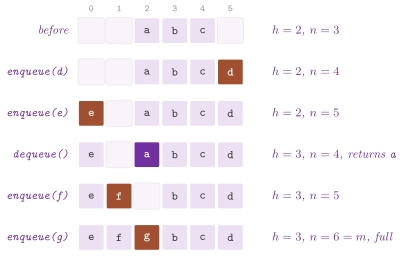
increments \(n\) (Algorithm 4.1). Thus the items run
through the vector as a band that wraps around its end (Figure
4.1, which replays the operations of the figure of
Morin 2013, §2.3 on \(m = 6\) places). When
\(n = m\) the queue is full, and its precondition refuses enqueue(). Indeed,
the capacity is fixed when the queue is built, which allocates the \(m\)
places once (and builds \(m\) items by their default constructor). We remark
that the count \(n\) is not redundant: a vector that kept only the places of
the front and of the back could not tell the full queue from the empty one,
since both have the two places equal. A common alternative leaves one place
always empty, and hence wastes it.
Algorithm 4.1. The operations of
ArrayQueue (Montresor 2025, §4.3.3);
\(A[ 0 .. m - 1 ]\) is the circular vector.
Lemma 4.1. If the items of an
ArrayQueue are at the places (4.2) before an operation, they are there
after it, with \(h\) and \(n\) updated; hence the queue satisfies the axioms
(4.1), and each operation takes \(O( 1 )\) time.
Proof. After enqueue( v ), the item of rank \(i < n\) is still at the place
\(( h + i ) \bmod m\), and \(v\), of rank \(n\), is at \(( h + n ) \bmod m\), which is
free since \(n < m\). After dequeue(), the item of old rank \(i \ge 1\) has rank
\(i - 1\) and is at the place \(( ( h + 1 ) + ( i - 1 ) ) \bmod m\). Hence, read
by rank, the queue is a sequence to which enqueue( v ) appends \(v\), from
which dequeue() removes the first item, and whose first item top() reads.
On sequences, appending \(v\) to an empty one makes \(v\) the first item,
appending it to one that is not empty leaves the first item as it is, and
removing the first item of a sequence that is not empty commutes with
appending at its end; these are the three axioms (4.1). Each operation makes a
constant number of steps. \(\square\)
Our code computes the modulo of (4.2) without a division. Since \(h < m\)
and \(n \le m\), the sum \(h + n\) is below \(2 m\), and its remainder is the sum
itself, or the sum minus \(m\) when it reaches \(m\); in the same way, the
advance of \(h\) in line 2 of dequeue() is an increment followed by a
comparison with \(m\). For instance, with the header
ADS/queue/ArrayQueue.h,
ADS::ArrayQueue< int > Q( 6 );  // m = 6, n = 0
for( int v : { 1 , 2 , 3 } )
 Q.enqueue( v );
int f = Q.dequeue();       // f is 1, and n = 2
bool b = Q.contains( 3 );  // true
The item of dequeue() is moved out of its place, as in ArrayStack. Besides
size() and capacity(), the class has contains( v ), which scans the
items from the front in \(O( n )\) time. It also gives a read-only view of the
items from the front to the back, whose iterator (CircularIterator of
ADS/Iterators.h) applies (4.2) at each access; the iterator is therefore of
random access, but not contiguous. The contracts check the preconditions of
(4.1), that enqueue() finds the queue not full, and the invariant
\(0 \le n \le m\) with \(h < m\).
Remark 4.1. The ArrayQueue of Morin 2013,
§2.3 has no capacity. When the vector is
full, add( x ) moves the items to a vector of \(2 n\) places, in the order of
their ranks from the place 0; remove() shrinks the vector in the same way
when \(3 n\) does not exceed its size. By the argument of Lemma
3.3, this costs \(O( 1 )\) amortized time per operation.
In the library, the variant that grows is RingDeque
(§4.5), at both ends.
In ADS/queue/ArrayQueue.h, the declarations of ArrayQueue that a user
calls are
// declarations of <ADS/queue/ArrayQueue.h>
template< class T >
class ArrayQueue
{
 public:
 using Item = T;
 explicit ArrayQueue( std::size_t dim );
 bool empty( void ) const;
 const T & top( void ) const;
 T dequeue( void );
 void enqueue( const T & v );
 std::size_t size( void ) const;
 std::size_t capacity( void ) const;
 bool contains( const T & v ) const;
 };
4.3 A queue on a linked list¶
A singly linked list is a queue when the items enter after its last cell and
leave from its first one, since neither the removal of the first cell nor the
insertion after the last one needs the predecessor of a cell (Montresor 2025,
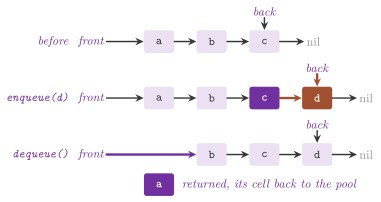
exercise 4.10). LinkedQueue keeps a
pointer \(\mathit{front}\) to the first cell and a pointer \(\mathit{back}\) to
the last one, both nil in the empty queue, and the count \(n\) of the items. An
enqueue( v ) links a new cell after the back, or makes it the front when the
queue is empty. A dequeue() unlinks the front, and resets the back when it
unlinks the last cell (Algorithm 4.2 and Figure
4.2).
Algorithm 4.2. The operations of LinkedQueue
(Montresor 2025, exercise 4.10).
Lemma 4.2. After any sequence of
operations whose preconditions hold, the cells reached from \(\mathit{front}\)
by the links hold the \(n\) items of a LinkedQueue in the order of their
arrival, the last of them is \(\mathit{back}\), and \(\mathit{front} =
\textbf{nil}\) if and only if \(\mathit{back} = \textbf{nil}\), i.e., if and
only if \(n = 0\). Hence the queue satisfies the axioms (4.1); each operation
takes \(O( 1 )\) time, and the space is \(\Theta( n )\) cells besides those
kept free by the pool.
Proof. We argue by induction on the operations, the empty queue having both
pointers nil. An enqueue( v ) builds a cell \(t\) with no successor; if the
queue is empty, line 3 makes \(t\) the only cell, and otherwise it links \(t\)
after the last one, and in both cases line 4 makes \(t\) the last cell. A
dequeue() on a queue that is not empty unlinks the first cell, whose
successor becomes the first one; if there was no successor, the queue is now
empty, and line 3 sets \(\mathit{back}\) to nil. The list read from the front is
thus a sequence to which enqueue( v ) appends \(v\) and from which dequeue()
removes the first item, which gives (4.1) as in Lemma
4.1. Each operation makes a constant number of steps,
and the pool gives or takes back a cell in \(O( 1 )\) time
(§5.5). \(\square\)
The queue has thus no bound on its size, at the price of one cell (an item and
a pointer) per item. In the code, the test of line 3 of enqueue() (whether
the new cell is linked from the front or from the last cell) becomes a single
assignment through a reference to the pointer to change. Its cells come from
an ObjectPool of the queue (§5.5), which gives the
new cell of line 2 of enqueue(), and to which dequeue() gives back the
cell it unlinks, after moving its item out. The cell freed by a dequeue() is
the one that the next enqueue() takes. A queue in a steady state (as many
insertions as removals) therefore calls no allocator, and its cells usually
stay in the cache (at least when the queue is "small"). Besides, the class
gives size() in \(O( 1 )\) time, the equality of two queues (the same items in
the same order), and a forward, read-only view of the items from the front to
the back. A copy is made cell by cell, in \(O( n )\) time; a move takes the
cells and the pool in \(O( 1 )\) time, and leaves the queue moved from empty and
usable. Its contracts check the preconditions of (4.1), and that
enqueue( v ) leaves \(v\) at the front when the queue was empty.
In ADS/queue/LinkedQueue.h, the declarations of LinkedQueue that a user
calls are
// declarations of <ADS/queue/LinkedQueue.h>
template< class T >
class LinkedQueue
{
 public:
 using Item = T;
 LinkedQueue( void );
 bool empty( void ) const;
 void enqueue( const T & v );
 T dequeue( void );
 const T & top( void ) const;
 std::size_t size( void ) const;
 bool operator==( const LinkedQueue & o ) const;
 };
4.4 A deque on a bidirectional list¶
A deque also removes its last item, and on a singly linked list this needs
the predecessor of the last cell, i.e., a scan of the list. Dequeue
therefore realizes the DEQUEUE of Montresor 2025, exercise
4.9 on the LIST of
ADS/sequence/List.h (see §2.10), a bidirectional circular
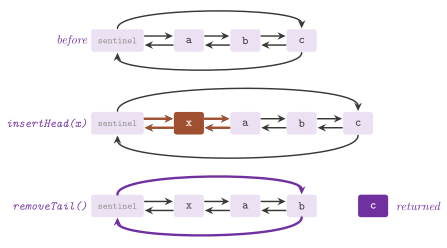
list with a sentinel. Every cell has a pointer to the next cell and one to
the previous cell, and the sentinel, which holds no item, closes the
circle: the first cell follows it and the last one precedes it. An
insertion at either end then sets the two links of the new cell and
rewrites two more, a removal rewrites two, and neither tests a special
case (Figure 4.3). Its four operations
are those of the list at its head and before its sentinel
(Algorithm 4.3).
Lemma 4.3. The operations of Dequeue insert
and remove at the two ends of the sequence of its items, i.e.,
insertHead( v ) makes \(v\) its first item and insertTail( v ) its last one,
while removeHead() and removeTail() remove and return the first and the
last item; each takes \(O( 1 )\) time, and the space is \(\Theta( n )\) cells.
Proof. With \(p = \mathrm{head}()\), i.e., \(\mathit{pos}_0\), the insertion
of (1.4) puts \(v\) at the index 0, and with \(p = \mathrm{next}(
\mathrm{tail}() )\), i.e., \(\mathit{pos}_n\) (the sentinel), at the index
\(n\); the removals at \(\mathrm{head}()\) and \(\mathrm{tail}()\) remove the
items of index 0 and \(n - 1\), after reading them. On List each of
head(), tail(), next(), read(), insert() and remove() takes
\(O( 1 )\) time (Table 2.1). \(\square\)
As in SequenceStack, a removal reads the item and then removes its cell,
and hence copies the item instead of moving it.
Algorithm 4.3. The operations of Dequeue
(Montresor 2025, exercise 4.9);
\(L\) is the list.
Note that the insertion at the tail is an insertion before the position
that follows the last item, i.e., before the sentinel. Also, the class
reads the two ends by head() and tail(), and gives the bidirectional
iterators of the list (forward and backward, with the items writable
through them). Its push_back() and push_front() are other names of the
two insertions, by which std::back_inserter and std::front_inserter
fill it. As the other lists of the library, it takes its cells from a pool,
and a deque in a steady state calls no allocator. This is the structure of
the algorithm of Pape and D'Esopo (Pape
1974), which puts a node at the tail the
first time it is reached and at the head afterwards
(§14.8.1).
In ADS/queue/Dequeue.h, the declarations of Dequeue that a user calls
are
// declarations of <ADS/queue/Dequeue.h>
template< class T >
class Dequeue
{
 public:
 using Item = T;
 bool empty( void ) const;
 void insertHead( const T & v );
 void insertTail( const T & v );
 T removeHead( void );
 T removeTail( void );
 const T & head( void ) const;
 const T & tail( void ) const;
 void push_back( const T & v );
 void push_front( const T & v );
 };
4.5 A deque on a circular vector that doubles¶
RingDeque is the circular vector of ArrayQueue with three changes.
Its number of places \(m\) is a power of 2, and the modulo of (4.2) is
therefore a mask; it doubles when it is full, and hence it has no
capacity; and it adds and removes items at both ends. It is thus the
ArrayQueue and the ArrayDeque of Morin 2013, §2.3 and
§2.4, with the mask of Morin 2013,
exercise 2.7 in place of the modulo, and
the deque of Knuth 1997, §2.2.2 on a
vector that grows.
Representation. The front and the back are two counters \(h\) and \(t\) modulo \(2^{64}\) (unsigned words), whose difference \(t - h\) is the number \(n\) of the items. The place of a counter \(c\) is \(c \mathbin{\&} ( m - 1 )\), and the item of rank \(i\) is at the place
This is (4.2) for \(m = 2^j\), as Lemma 4.4 below
shows, and the counters can wrap around \(2^{64}\) with no item changing its
place. An
insertion at the back and a removal from the front change one counter each
(\(t\) and \(h\)), and so do an insertion at the front (which decrements \(h\))
and a removal from the back (which decrements \(t\)). Thus the deque is empty
when \(h = t\), and full when \(t - h = m\). Its places are raw memory, in which
an item is built when it is inserted and destroyed when it is removed.
Unlike ArrayQueue, the type of the items thus needs no default
constructor, and a free place holds no item. With no places the mask is \(m -
1 = 2^{64} - 1\), i.e., capacity() is 0.
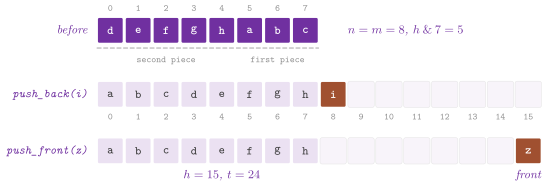
Growth. When the vector is full, an insertion first moves the \(n = m\)
items to a new vector of \(\max\{ 2 m , 8 \}\) places, in the order of their
ranks from the place 0, and frees the old one
(Algorithm 4.4). The items of the old vector lie in
at most two contiguous pieces, \(A[ h \mathbin{\&} ( m - 1 ) .. m - 1 ]\) and
the part that wrapped around to \(A[ 0 .. ]\). Each piece is moved by one
memcpy() when the items can be copied bit by bit; otherwise each item is
built in the new vector by its move constructor (by its copy constructor
if moving could throw) and destroyed in the old one. After the move \(h = 0\)
and \(t = n\), and an insertion at the back writes the place \(n\). An
insertion at the front of a full deque puts the new item at the last place
of the new vector, which (4.3) makes the place before 0. With \(M = \max\{ 2 m
, 8 \}\) the new number of places, it sets \(h = M - 1\) and \(t = n + M\),
which makes \(t - h\) equal to \(n + 1\), the new number of items
(Figure 4.4).
Algorithm 4.4. The insertions at the two
ends of RingDeque (the circular queue of Knuth 1997,
§2.2.2, with the doubling); \(h\) and
\(t\) are the counters of the front and of the back.
In the common case an insertion is a test, a construction in place and an
increment, i.e., the lines 2 and 6 of emplace_back(). The growth of the
lines 3 to 5 is a call out of line, behind a branch marked as unlikely, and
for an insertion at the front it puts the new item at the last place of the
new vector, as described above. The new item is built in a temporary before the growth, since the argument
of push_back() may be an item of the same deque (say,
d.push_back( d.front() )), which the growth moves and destroys; the
temporary is then moved into its place. Each of the removals pop_front() and
pop_back() destroys the item at its end and changes one counter, in
\(O( 1 )\) time, and clear() destroys all the items and keeps the places.
In a queue the insertions write \(t\) and the removals write \(h\), and the
two chains of dependent instructions therefore do not wait for each other.
Lemma 4.4. After any sequence of operations at the ends whose preconditions hold, \(n = ( t - h ) \bmod 2^{64} \le m\), and the item of rank \(i < n\) is at the place (4.3), which equals \(( \bar{h} + i ) \bmod m\) for the place \(\bar{h} = h \mathbin{\&} ( m - 1 )\) of the front; hence the operations at the ends insert and remove at the two ends of the sequence of the items by rank.
Proof. For \(m = 2^j\) and any integer \(x \ge 0\), \(x \mathbin{\&} ( m - 1
) = x \bmod m\), and since \(m\) divides \(2^{64}\), \(( x \bmod 2^{64} ) \bmod
m = x \bmod m\); the counters taken modulo \(2^{64}\) thus give the places
that they would give with no wrap, and \(( h + i ) \bmod m = ( \bar{h} + i
) \bmod m\). Now by induction on the operations, the empty deque having \(h
= t\). An insertion at the back that finds \(n < m\) builds the item at the
place of \(t\), i.e., of \(h + n\), the rank \(n\), and increments \(t\); one at the
front decrements \(h\) and builds the item at the place of the new \(h\), the
rank 0, while the old item of rank \(i\) is now of rank \(i + 1\) at the same
place. A removal from the front destroys the item of rank 0 and increments
\(h\), and one from the back destroys the item of rank \(n - 1\) and decrements
\(t\). A growth (lines 3 to 5 of emplace_back()) moves the item of rank
\(i\) to the place \(i\) of the new vector and sets \(h = 0\) and \(t = n\); for
emplace_front(), the new item goes to the place \(M - 1\) with \(h = M - 1\)
and \(t = n + M\), so that the old item at the place \(i\) has the rank \(i +
1\), since \(( h + i + 1 ) \bmod M = ( M - 1 + i + 1 ) \bmod M = i\). In
every case \(t - h\) changes by the number of
items inserted or removed, and stays at most \(m\), since an insertion into
a full deque grows it first. \(\square\)
Lemma 4.5. Starting from an empty
RingDeque, any sequence of operations that reaches at most \(N\) items,
with no call of reserve() or of shrink_to_fit(), moves fewer than \(2 N\) items in all the growths, and the deque never has
more than \(\max\{ 8 , 2 ( N - 1 ) \} < 2 N + 8\) places; hence each
insertion at an end costs \(O( 1 )\) amortized time, and each removal
\(O( 1 )\) time.
Proof. A growth happens only when the deque is full, and it moves its \(m\) items to \(2 m\) places (the first one, from no places to 8, moves nothing). Since the vector never shrinks on its own, the growths happen at the sizes \(8 , 16 , \ldots , 2^k\), all below \(N\), since the insertion that causes the growth at the size \(2^k\) brings the deque to \(2^k + 1 \le N\) items. They move \(8 + 16 + \cdots + 2^k < 2^{k+1} \le 2 ( N - 1 )\) items, and leave \(2^{k+1} \le 2 ( N - 1 )\) places. If no growth from 8 places happens, the deque has at most 8 places. \(\square\)
Unlike a vector that grows at one end only, the places freed at one end serve
the insertions at the other. A deque used as a queue in a steady state thus
never grows, and never moves its items once it has reached its largest size.
Neither does it shrink, and its space remains that of its largest size until
shrink_to_fit() moves the items to the least power of 2 places (and 8 at
least) that holds them, or frees the vector of an empty deque. Furthermore,
the constructors take a list of items, and copy a deque item by item; a move
takes the vector in \(O( 1 )\) time, and leaves the deque moved from with no
places. Finally, reserve( n ) doubles the vector until it has \(n\) places at
least.
Operations by rank. The item of rank \(i\) is read and written by
operator[] in \(O( 1 )\) time through (4.3), and the random-access iterators
of the class (MaskIterator) do the same; one can thus run, e.g., std::sort
on a deque that wraps around its vector. The LIST of Morin also inserts and
removes at a rank, and his ArrayDeque does it by moving the items on the
shorter side of the rank. If \(0 < i < \lfloor n / 2 \rfloor\),
insert( i , v ) moves the front item to a new place before it and the items
of the ranks \(1 , \ldots , i - 1\) one place toward the front. Otherwise, for
\(\lfloor n / 2 \rfloor \le i < n\), it moves the back item to a new place after
it, and the items of the ranks \(i , \ldots , n - 2\) one place toward the back;
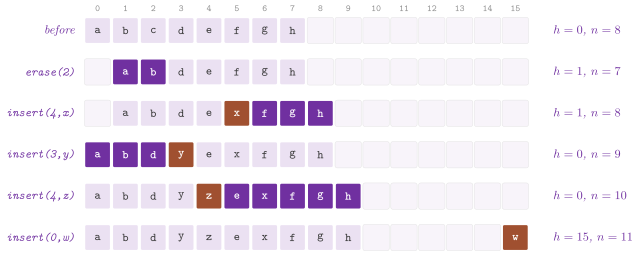
erase( i ) does the converse (Algorithm 4.5). Figure
4.5 replays the operations of the figure of Morin 2013,
§2.4 on 16 places. We remark that its last
insertion, at the rank 4 of a deque of 9 items, moves the back side, since 4
is not below \(\lfloor 9 / 2 \rfloor = 4\). His code does the same, with the
integer division of i < n/2, whereas the figure of his book moves the front
side.
Algorithm 4.5. The insertion and the removal at
a rank of RingDeque (the add( i , x ) and remove( i ) of the
ArrayDeque of Morin 2013, §2.4), and the
moves of the loops of line 4 of insert() and line 6 of erase() by runs
(Morin 2013, exercise 2.6);
\(D[ 0 .. n - 1 ]\) are the items by rank, the item \(D[ k ]\) at the place
\(( h + k ) \bmod m\) of the vector \(A\), and \(\ell\) the length of a run.
Lemma 4.6. insert( i , v ) moves at most
\(\min\{ i , n - i \} + 2\) items, and takes \(O( 1 + \min\{ i , n - i \} )\)
amortized time; erase( i ) moves \(\min\{ i , n - 1 - i \}\) items, and takes
\(O( 1 + \min\{ i , n - i \} )\) time. Each of their loops moves its items in at
most three runs of places contiguous in the vector.
Proof. For \(i < \lfloor n / 2 \rfloor\), insert() moves the front item
to a new place and \(i - 1\) items, and then writes \(v\); since then \(i <
n - i\), these are \(\min\{ i , n - i \} + 1\) moves. Otherwise it moves the
back item and \(n - 1 - i\) items, and then writes \(v\), i.e., \(n - i + 1\)
moves; here \(n - i \le \min\{ i , n - i \} + 1\), because \(i \ge \lfloor n
/ 2 \rfloor\) gives \(n - i \le \lceil n / 2 \rceil \le i + 1\). In the same
way, erase() moves \(i\) items when \(i < \lfloor n / 2 \rfloor\), and \(n -
1 - i\) otherwise, which is then at most \(i\). Only an insertion at an end may
grow the vector, and its cost is amortized by
Lemma 4.5. As for the runs, consider shiftDown()
(the argument for its mirror is the same). The places \(d\) of its
destinations are the residues modulo \(m\) of the \(\mathit{hi} -
\mathit{lo} < n \le m\) consecutive integers \(h + \mathit{lo} , \ldots , h
+ \mathit{hi} - 1\); at most \(m\) consecutive integers contain at most one
multiple of \(m\), and \(d\) passes from \(m - 1\) to 0 only at a multiple of \(m\)
that is not the first of them, hence at most once. The same holds for
the places \(s = ( d + 1 ) \bmod m\) of the sources, which are the residues
of \(\mathit{hi} - \mathit{lo} \le m\) consecutive integers. By line 5, a
run ends either at \(\mathit{hi}\) or where \(d\) or \(s\) is about to pass from
\(m - 1\) to 0, i.e., at most at two places besides the last; hence there are
at most three runs. \(\square\)
The moves of the two sides are thus made on runs of places that are
contiguous in the vector, as Morin 2013,
exercise 2.6 asks: each run of line 6 of
shiftDown() is one std::move (one memmove() for the items that can be
copied bit by bit), and shiftUp(), which makes the moves of line 7 of
insert() and line 3 of erase(), is the mirror, by
std::move_backward. The argument \(v\) of insert() is copied before anything moves, since it
may be an item of the deque; the insertions at the ranks 0 and \(n\) are
those at the ends.
Rotation. rotate( r ) moves the item of rank \(i\) to the rank
\(( i + r ) \bmod n\), for every \(i\) (Morin 2013, exercise
2.5). When the vector is full, the items
already sit in a circle, and the rotation only moves the two counters back by
\(r\). Otherwise the deque moves \(\min\{ r , n - r \}\) items from one end to the
other, one at a time (Algorithm 4.6).
Algorithm 4.6. The rotation of
RingDeque (Morin 2013, exercise 2.5),
\(r\) reduced modulo \(n\).
Lemma 4.7. For \(0 < r < n\), rotate( r ) moves
the item of rank \(i\) to the rank \(( i + r ) \bmod n\), for every \(i\), in
\(O( 1 )\) time when \(n = m\) and in \(O( 1 + \min\{ r , n - r \} )\) time
otherwise, and it never grows the vector.
Proof. When \(n = m\), line 2 leaves every item at its place, and with the new front \(h' = h - r\) the item at the place of \(h + i\), which is that of \(h' + i + r\), has the rank \(( i + r ) \bmod m\) by Lemma 4.4. Otherwise, a removal from the back followed by the insertion of the same item at the front moves the item of rank \(n - 1\) to the rank 0 and every other item from the rank \(i\) to \(i + 1\), i.e., it rotates by 1; \(r\) of them rotate by \(r\). In the same way, a move from the front to the back rotates by \(- 1\), and \(n - r\) of them by \(- ( n - r ) \equiv r \pmod n\). Each move finds a free place, the one its removal has just freed, and costs \(O( 1 )\) time. \(\square\)
On a RingDeque, the function rotate( l , r ) of
ADS/sequence/IndexedList.h calls this member; on the lists that have no
rotate() it follows the \(\gcd( n , r )\) cycles of the permutation by
operator[] (see §2.16.1). Its contracts check
that front(), back() and the removals find the deque not empty, that
operator[] reads a rank below \(n\), that insert( i , v ) and erase( i )
receive \(i \le n\) and \(i < n\), and the invariant that the number of places is
0 or a power of 2 not smaller than \(n\).
In ADS/queue/RingDeque.h, the declarations of RingDeque that a user
calls are
// declarations of <ADS/queue/RingDeque.h>
template< class T >
class RingDeque
{
 public:
 RingDeque( void );
 RingDeque( std::initializer_list< T > l );
 bool empty( void ) const;
 std::size_t size( void ) const;
 std::size_t capacity( void ) const;
 void reserve( std::size_t n );
 T & front( void );
 const T & front( void ) const;
 T & back( void );
 const T & back( void ) const;
 T & operator[]( std::size_t i );
 const T & operator[]( std::size_t i ) const;
 void push_back( const T & v );
 void push_back( T && v );
 void push_front( const T & v );
 void push_front( T && v );
 template< class... Args >
 T & emplace_back( Args &&... args );
 template< class... Args >
 T & emplace_front( Args &&... args );
 void pop_front( void );
 void pop_back( void );
 void clear( void );
 void insert( std::size_t i , const T & v );
 void erase( std::size_t i );
 void rotate( std::size_t r );
 void shrink_to_fit( void );
 bool operator==( const RingDeque & o ) const;
 };
4.6 A queue with no duplicates¶
UniqueQueue is a queue that never holds two equal items, with one of two
policies (the enumeration Duplicate) for an item that is already in the
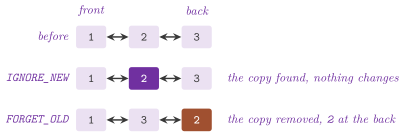
queue. With IGNORE_NEW, enqueue( v ) does nothing, and each item keeps the
place of its first arrival, as the visits of a graph want it. With
FORGET_OLD, enqueue( v ) removes the old copy and enqueues \(v\) at the
back; each item then keeps the place of its last arrival, as a cache of the
least recently used items wants it (Figure 4.6). Either
way, enqueue() must first find the copy (Algorithm
4.7). In a List (see
§2.10), where the items are kept, the copy is
removed in \(O( 1 )\) time but found by a scan.
Algorithm 4.7. The insertion of
UniqueQueue; \(L\) is the list of the items.
Lemma 4.8. If the equality of the items is an
equivalence, then after any sequence of operations no two items of a
UniqueQueue are equal, the items leave in the order of their first arrival
(IGNORE_NEW) or of their last one (FORGET_OLD), among those still in the
queue, and the item of enqueue( v ) is in the queue afterwards. An
enqueue() and a contains() make at most \(n\) comparisons, and dequeue(),
top() and size() take \(O( 1 )\) time.
Proof. We argue by induction on the operations, the empty queue having
no item.
Let \(v\) be enqueued. If no item is equal to \(v\), then \(v\) is appended
(line 6), and no two items are equal afterwards. If one is, there is only
one, by induction; with IGNORE_NEW the queue does not change, and with
FORGET_OLD the copy is removed (line 5) and \(v\) is appended, which again
leaves no two equal items. In either case the order of the others does not
change, and the item kept is the one of the first arrival, or of the last.
A dequeue() removes the first item of the list. As for the comparisons,
the scan of line 2 compares \(v\) with the items from the front up to the
copy, or with all of them, i.e., at most \(n\) times; with FORGET_OLD the
code, after removing the copy, appends \(v\) with no other scan, since no item
left is equal to it. On the List of the
items, a removal at a position and an append take \(O( 1 )\) time.
\(\square\)
The scan stops at the copy, and when a copy is in the queue at a place
drawn uniformly it makes about \(n / 2\) comparisons on average. Note that the invariant that no item occurs twice (an
\(O( n^2 )\) check of the contracts) requires the equality of the items to be
an equivalence.
An item unequal to itself, such as a NaN, would be enqueued again at each
enqueue(); the postcondition, which checks that \(v\) is in the queue,
refuses it. With FORGET_OLD, the item \(v\) is copied before the old copy is
removed, since \(v\) may refer to that copy (as in q.enqueue( q.top() )).
Also, the view of the items from the front to the back is read-only, since a
change through it could create a duplicate. A dictionary from the items to
their cells would bring enqueue() to \(O( 1 )\) expected time (see chapter
7), at the price of a hash of the items and of a
second structure. We kept the specification of Montresor 2025,
§4.3, in which the items need only an
equality.
In ADS/queue/UniqueQueue.h, the declarations of UniqueQueue that a user
calls are
// declarations of <ADS/queue/UniqueQueue.h>
template< std::equality_comparable T , Duplicate D = Duplicate::IGNORE_NEW >
class UniqueQueue
{
 public:
 using Item = T;
 bool empty( void ) const;
 void enqueue( const T & v );
 T dequeue( void );
 const T & top( void ) const;
 bool contains( const T & v ) const;
 std::size_t size( void ) const;
 };
4.7 A random queue¶
The RandomQueue of Morin 2013, exercise
2.2 is a bag: push( x ) puts an item in,
and pop() takes out one chosen uniformly at random among those inside, both
in \(O( 1 )\) amortized time. Its items are the first \(n\) places of a
std::vector, which grows by a constant factor (cf. Lemma
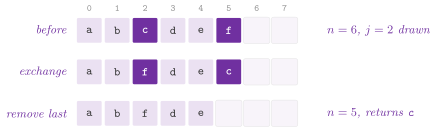
3.3), in no order. To remove one, pop() draws a place
\(j\) uniformly in \(\{ 0 , \ldots , n - 1 \}\), exchanges its item with the last
one and removes the last place (Algorithm 4.8 and
Figure 4.7); no item moves but these two.
Algorithm 4.8. The removal of
RandomQueue (Morin 2013, exercise 2.2);
\(A[ 0 .. n - 1 ]\) are the items.
Lemma 4.9. Whatever the sequence of
operations before it, a pop() on a queue of \(n\) items returns each of
them with probability \(1 / n\), provided that the draw of the place is
uniform and independent of the previous ones. Hence \(n\) pops after \(n\)
pushes of distinct items give them in each of the \(n!\) orders with
probability \(1 / n!\).
Proof. The place \(j\) is drawn uniformly among the \(n\) places, each of which holds one of the items, and the draw does not depend on how the items came to be in those places. For the second claim, a given order \(x_1 , \ldots , x_n\) comes out if the \(k\)-th pop returns \(x_k\), for each \(k\); given the first \(k - 1\) pops, this has probability \(1 / ( n - k + 1 )\) by the first claim, applied to the \(n - k + 1\) items left, and the product of these conditional probabilities is \(1 / n!\). \(\square\)
The order of the vector thus never matters, and the exchange with the last
place, which changes it, is harmless; sample() reads an item drawn in the
same way, without removing it. Emptying a queue after \(n\) pushes thus
gives the items in a uniformly random order. This is the shuffle of Fisher and Yates
1938 in the form of Durstenfeld
1964, where the place drawn is
exchanged with the last one, which then leaves.
The place is drawn by uniform( n ), after Lemire
2019. Let \(w\) be a word of 64 bits of the
generator SplitMix64 (Steele, Lea and Flood
2014; see §17.9),
which the constructor seeds (with 1, unless told otherwise) for a reproducible
run, and let \(w \cdot n = 2^{64} h + l\) be its product with \(n\) on 128 bits.
The draw returns the high half \(h\), unless \(l\) is below the threshold
\(\theta = ( 2^{64} - n ) \bmod n = 2^{64} \bmod n\), in which case it draws
another word (Algorithm 4.9).
Algorithm 4.9. The uniform draw of a place in \([ 0 , n )\) (Lemire 2019).
Lemma 4.10. If the words \(w\) are uniform in
\([ 0 , 2^{64} )\), uniform( n ) returns each \(h \in [ 0 , n )\) with
probability \(1 / n\); each word is rejected with probability
\(\theta / 2^{64} < n / 2^{64}\), and the division that computes \(\theta\) is
made only when \(l < n\), i.e., with probability at most \(n / 2^{64}\).
Proof. Let \(2^{64} = q n + \theta\) with \(0 \le \theta < n\). The words \(w\) whose product has the high half \(h\) are those with \(w n \in [ 2^{64} h , 2^{64} ( h + 1 ) )\). Their low halves \(l = w n - 2^{64} h\) form an arithmetic progression of difference \(n\) in \([ 0 , 2^{64} )\), whose first term \(l_0\) is below \(n\). If \(l_0 \ge \theta\), the progression has \(\lfloor ( 2^{64} - 1 - l_0 ) / n \rfloor + 1 = q\) terms, all accepted, since \(2^{64} - 1 - l_0 = q n - ( l_0 + 1 - \theta )\) with \(1 \le l_0 + 1 - \theta \le n\). If \(l_0 < \theta\), it has \(q + 1\) terms, of which only the first is rejected. Each \(h\) is thus the image of \(q\) accepted words, out of the \(2^{64} - \theta = q n\) words accepted in all. The words rejected have \(l < \theta\), and there are \(2^{64} - q n = \theta\) of them (one for each of the \(\theta\) values of \(h\) whose progression starts below \(\theta\)), a fraction \(\theta / 2^{64}\); finally, \(l < \theta\) implies the test \(l < n\) that comes before the division. \(\square\)
The words are drawn independently, and each is accepted with probability
\(p = 1 - \theta / 2^{64} > 1 - n / 2^{64}\); the number of words drawn is thus
geometric, with expected value \(1 / p\), which is below \(1 + 2^{-31}\) for a
queue of fewer than \(2^{32}\) items (where \(1 - p < 2^{-32}\)), so that pop()
and sample() take \(O( 1 )\) expected time, but have no bound in the worst
case. In practice the draw costs one multiplication and one comparison on all
but a negligible fraction of the calls, whereas a draw by \(w \bmod n\) would
cost a division at each call (and would be biased). Also, the class has
size(), empty(), clear() and items(), the vector of the items in no
order. Its contracts check that pop() and sample() find the queue not
empty, and that uniform( n ) receives \(n > 0\).
In ADS/queue/RandomQueue.h, the declarations of RandomQueue that a user
calls are
// declarations of <ADS/queue/RandomQueue.h>
template< class T >
class RandomQueue
{
 public:
 using Item = T;
 explicit RandomQueue( std::uint64_t seed = 1 );
 bool empty( void ) const;
 std::size_t size( void ) const;
 void push( const T & x );
 void push( T && x );
 T pop( void );
 const T & sample( void );
 std::size_t uniform( std::size_t n );
 void clear( void );
 const std::vector< T > & items( void ) const;
 };
4.8 Queues and deques with the minimum¶
The MinQueue and the MinDeque of Morin 2013, exercises 3.15 and
3.16 are a queue and a deque that also
give their least item by min(), in \(O( 1 )\) amortized time per
operation, under an order C (a strict weak order, std::less<> by
default). Both are built on the MinStack of ADS/stack/MinStack.h
(§3.5), the stack of Morin 2013, exercise
3.14 that keeps, beside the vector of
its items, a second vector of the record lows, whose top is the least item
of the stack (Algorithm 3.3 and
Lemma 3.4); each of its operations costs \(O( 1 )\)
time, but for the doublings of the two vectors.
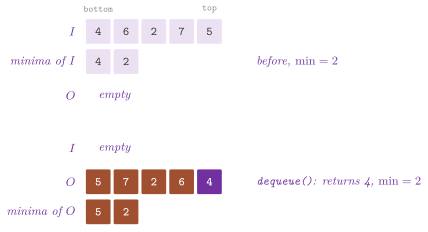
A queue on two stacks. MinQueue enqueues on a stack \(I\) (the back, the
last item on top) and dequeues from a stack \(O\) (the front, the first item
on top). When \(O\) is empty, dequeue() first moves all the items of \(I\) to
\(O\), popping them from \(I\) and pushing them on \(O\). This reverses their
order, and puts the oldest item on top of \(O\) (Algorithm
4.10 and Figure 4.8). As for
the least item, it is the lesser of the minima of the two stacks, found in
\(O( 1 )\) time (cf. min() below).
Algorithm 4.10. The removal of
MinQueue (Morin 2013, exercise 3.15).
The loop of line 2 is the move of \(I\) to \(O\), item by item, and min()
returns the minimum of the stack that is not empty, when the other one is,
and otherwise the lesser of the two minima, i.e., the one of \(O\) unless
that of \(I\) is less than it.
Lemma 4.11. The items of a MinQueue
leave it in the order in which they entered; any sequence of \(s\)
operations from the empty queue takes \(O( s )\) time, and min() returns
the least item in \(O( 1 )\) time.
Proof. The items of \(O\) are all older than those of \(I\), since \(I\) is
moved to \(O\) only when \(O\) is empty. Since the move reverses \(I\), the items
of \(O\) are in the order of their age from the top. Hence the oldest
item is the top of \(O\), or the bottom of \(I\) when \(O\) is empty (the item
that top() reads). Each item is pushed on \(I\) once, popped from \(I\) and
pushed on \(O\) at most once, and popped from \(O\) at most once: these are
four operations of the stacks per item, and the \(s\) operations enqueue at
most \(s\) items. Since each operation of a MinStack costs \(O( 1 )\)
amortized time (§3.5), the \(4 s\) operations of the
stacks take \(O( s )\) time. Every item is in one of the two stacks, whose minima are
their least items. \(\square\)
The bound is on the sequence, not on the operation. A dequeue() that finds
\(O\) empty moves all of \(I\), i.e., it takes \(\Theta( n )\) time, and a queue
that alternates long runs of insertions with long runs of removals may pay
it once per run; §4.9 removes this worst case.
A deque on two stacks. MinDeque keeps a stack \(F\) with the front on
top and a stack \(B\) with the back on top, back to back as in the
DualArrayDeque of Morin 2013, §2.5 (see
§2.4). In the order of the deque, the items are those of \(F\)
from the top down, and then those of \(B\) from the bottom up. An insertion or
a removal at an end is that of its stack, but for a removal from an empty
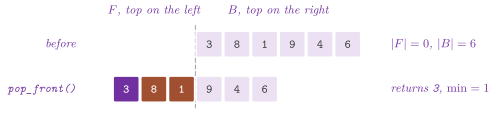
side, which first deals the \(k\) items of the other side again. The \(\lceil
k / 2 \rceil\) items nearer to the empty end (i.e., the bottom items of the
other stack) go to the empty side, in the reverse order, and the other
\(\lfloor k / 2 \rfloor\) stay (Algorithm 4.11 and
Figure 4.9). A deal takes \(O( k )\) time (one may
argue that this is rather wasteful, but it happens rarely, cf. Lemma
4.12), through a vector that holds the items popped.
Algorithm 4.11. The removal from the
front of MinDeque and the deal (Morin 2013, exercise
3.16); \(s_0 , \ldots , s_{k-1}\) are the
items of the stack \(s\) from its bottom.
Lemma 4.12. A deal does not change the
order of the items of a MinDeque. Any sequence of \(s\) operations on a
MinDeque from the empty deque takes \(O( s )\) time, and min() returns
the least item in \(O( 1 )\) time.
Proof. Let a deal move the items \(s_0 , \ldots , s_{k-1}\) of \(B\) (from
its bottom) to the empty \(F\), the other case being symmetric. In the order
of the deque, these items are \(s_0 , \ldots , s_{k-1}\), since \(F\) is
empty. After line 3 of deal(), \(F\) holds \(s_0 , \ldots , s_{h-1}\) from
its top down, and after line 4, \(B\) holds \(s_h , \ldots , s_{k-1}\) from its
bottom up; read as above, the deque is still \(s_0 , \ldots , s_{k-1}\). As
for the cost, let a deal of \(k\) items cost at most \(c k\), for a constant \(c\)
(it pops \(k\) items and pushes \(k\)), and let \(\Phi = c \, | \, |F| - |B| \,
|\), which is 0 for the empty deque and never negative. An operation that
does not deal costs \(O( 1 )\) and changes \(\Phi\) by \(c\) at most. A deal is
made when one side is empty and the other has \(k\) items, i.e., when \(\Phi =
c k\). It leaves the two sides with \(\lceil k / 2 \rceil\) and \(\lfloor k /
2 \rfloor\) items, i.e., \(\Phi \le c\), and the drop of \(\Phi\), at least \(c (
k - 1 )\), pays for the deal but for \(c\); the removal that follows changes
\(\Phi\) by \(c\) at most. Hence the amortized cost of each operation (its cost
plus the change of \(\Phi\)) is \(O( 1 )\). The minimum is the lesser of those
of \(F\) and \(B\), as in MinQueue. \(\square\)
The deal splits the items in two halves, instead of moving them all to the
empty side, and the bound holds at both ends for this reason. A deal that
moved all the \(k\) items would leave the other side empty; a sequence that
removed alternately at the two ends would then move all the items at each
operation. Here too a single operation may take \(\Theta( n )\) time. Both
classes also have size(), empty() and clear(), and MinDeque reads
its ends by front() and back() (the bottom of the other stack when a
side is empty). In both, the contracts check that the removals, the reads
and min() find the structure not empty.
In ADS/queue/MinQueue.h, the declarations of MinQueue that a user calls
are
// declarations of <ADS/queue/MinQueue.h>
template< class T , class C = std::less<> >
class MinQueue
{
 public:
 using Item = T;
 explicit MinQueue( C less = C() );
 bool empty( void ) const;
 std::size_t size( void ) const;
 void enqueue( const T & x );
 T dequeue( void );
 const T & top( void ) const;
 const T & min( void ) const;
 void clear( void );
 };
In ADS/queue/MinDeque.h, the declarations of MinDeque that a user calls
are
// declarations of <ADS/queue/MinDeque.h>
template< class T , class C = std::less<> >
class MinDeque
{
 public:
 using Item = T;
 explicit MinDeque( C less = C() );
 bool empty( void ) const;
 std::size_t size( void ) const;
 void push_front( const T & x );
 void push_back( const T & x );
 T pop_front( void );
 T pop_back( void );
 const T & front( void ) const;
 const T & back( void ) const;
 const T & min( void ) const;
 void clear( void );
 };
The minimum is one instance of an aggregate of the window, and
SlidingAggregate< G > (§1.15.4) keeps the
combination of the items of a queue for any monoid \(G\), by the algorithm that
the algebra of \(G\) allows; for the monoid of the minima it computes what
MinQueue computes, which stays for the orders that are objects and for the
least item given by reference.
4.9 The minimum in constant worst-case time¶
Lemma 4.11 and Lemma 4.12 bound
sequences, not operations: one dequeue() of MinQueue may move the whole
back, and one removal of MinDeque may deal a whole side.
RealTimeMinQueue and RealTimeMinDeque spread that work over the
operations that come before the moment it is needed. Every operation,
min() included, then takes \(O( 1 )\) time in the worst case, at the price
of larger constants and of a more delicate state. For the queue the idea is
the real-time queue of Hood and Melville
1981; for the deque it is the global
rebuilding of Overmars 1983, as
Gajewska and Tarjan 1986 apply it to
the deques with heap order.
Arrays with the minimum. Both classes keep their stacks in arrays of
fixed capacity (detail::CellArray, the arrays of the real-time windows
of SlidingAggregate, here with the least places that detail::MinCells
pushes), allocated with their final size when the work that fills them
starts. Its live cells are the range
\([ \mathit{lo} , \mathit{hi} )\), and a cell holds an item and the place of the
least item among those of the places from 0 up to it. Hence the minimum of
the array is read at the cell of its top, and a push builds a cell on
top with its least place, that of the cell below unless the new item is
less than the item there (the function push() of
Algorithm 4.12, where \(\mu( i )\) is the least
place of the cell \(i\)).
Lemma 4.13. As long as no cell of an array
with the minimum has been removed from its bottom, i.e., \(\mathit{lo} = 0\),
the least place \(\mu( i )\) of each live cell \(i\) is the place of a least
item among \(a[ 0 .. i ]\); in particular, the cell on top gives a least item
of the array, and each push() and pop() takes \(O( 1 )\) time.
Proof. We argue by induction on the operations, the empty array having no
cell. A push( x ) at the place \(i = \mathit{hi}\) sets \(\mu( i ) = i\) when
\(i = 0\) or when \(x\) is less than the item at \(\mu( i - 1 )\), which by
induction is a least item of \(a[ 0 .. i - 1 ]\); otherwise it sets
\(\mu( i ) = \mu( i - 1 )\), whose item is not larger than \(x\). In both cases
\(\mu( i )\) gives a least item of \(a[ 0 .. i ]\), and the cells below are not
changed. A pop() removes the cell on top only, and the least places of the
others depend only on the cells below them, which do not change. Each
operation makes one comparison and a constant number of other steps. \(\square\)
In the queue and in the deque, an array that receives pushes has had no removal from its bottom, as the proofs below check.
A cell is removed from the top by pop(), and from the bottom by
popBottom(), which destroys it and advances \(\mathit{lo}\). However, the least
places of the cells above it are not updated, and they may therefore point
to a cell no longer live (a case that RealTimeMinQueue handles below). No
operation of the array copies, moves or destroys more than one item, and
the allocation of an array of raw cells is counted as \(O( 1 )\).
The rotation of Hood and Melville. RealTimeMinQueue keeps, as
MinQueue does, a front \(F\) (the first item on top) and a back \(R\) (the
last item on top), with \(|R| \le |F|\) between the operations that come
outside a rotation. When an operation makes \(|R| = |F| + 1\), a rotation
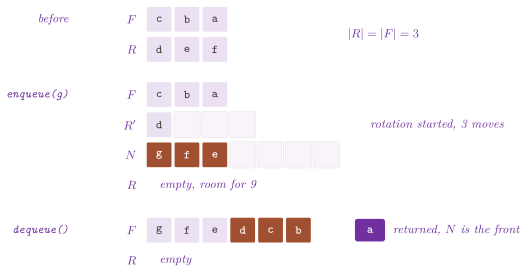
starts: \(R\) is frozen as \(R'\), and a new empty back takes the insertions. A
new front \(N\) is then built from its bottom, by three moves per operation,
first with the items of \(R'\) from its top and then with those of \(F\) from
its bottom, while the removals still take the top of \(F\). When the moves of
\(F\) meet its top the rotation ends, and \(N\) becomes the front (Algorithm
4.12 and Figure 4.10). Here
the items are moved, not copied, since an item is in only one of the arrays
at a time. We write the rotation once, in detail::RealTimeRotation, on
the arrays of a policy of cells; the queue gives it the cells with the
least place, and SlidingAggregate< G , WorstCase > the cells with the
aggregate of \(G\) (pushed on a front with the new item first, and on a back
with it last), so that the two differ only in what a cell keeps and in how
the summary of the queue is read from its parts.
Algorithm 4.12. The push on an array
with the minimum, the removal of RealTimeMinQueue and the moves of a
rotation (Hood and Melville 1981), and
the minimum of the queue; \(r_0\) is the size of \(R'\) when the rotation
started.
The insertion enqueue() runs the lines 3 and 4 of dequeue() after its
push on \(R\). Ending the rotation (line 10) costs no move, and the code
checks it even when the three moves are spent; hence \(F\) is never left empty with the rotation
still going on. A rotation allocates its arrays when it starts, \(N\)
with \(|F| + |R'|\) cells and the new back with \(|F| + |R'| + 2\). Its old
front, whose cells have all been moved or removed by then, is freed when
the rotation ends, together with \(R'\), which is empty.
Lemma 4.14. Let a rotation start with \(f =
|F|\) and \(|R'| = f + 1\). Then \(F\) does not empty before the rotation
ends, which happens within \(\lceil ( 2 f + 1 ) / 3 \rceil\) operations
(the one that starts it included); at the end \(|R| \le |F|\), and the arrays
allocated at the start are large enough until the next rotation. Hence
every operation of RealTimeMinQueue takes \(O( 1 )\) time in the worst
case, and min() returns the least item.
Proof. The moves are at most the \(f + 1\) of \(R'\) and the \(f\) of \(F\) (fewer
if some items of \(F\) are removed first), three per operation, and hence at
most \(\lceil ( 2 f + 1 ) / 3 \rceil\) operations make moves. The \(f + 1\)
moves of \(R'\) are done when the operation that starts the rotation and the
\(k\) after it have made \(3 ( k + 1 ) \ge f + 1\) moves, i.e., at \(k = \lceil (
f + 1 ) / 3 \rceil - 1\). Until then at most \(k\) items have been removed from
\(F\), and \(f - k > 0\) for \(f \ge 1\) (for \(f = 0\), \(R'\) holds one item, and
the rotation ends in the operation that starts it). After that, the moves of
\(F\) go up from its bottom and the removals down from its top, and the
rotation ends when they meet, before a removal could find \(F\) empty. At the
end, \(N\) holds the items left of \(F\) above those of \(R'\), in the order of
the queue; after \(d\) removals these are \(2 f + 1 - d\) items, which fit in
its \(2 f + 1\) cells. Meanwhile, the new back has received the insertions
made after the start, at most \(\lceil ( 2 f + 1 ) / 3 \rceil - 1 - d < 2 f +
1 - d\) of them, and hence \(|R| \le |F|\). Then the next rotation starts as
soon as \(|R| = |F| + 1 \le 2 f + 2\), within the \(2 f + 3\) cells of the back.
Every operation thus makes one push or one pop, three moves, and at most one
start and one end, each of which allocates or frees arrays with no live
cells. As for min(), the items of the queue are those of the four parts
\(F\), \(R'\), \(N\) and \(R\). The last three never lose a cell at the bottom, and
the minimum of each is read at its top by the induction given with the
arrays. The array \(F\) has the live places from 0 when the rotation starts,
since it is then the \(N\) of the previous rotation, or the first front; the
items of \(F\) go to \(N\) from its bottom, in order, after the \(r_0\) items of
\(R'\), and the item of the place \(a\) of \(F\) is therefore at the place
\(r_0 + a\) of \(N\). Hence the least place \(a\) of the top of \(F\) gives a least
item among the live items of \(F\) and those moved to \(N\), read in \(F\) or in
\(N\) by line 4 of min(); this item is in the queue, and no live item of
\(F\) is less than it. The least of the candidates of lines 4 and 5 is thus
a least item of the queue (an item moved to \(N\) may be counted twice, which
does not change the least). \(\square\)
Furthermore, the class visits the items from the front to the back by
forEach( f ), in \(O( n )\) time; the order is the top of \(F\) down to its
first place not moved, the items of \(F\) in \(N\), the frozen back from its
bottom, its items in \(N\), and the back. It is used by the copy constructor; a
move exchanges the state in \(O( 1 )\) time, and clear() replaces the state by
that of an empty queue. Its contracts check the preconditions of (4.1), and
the invariant that \(F\) is not empty when the queue is not.
The global rebuilding of a deque. RealTimeMinDeque keeps the stacks
\(F\) and \(B\) of MinDeque, and avoids the deals by keeping the two sides
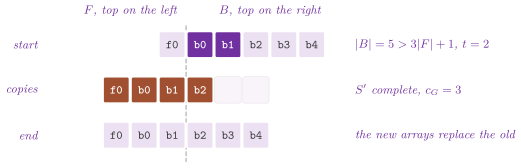
within a factor 3 of each other. A rebuild starts when one side \(G\) has
more than \(3 |S| + 1\) items, \(S\) being the other side, or when a side fills
half its array. Let \(n_0\) be the number of items at the start, and \(t =
|G| - \lceil n_0 / 2 \rceil\): the \(\lceil n_0 / 2 \rceil\) items nearest the
top of \(G\) stay on its side, and the \(t\) at its bottom pass to the other.
Two new arrays of \(2 n_0 + 16\) cells are filled from their bottom with
copies, twelve per operation. They are \(S'\), with \(G[ t - 1 ] , \ldots ,
G[ 0 ]\) and then the items of \(S\) from its bottom, and \(G'\), with \(G[ t ] ,
G[ t + 1 ] , \ldots\) up to the top (Algorithm 4.13
and Figure 4.11). Meanwhile, the operations go on
on the old stacks, as on MinDeque but with no deal. Each copy keeps a
prefix of its old stack, and a removal that goes below the end of a prefix
also removes the top of the copy. When both prefixes reach their tops, the
new arrays replace the old ones, which the operations that follow destroy
twelve cells at a time.
Algorithm 4.13. The rebuild of
RealTimeMinDeque (the global rebuilding of Overmars
1983, after Gajewska and Tarjan
1986), the test that starts it, and
the removal that keeps the prefixes of the copies.
The start of a rebuild, before line 2 of rebuild(), takes for \(G\) the
side with more items (the front when the two are equal), computes \(n_0\)
and \(t\), and allocates the two new arrays; for \(n_0 < 32\) it runs the
steps until the rebuild ends, and frees the old arrays at once. In the
code, the loop of line 3 checks the end of line 7 before it spends a copy.
Lemma 4.15. Let a rebuild start with \(n_0
\ge 32\) items. Then it ends within \(n_0 / 11 + 2\) operations, during which
neither side of the old stacks empties and \(G\) keeps its \(t\) bottom items;
every operation of RealTimeMinDeque takes \(O( 1 )\) time in the worst
case, the next rebuild starts \(\Omega( n_0 )\) operations later, and a
removal finds its side empty only when the deque has one item.
Proof. The copies are at most \(n_0\) plus one per insertion during the
rebuild (a removal only shortens a prefix), twelve per operation. The
operation that starts the rebuild and the \(k\) after it finish them once
\(12 ( k + 1 ) \ge n_0 + k\), i.e., for some \(k \le n_0 / 11 + 1\). When a
rebuild starts by the sizes, the operation before it left \(|G| \le 3 |S| +
1\) and changed one side by one item; hence \(3 |S| + 2 \le |G| \le 3 |S| +
4\), i.e., \(|S| \ge ( n_0 - 4 ) / 4 \ge 7\). (The sides are within the
factor 3 after every operation that starts no rebuild: after one that ends
a rebuild, by the sizes at the end given below, and after any other one by
the test of due().) When it starts by the room, the sizes were within the
factor 3, i.e., \(|S| \ge ( n_0 - 1 ) / 4\). Either
way \(|S|\) exceeds the at most \(n_0 / 11 + 2\) removals from \(S\) during the
rebuild, since \(( n_0 - 4 ) / 4 > n_0 / 11 + 2\) for \(n_0 > 132 / 7\).
Also, \(G\) has \(\lceil n_0 / 2 \rceil \ge 16\) items above its bottom \(t\),
more than the removals from it, and the half of each array that is free
holds the insertions. Since the old stacks are copied, not moved, they
keep all their cells below their tops; their minima stay right, and the
operations act on them as on MinDeque. At the end each side has \(\lceil
n_0 / 2 \rceil\) or \(\lfloor n_0 / 2 \rfloor\) items, changed by at most \(n_0
/ 11 + 2\), with room for \(n_0 + 8\) before half its array. A new rebuild
needs \(|G| - 3 |S|\) to grow from about \(- n_0\) to 2, by 3 at most per
operation, or a side to grow by about \(n_0 / 2\); either takes \(\Omega( n_0
)\) operations, more than those that destroy the at most \(n_0 + n_0 / 11 +
2\) live cells of the old arrays, twelve per operation. A deque of fewer
than 32 items is rebuilt within the operation that starts it, in \(O( 1 )\)
time, and all the old arrays are freed at once. These hold \(O( 1 )\) live
cells. By the argument above, only those of the last rebuild of \(n_0' \ge
32\) items can be left, at most \(n_0' + n_0' / 11 + 2\). Since the deque has
lost at least \(n_0' - 31\) items since that rebuild started, at one per
operation, at least \(12 ( n_0' - 31 - n_0' / 11 - 2 )\) of them have been
destroyed after it ended, and fewer than 100 remain. Finally, outside a
rebuild the sides satisfy \(|G| \le 3 |S| + 1\), so that an empty side \(S\)
leaves \(n = |G| \le 1\), and during a rebuild neither side empties, as
shown above. \(\square\)
The items are copied, whereas the queue moves them, since the old stacks stay
in use during the rebuild; the type of the items must therefore be copyable. A
removal from an empty side thus finds the only item on the other side, where
front() and back() read it too. Besides forEach( f ), the class has
size(), empty() and clear(); it copies item by item and moves in
\(O( 1 )\) time. Its contracts check the preconditions of the removals, and the
invariant that a rebuild never reads a cell that a removal has destroyed.
In ADS/queue/RealTimeMinQueue.h, the declarations of RealTimeMinQueue
that a user calls are
// declarations of <ADS/queue/RealTimeMinQueue.h>
template< class T , class C = std::less<> >
class RealTimeMinQueue
{
 public:
 using Item = T;
 explicit RealTimeMinQueue( C less = C() );
 bool empty( void ) const;
 std::size_t size( void ) const;
 void enqueue( const T & x );
 T dequeue( void );
 const T & top( void ) const;
 const T & min( void ) const;
 template< class F >
 void forEach( F && f ) const;
 void clear( void );
 };
In ADS/queue/RealTimeMinDeque.h, the declarations of RealTimeMinDeque
that a user calls are
// declarations of <ADS/queue/RealTimeMinDeque.h>
template< std::copy_constructible T , class C = std::less<> >
class RealTimeMinDeque
{
 public:
 using Item = T;
 explicit RealTimeMinDeque( C less = C() );
 bool empty( void ) const;
 std::size_t size( void ) const;
 void push_front( const T & x );
 void push_back( const T & x );
 T pop_front( void );
 T pop_back( void );
 const T & front( void ) const;
 const T & back( void ) const;
 const T & min( void ) const;
 template< class F >
 void forEach( F && f ) const;
 void clear( void );
 };
4.10 Algorithms on a queue¶
The functions of ADS/queue/QueueAlgorithms.h act on a queue through
enqueue(), dequeue(), top() and empty() only, and are therefore
written once for all the models of the concept Queue. Moving the positive
items of a queue \(q\), in their order, to the back of another queue out
dequeues each item of \(q\) once (extractPositive()) and leaves \(q\) empty.
Copying them instead, with \(q\) left as it was (copyPositive()), enqueues
each item in an auxiliary queue as it is dequeued, and moves the auxiliary
queue back to \(q\) at the end (Algorithm 4.14).
Lemma 4.16. Let \(q\) hold \(x_1 , \ldots ,
x_n\) from the front, and let out be another queue. Then
extractPositive( q , out ) appends to out the items \(x_i > 0\) in the
order of \(i\) and leaves \(q\) empty, while copyPositive( q , out ) appends
the same items and leaves \(q\) with \(x_1 , \ldots , x_n\) again. Each makes
\(O( n )\) operations of the queues, and the second takes \(O( n )\) space
besides them.
Proof. By (4.1), the dequeues of line 3 (or line 4) return \(x_1 , \ldots
, x_n\) in this order, and the enqueues on out keep the order of the items
\(x_i > 0\) appended. In copyPositive(), the auxiliary queue \(A\) receives
\(x_1 , \ldots , x_n\) in the same order, and line 7 dequeues them from \(A\)
in this order and enqueues them on \(q\), which is empty after line 3.
Every item is dequeued and enqueued at most twice, and \(A\) holds at most
\(n\) items. \(\square\)
Note that the auxiliary
queue is a LinkedQueue, whatever the type of \(q\), since an ArrayQueue
would need a capacity that the interface does not give.
Algorithm 4.14. The positive items of a queue, moved and copied.
One could restore \(q\) with no auxiliary queue by rotating it, i.e., by
enqueueing each item again in \(q\) as soon as it is dequeued, but only
knowing how many items \(q\) holds, which the QUEUE does not say. (A mark
enqueued at the end would do, if the type of the items had a value unequal
to all the others.) Both functions check, as preconditions, that the two
queues are distinct objects; copyPositive() also checks, as an audit,
that \(q\) holds its old items in their old order.
A queue also reverses a stack, since it keeps the order in which the items
are popped: this is reverseWithQueue() of ADS/stack/StackAlgorithms.h
(Morin 2013, exercise 1.4), described
with the algorithms on a stack (Algorithm 3.7).
Three of the problems on the lines of a text of Morin 2013, exercise
1.1 call for a queue. The first writes,
for each blank line after the 42nd, the line 42 lines before it, keeping 43
lines at most; a queue whose length is kept at 43 by a dequeue() after
each enqueue() beyond it solves it (on a RingDeque, the vector stops at
64 places). Writing the lines of even rank before those of odd rank takes
two queues, filled in turn. Finally, writing the lines in a random order
takes a RandomQueue, emptied after all the lines are in (cf.
Lemma 4.9).
In ADS/queue/QueueAlgorithms.h, the functions are declared as
// declarations of <ADS/queue/QueueAlgorithms.h>
template< Queue Q >
void extractPositive( Q & q , Q & out );
template< Queue Q >
void copyPositive( Q & q , Q & out );
4.11 Engineered variants¶
We keep the realizations of the book as they are written, but for three
changes that do not alter their interface. First, ArrayQueue computes
the modulo of (4.2) by a comparison and a subtraction, which is correct
because the sum of two places is below \(2 m\) (§4.2).
Second, LinkedQueue and Dequeue take their cells from a pool
(§5.5); a queue in a steady state reuses the cell
just freed, which is likely still in the cache, and calls no allocator.
Third, ArrayQueue and LinkedQueue move the item removed out of its
place instead of copying it, which matters when the items own memory
(Dequeue copies it, as noted in §4.4).
RingDeque differs from the ArrayDeque of Morin in four points: (i) the
mask of a power of 2 replaces the division of %, which on most
processors costs tens of cycles, against one for the mask; (ii) the places
are raw memory, and a growth moves the items by memcpy() on at most two
pieces, where the ArrayDeque of Morin builds its new array by default and
assigns the items one by one; (iii) the moves by rank are made by runs
(Lemma 4.6 and what follows it); and (iv) the deque
does not shrink, so that a queue whose size oscillates never reallocates,
where the ArrayDeque of Morin resizes whenever \(3 n < m\). Furthermore,
the two counters modulo \(2^{64}\) make the insertions at the back and the
removals from the front two chains of instructions that do not depend on
each other. Also, the operations at the ends are inlined, and the growth is
kept out of line.
Compared with std::deque, which keeps the items in blocks of 512 bytes
reached by a map of pointers, RingDeque has no indirection and no
allocation but at the doublings, and its items lie in at most two contiguous
pieces. Unlike boost::circular_buffer, its vector grows when full; unlike
boost::container::devector, the places freed at one end serve the
insertions at the other, and a queue used as a FIFO never moves its items.
Its price is the space of the largest size, at most \(2 N + 8\) places for \(N\)
items (Lemma 4.5), until shrink_to_fit(). We leave
the running times against these libraries to the campaign of Appendix
B, and we give no number here.
RandomQueue draws its places with no division in the common case
(Lemma 4.10), whereas the obvious \(w \bmod n\) costs
a division at each draw and is biased. We expect the real-time structures of
§4.9 to be somewhat slower than MinQueue and
MinDeque over a whole sequence, since their constants are larger (three
moves per operation for the queue, twelve copies for the deque, and more
arrays). They are the choice when the time of each operation counts, e.g.,
in a loop with a deadline, or when the items are expensive to move in
bulk.
4.12 Discussion and references¶
The queue on a circular vector, the queue on a linked list and the deque are
in most textbooks on data structures (see, e.g., Knuth 1997, §2.2.1 and
§2.2.2, which also has the deques
restricted on input or on output, and Montresor 2025,
§4.3). Morin 2013, §2.3 and
§2.4 adds the vector that grows and
shrinks and the operations by rank on the shorter side, and calls these
structures folklore. The deque of the algorithm of Pape and D'Esopo is in
Pape 1974, and the queue on two stacks is
folklore as well. Its worst case was removed by Hood and Melville
1981, whose queue is real-time and purely
functional (no cell is ever changed); Okasaki
1995 obtained simpler real-time queues
and deques by lazy evaluation, and Kaplan and Tarjan
1999 added the concatenation of two
deques in \(O( 1 )\) worst-case time. The deque with the minimum in \(O( 1 )\)
worst-case time per operation is that of Gajewska and Tarjan
1986. It applies to the two stacks of a
deque the global rebuilding of Overmars
1983, i.e., the construction of a new
copy of a structure in the background while the old one stays in use. The
thresholds of RealTimeMinDeque (the factor 3, the twelve copies per
operation, and the size 32 below which a rebuild is done at once) are those
of the library, chosen so that the proof of Lemma 4.15
goes through with simple constants; other choices are possible, and possibly
better in practice. Finally, the draw of a place without division is that of
Lemire 2019.
A typical use of a queue with its minimum is the minimum over a sliding
window, since the window gains an item at one end and loses one at the other
at each step. There, a deque of the indices whose values increase, which
drops from its back the indices that a new one dominates, answers in \(O( 1
)\) amortized time with no stack, as in maxSumSegmentLength()
(§13.5). Chapter 24
has the queues shared by threads (with one or many producers and consumers,
on a circular vector or on a list), and chapter 9 the
priority queues. Also, the other deques of chapter 2 of Morin
(DualArrayDeque, the Treque and the deques of blocks) are in chapter
2.
4.13 Exercises¶
Each exercise names the test of the library that solves it (run it with
ctest -R <name>).
- Realize the QUEUE on a circular vector of \(m\) places, with each
operation in \(O( 1 )\) time and no division, and check that the queue
refuses an item when full and still answers
contains()when its items wrap around the end of the vector (Montresor 2025, §4.3.3). Tests:ch04.spec.ArrayQueue,beyond.queue-contains-sequence-equal. - Check the axioms (4.1) on random sequences of operations, for a queue on
a vector and for one on a list. Tests:
contract_queue.queue-axioms,contract_queue.array-queue,contract_queue.linked-queue. - Realize the QUEUE on a singly linked list with pointers to its first and
last cells, so that it also works after it has been emptied, and give it
a copy and a move (Montresor 2025, exercise
4.10). Test:
ch04.ex4.10. - Realize the DEQUEUE with every operation in \(O( 1 )\) time, and explain
why a singly linked list does not suffice (Montresor 2025, exercise
4.9). Tests:
ch04.ex4.9,contract_queue.dequeue. - Give the output of the sequence
FIRS*T*IN***FI*RS***T*OUT*****on a queue, a letter meaningenqueue()and an asteriskdequeue(), and the least capacity of anArrayQueuethat runs it. Test:beyond.lifo-fifo-traces. - Using only a queue, reverse the order of the items of a stack that has
only
push()andpop()(Morin 2013, exercise 1.4). Test:ods_lists.ods-ex1.4.reverse-stack. - Solve the problems 3, 8 and 9 of Morin 2013, exercise
1.1 (the line 42 lines before each
blank line with 43 lines kept, the lines of even rank before those of
odd rank, the lines in a random order) with a queue, two queues and a
random queue. Test:
ods_lists.ods-ex1.1.lines. - Realize the
ArrayQueueand theArrayDequeof Morin 2013, §2.3 and §2.4 on one circular vector that doubles, so that a queue in a steady state never grows, and the insertion and the removal at the rank \(i\) take \(O( 1 + \min\{ i , n - i \} )\) time; replay the operations of the two figures of those sections (Figure 4.1 and Figure 4.5). Tests:ods_lists.ods-2.3.array-queue,ods_lists.ods-2.4.array-deque. - Make the moves of
insert( i , v ),erase( i )and of the growth of the previous exercise by blocks of contiguous places rather than item by item, and check them when the items to move wrap around the end of the vector (Morin 2013, exercise 2.6). Test:ods_lists.ods-2.4.array-deque. - Replace the modulo of the previous exercises by the mask of a vector
of \(2^j\) places (Morin 2013, exercise
2.7). Test:
ods_lists.ods-ex2.7.power-of-two. - Rotate a LIST so that the item of rank \(i\) goes to the rank \(( i + r )
\bmod n\), in \(O( 1 + \min\{ r , n - r \} )\) time on a deque on a
circular vector, and in \(O( 1 )\) when its vector is full (Morin 2013,
exercise 2.5). Test:
ods_lists.ods-ex2.5.rotate-list. - Realize a deque on a circular vector that grows, with items that own
memory or that can only be moved, an item of the deque inserted into it
when it must grow, and random-access iterators, against
std::deque. Tests:engineered_queues.ring-deque,engineered_queues.ring-deque-items,engineered_queues.book-queues-engineered. - Design a
RandomQueue, whoseremove()takes an item chosen uniformly at random among those inside, withadd( x )andremove()in \(O( 1 )\) amortized time, and draw its places with no bias (Morin 2013, exercise 2.2). Test:ods_lists.ods-ex2.2.random-queue. - Realize a queue with no duplicates under the two policies of
§4.6, and move or copy the positive items of a
queue using only its operations. Tests:
beyond.queue-algorithms,contract_queue.unique-queue. - Design a
MinQueuewithadd( x ),remove(),size()andmin()in \(O( 1 )\) amortized time (Morin 2013, exercise 3.15), and then one in which every operation takes \(O( 1 )\) time in the worst case. Tests:ods_lists.ods-ex3.15.min-queue,ods_lists.ods-ex3.15.real-time-min-queue. - Design a
MinDequewith the four operations of the DEQUE,size()andmin()in \(O( 1 )\) amortized time (Morin 2013, exercise 3.16), and then one in which every operation takes \(O( 1 )\) time in the worst case. Tests:ods_lists.ods-ex3.16.min-deque,ods_lists.ods-ex3.16.real-time-min-deque.